
Banknotes 1994-2020 (Series VII)
The development of the seventh series of banknotes was driven by a need for additional security, but also by the increased use of ATMs and vending machines.
Requirements for machine processing set limits for the artistic design. New security features such as a holographic strip, fluorescent effects and iridescent print were introduced. The 200-krone note was added. The introduction of different sizes both in length and height made it easier to distinguish denominations, especially for people who are blind or visually impaired. The name of the Bank in Norway’s two official written languages, NORGES BANK and NOREGS BANK, appeared on the obverse and reverse sides, respectively. The portraits were to be of famous personages in science and culture, and at least two were to be women. The obverse sides were designed by the graphic artist Sverre Morken and the reverse sides by the graphic artist Arild Yttri.
50-krone note
Issued on 20 January 1997, no longer legal tender from 18 October 2019.
Size: 128 x 60 mm.
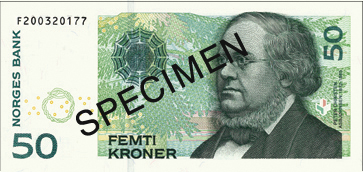
Obverse: Portrait of Peter Christen Asbjørnsen
50-krone note - motifs
Notes with annual figures from 2003 have been upgraded with a broader security thread and with the text "Norges Bank". Notes with annual figures from 2008 (printed abroad) have a letter in front of the serial number.
Obverse

The motif on the obverse is a portrait of Peter Christen Asbjørnsen. The background is based on Asbjørnsen's story "A summer night in Krogskogen" and also creates associations with his profession as a forester.
The 12-sided form is intaglio, encircles a hexagon resembling a spider web and encompasses a number of security features.
Willow twine is portrayed over the watermark on the left side of the obverse. In the Norwegian folk tale "The princess that no one could silence", the main character, Per Askeladden tied willow twine around the magpie to keep it from falling apart in the oven. Willow twine is also used for tethering cows, in fencing and on panniers. It may also symbolise Asbjørnsen's exceptional ability to gather the best folk tales from the oral tradition.
Designed by graphic designer Sverre Morken.
Reverse

The reverse is also based on "A summer night in Krogskogen".
Many of us have experienced the stillness of a woodland tarn and the feeling of magic as we glance into the water and see the reflections of clouds overhead, hear the buzzing of a dragonfly and perceive the fragrance of flowering water lilies. Many Norwegian artists have been inspired by this experience. Theodor Kittelsen's drawings of this motif are the most famous.
The key in the lower right-hand corner is a symbol used by Asbjørnsen in the fairytale "The storehouse key on the distaff" where the farm boy cunningly exposes the arrogance and deceit of the couple whom he had thought were to be his in-laws. By extension the key may also symbolise an openness to contact with fairies and goblins.
Designed by graphic designer Arild Yttri.
100-krone note
Issued on 15 September 1997, no longer legal tender from 30 May 2018.
Size: 136 x 65 mm.
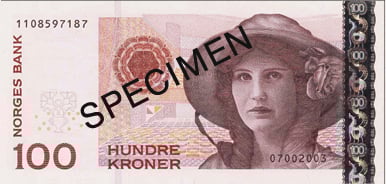
Obverse: Portrait of Kirsten Flagstad
100-krone note - motifs
Put into circulation 15 September 1997, but produced with annual figures from 1995. Upgraded in 2003 with a hologram foil stripe. Serial numbers of banknotes from 2010 and subsequent years (printed abroad) begin with a letter.
Obverse

The motif on the obverse of the note is a portrait of the opera singer Kirsten Flagstad. The background is an illustration of the main auditorium of the Norwegian Opera, as viewed from the stage.
The rosette encircling a hexagon encompasses a number of security features.
One of Kirsten Flagstad's embroideries, which are on display at the Kirsten Flagstad commemorative collection at Strandstuen in Hamar, has been used for the vignette in the area containing the watermarks.
Designed by graphic designer Sverre Morken
Reverse

The architects Morgenstierne and Eide were engaged in 1929 to design the Folketeater building in Oslo. The building was completed in 1935 and served as a cinema and theatre until the Norwegian Opera took over the premises in 1959.
The reverse of the note is based on the ground plan of the opera's main auditorium.
The vignette in the area containing the watermarks is a brooch worn by Kirsten Flagstad in a Wagner opera.
Designed by graphic designer Arild Yttri.
200-krone note
Issued on 1 November 1994, no longer legal tender from 30 May 2018.
Size: 144 x 70 mm.
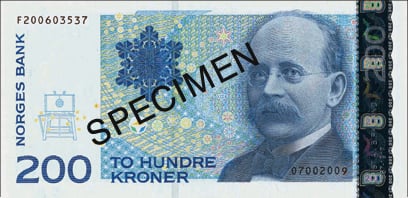
Obverse: Portrait Kristian Birkeland
200-krone note - motifs
Upgraded in 2002 with a hologram, foil stripe. Notes with annual figures from 2009 (printed abroad) have a letter in front of the serial number.
Obverse

The motif on the obverse of the note is a portrait of Kristian Birkeland. The northern lights rising upwards toward the North Star are the central feature of the background.
We also find well-known constellations such as Little Bear (Ursa Minor) and the Big Dipper.
Birkeland's "Terrella" where he produced artificial northern lights is depicted in the area containing the watermarks. Birkeland demonstrated that when plasma escapes from the sun and travels through space, the earth's magnetic field compresses it on the daylight side of the earth and stretches it into a tail on the night side, ultimately producing the northern lights.
The snow crystal symbolises winter, the time of year when the northern lights are most visible, and includes a number of security features.
Reverse

The reverse side of the note is based on the northern lights that are visible during the day. Whereas the northern lights on our side of the earth are visible along the coast of northern Norway at night, they are visible over Svalbard, a Norwegian archipelago in the Arctic Ocean, during the day.
Discovery of the auroral oval and the northern lights on the day side of the earth is one of the most sensational results of modern space research.
The illustrations in the lower right hand corner of the note depict Birkeland's thoughts about the orientation of electric currents in connection with the northern lights. Currents near the auroral arcs flow parallel to the ground, while those that are higher up flow along the earth's magnetic field lines. These currents are called Birkeland Currents.
500-krone note
Issued on 7 June 1999, no longer legal tender from 18 October 2019.
Size: 152 x 75mm.
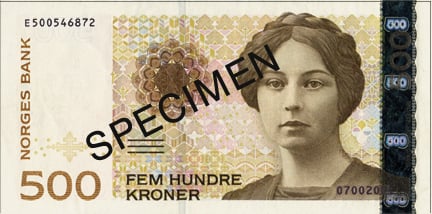
Obverse: Portrait Sigrid Undset
500-krone note - motifs
Notes with annual figures from 2008 (printed abroad) have a letter in front of the serial number.
Obverse

The motif is a portrait of Sigrid Undset as a young woman. The rosette on the left was inspired by one of her lace collars and encompasses a number of security features.
The background is based on Gudbrandsdal tapestries, in particular a pattern where the cross figures prominently. The watermark area contains a double cross.
Designed by graphic designer Sverre Morken.
Reverse

"The Bridal Wreath" is the title of the first book in Undset's trilogy about Kristin Lavransdatter. The author used the wreath to symbolise secular and spiritual love. A tapestry pattern from Gudbrandsdalen provides the background for the wreath.
Designed by graphic designer Arild Yttri.
1000-krone note
Issued 19 June 2001, no longer legal tender from 14 November 2020.
Size: 160 x 80 mm.
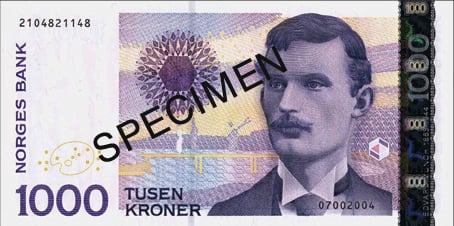
Obverse: Portrait Edvard Munch
1000-krone note - motifs
Obverse

The main motif is a portrait of Edvard Munch as a young man set against a background inspired by Munch's painting "Melancholy".
Designed by graphic designer Sverre Morken.
Reverse

The motif is a rendering of one of Munch's studies for his masterpiece "The Sun", which is among the decorations adorning the University of Oslo's Aula.
Designed by graphic designer Arild Yttri.