

Foreword by the Governor
Dear reader,
Norges Bank performs critical national missions. As Norway's central bank, we are tasked with maintaining monetary stability, promoting financial stability and an efficient and secure payment system, and managing the Government Pension Fund Global.
Our missions guide all we do. At the same time, the world around us is continually evolving. Heightened geopolitical uncertainty is affecting the framework for international cooperation and trade. New monetary and payment systems are emerging, and new technology, particularly artificial intelligence, is advancing rapidly. To succeed in our missions, we need to adapt to change and be prepared for the unexpected.
Following a marked decline in the two preceding years, inflation changed little in 2025. At the end of 2025, inflation was still above the 2% target. In June, Norges Bank’s Monetary Policy and Financial Stability Committee began a cautious normalisation of monetary policy. The policy rate was reduced from 4.5% to 4% during 2025. The December policy rate forecast indicated that the policy rate would decline further to somewhat above 3% towards the end of 2028. With this policy rate path, the Committee expected inflation to recede and move down towards the target without a large increase in unemployment.
Despite a turbulent backdrop, international equity indices rose in 2025, resulting in high returns in international currency terms for both the Government Pension Fund Global and Norges Bank’s foreign exchange reserves. However, the economic outlook is uncertain, and we must be prepared for considerable fluctuations in returns and market value ahead.
In December, we launched Strategy 28, our strategy for the next three years. Over the strategy period, we will build on our strengths and experience while taking the necessary steps to modernise and adapt. Society can rest assured that we will also deliver on our missions in a sound, efficient and responsible manner in the years ahead.
Oslo, 27 February 2026
Ida Wolden Bache
Governor


Norges Bank’s Executive Board
The Executive Board comprises the Governor, the two Deputy Governors and six external board members, all appointed by the King in the Council of State. The Governor is Chair and the two Deputy Governors are First Deputy Chair and Second Deputy Chair of the Executive Board. In addition, two board members are selected by and among employees to participate in the deliberation of administrative matters.

The Executive Board has four preparatory and advisory committees, whose work improves and streamlines the Executive Board’s discussions. For more information on the members of the Executive Board, see Norges Bank's website.
Work of the Executive Board in 2025
The Executive Board held 16 meetings and discussed 222 items of business in 2025. This is in line with previous years. Meetings in the form of seminars are also used for more in-depth discussions and presentations of the premises of important agenda items with Bank staff.
In addition, the Executive Board’s four subcommittees are used for the preparation of selected items for the Executive Board’s consideration.
Approximately two thirds of the Board’s time was spent on matters related to the management of the Government Pension Fund Global. This share has remained stable since the Committee for Monetary Policy and Financial Stability was established.
Table 1 Work of the Executive Board 2021–2025
|
2021 |
2022 |
2023 |
2024 |
2025 |
|
|---|---|---|---|---|---|
|
Number of Executive Board meetings |
14 |
14 |
13 |
11 |
16 |
|
Number of Executive Board seminars |
5 |
6 |
5 |
5 |
6 |
|
Number of matters considered by the Executive Board |
228 |
212 |
218 |
182 |
222 |
|
|
|||||
|
Committee meetings |
|||||
|
Audit Committee |
11 |
7 |
6 |
6 |
7 |
|
Remuneration Committee |
7 |
6 |
6 |
5 |
5 |
|
Ownership Committee |
9 |
7 |
8 |
8 |
10 |
|
Risk and Investment Committee |
13 |
13 |
9 |
11 |
12 |
Annual Report of the Executive Board for 2025

The geopolitical situation remained unpredictable throughout 2025. The framework for international cooperation and trade changed, and there was substantial uncertainty regarding the global and domestic economic outlook.
At the beginning of 2025, the monetary policy rate had been at 4.5% since the beginning of 2023. The policy rate had contributed to cooling down the Norwegian economy and to dampening inflation. Inflation in Norway is still above the 2% target. In June, the Committee began a cautious normalisation of monetary policy and reduced the policy rate to 4% over the course of the year. See the Annual Report of the Monetary Policy and Financial Stability Committee for 2025 for further information.
Global equity markets market grew in 2025, contributing to positive returns for both the Government Pension Fund Global (GPFG) and Norges Bank’s foreign exchange reserves. The value of the GPFG at the end of 2025 was NOK 21 268bn and was affected by the return on investments, capital inflows from the Norwegian government and exchange rate movements. The market value of the total equity and fixed income portfolio in the foreign exchange reserves was NOK 727.5bn at the end of 2025.
Over the course of 2025, the Executive Board has further strengthened the follow-up of the management of the GPFG in situations of heightened risk, such as in countries involved in war and conflict. In 2025, the Executive Board also evaluated the GPFG’s real estate strategy performance and adjusted the strategy.
Efforts to modernise Norges Bank’s settlement system continued in 2025. This is an extensive and long-term undertaking that also requires adaptations to safeguard security and contingency requirements. In order to achieve Norges Bank’s liquidity management policy objectives, the Executive Board has decided to introduce tradeable central bank certificates as a new instrument to withdraw surplus liquidity from the banking system.
The 2023–2025 strategy period ended in 2025. Strategy 25 included specific initiatives and there was a need to strengthen the organisation in order to ensure sufficient capacity, quality and robustness. The Executive Board’s assessment is that Norges Bank has to a large extent achieved its strategic ambitions. In 2025, the Executive Board prepared the strategy for the 2026-2028 period. Strategy 28 describes the Bank’s key priorities for the next three years. The GPFG will be the leading and most highly respected large investment fund globally. The central bank will be Norway’s leading institution in the field of macroeconomic analysis, maintaining world-class standards.
Efforts to deliver on the Bank’s missions starts with the Bank’s employees. The Bank is committed to creating a positive working environment to promote employee well-being and development and ensure that employees have the right expertise. In 2025, particular emphasis was placed on strengthening AI expertise. The Executive Board was satisfied with the results achieved and the feedback in the 2025 staff survey and would like to thank all employees for their valuable contribution through the year. See Society and social conditions for more information on Norges Bank’s employees.
Government Pension Fund Global
Norges Bank manages the GPFG on behalf of the Ministry of Finance. The objective of the Bank’s investment management is to achieve the highest possible long-term return within the constraints laid down in the mandate from the Ministry of Finance.
The investments in the GPFG returned 15.1% in 2025 following strong gains in global equity markets. The return was 0.28 percentage point below the GPFG's benchmark index. This is within the range of variation in relative return that can be expected from one year to the next. The Executive Board emphasises the importance of assessing results over time and is satisfied that the return over time has been higher than the return on the GPFG’s benchmark index.
At the end of 2025, the value of the GPFG was NOK 21 268bn and the GPFG’s investments comprised 71.3% equities, 26.5% fixed income, 1.7% unlisted real estate and 0.4% unlisted renewable energy infrastructure.

Return on the Government Pension Fund Global
The value of the GPFG is affected by the return on investments, capital inflows and withdrawals by the government, as well as exchange rate movements. Measured in terms of the fund’s currency basket1, the return for 2025 was 15.1% before management costs or NOK 2 362bn in accounting terms. In addition, owing to a stronger krone, the value of the GPFG measured in NOK terms decreased by NOK 1 155bn, but this has no bearing on GPFG purchasing power in foreign currency. Net transfers from the Norwegian government were NOK 327bn after the payment of management fees.
The return on equities was no less than 19.3%. Solid corporate earnings in investee companies and optimism related to artificial intelligence led to strong equity markets. Fixed-income instruments returned 5.4% in 2025, while investments in unlisted real estate returned 4.4%. The GPFG’s investments in unlisted renewable energy infrastructure returned 18.1% in 2025.
The Executive Board considers the overall return on the GPFG over time to have been solid. In the period between 1998 and 2025, the average annual return was 6.6%. The annual net real return, after deductions for inflation and management costs, was 4.3% in the same period.
Over the past five years, the GPFG has generated an accumulated return of 8.3% measured in the GPFG’s currency basket before management costs, or approximately NOK 7 000bn in accounting terms. The largest contribution comes from the GPFG’s equity investments. With such a large fund and an equity share of around 70%, we have to be prepared for the possibility of a significant decline in the GPFG’s value.
Return relative to the benchmark index
The Ministry of Finance determines the GPFG’s overall investment strategy. Norges Bank manages the GPFG with a view to achieving the highest possible long-term return, within the constraints laid down in the mandate from the Ministry of Finance. The Executive Board determines a strategic plan for the fulfilment of the investment mandate.
Since 2013, Norges Bank has grouped its investment strategies into three main strategies: market exposure, security selection and fund allocation. In the strategic plan for the period 2026 to 2028, which the Executive Board adopted towards the end of 2025, these strategies have largely been continued. The investment strategies are complementary and aim to take advantage of the GPFG’s distinctive characteristics. Not all investment strategies are expected to generate excess return at all times. The strategies have different time horizons and results will vary with different market conditions. The objective is for them to collectively generate excess return over time.
Under the strategy for market exposure, the GPFG is invested broadly and cost-effectively in the equities and bonds included in the benchmark index. The security selection strategy involves analysing companies and assessing whether the GPFG should invest more or less relative to the benchmark index. Norges Bank uses both internal and external managers for security selection. The fund allocation strategy comprises various strategies designed to improve the GPFG’s return and risk characteristics over time. The GPFG’s investments in real estate and unlisted renewable energy infrastructure form part of this strategy.
In 2025, the GPFG’s return before management costs was 0.28 percentage point lower than the return on the benchmark index. Market exposure contributed positively, while security selection and fund allocation contributed negatively to the GPFG’s relative return. The Executive Board notes that the GPFG’s total return over the last three years has been lower than that of the benchmark index due to the negative contribution from fund allocation.
The Executive Board emphasises that the fund’s performance must be assessed as a whole and over time. In the period between 1998 and 2025, the annual return before management costs was 0.24 percentage point higher than the return on the benchmark index from the Ministry of Finance. Norges Bank has measured the contributions to excess return from the three main strategies since 2013. Both since 2013 and over the past five years, the annual return before management costs has been 0.19 percentage point higher than the benchmark index. The Executive Board is satisfied with the GPFG’s performance over time.
The contributions from market exposure and security selection have been positive. With the exception of 2018, the market exposure strategy has contributed positively to the GPFG’s relative return each year since 2013. The results from security selection have fluctuated somewhat more but have contributed positively in eight of 13 years.
Fund allocation, and real estate investments in particular, have contributed negatively to the GPFG’s excess return. Since 2017, decisions on whether and how the GPFG should invest in real estate have been delegated to Norges Bank within the limits for deviation from the GPFG’s benchmark index.
The Executive Board is not satisfied with the results achieved in real estate investments over time. Real estate returns have been weak, both relative to the equities and bonds sold to fund them and compared with returns in the broader real estate market as measured by a global index. Norges Bank Investment Management made several organisational changes related to real estate management at the beginning of 2025 and began work on adjusting the real estate strategy at the same time.

The Executive Board has now adopted a new strategy for real estate. Norges Bank invests in real estate to achieve the objective of the highest possible return over time. Achieving this goal may also improve the long-term trade-off between return and risk in the GPFG. To date, the strategy has focused on investing in traditional sectors such as office and retail in predetermined countries and cities. Moving forward, Norges Bank will adopt a broader approach to real estate investments and diversify into more sectors and geographies. Norges Bank will invest more in unlisted real estate through external managers, funds and other indirect investment structures. This will especially apply to investments in new real estate sectors. The Executive Board has further specified that a framework shall be established for the funding of unlisted investments, which includes considerations of the underlying risk of the investment and adjusts for leverage.
Since 2019 the Ministry of Finance has allowed Norges Bank to invest up to 2% of the GPFG in unlisted renewable energy infrastructure. The strategy has been to gradually approach investment opportunities and develop expertise. Norges Bank made few investments during the initial years but has increased investments based on, among other things, assessments of improved return expectations. Several new investments through 2025, including the GPFG’s first investment in electricity grids and its first investment in an energy transition fund, contributed to an increase in the share of the GPFG invested in unlisted renewable energy infrastructure from 0.1% to 0.4%. The investments are made with a long time horizon, which indicates that results should be assessed over time.

Risk and costs
The objective of the highest possible return in the GPFG is to be achieved with an acceptable level of risk. The GPFG’s risk is measured, analysed and followed up using a broad set of targets and various analytical methods. The management mandate stipulates that Norges Bank shall manage the GPFG with the aim of ensuring that the expected relative volatility (tracking error) does not exceed 1.25 percentage points. At the end of 2025, the expected relative volatility was 0.37 percentage point, compared with 0.44 percentage point at the end of the previous year.
Measured over the entire period between 1998 and 2025, the realised tracking error has been 0.62 percentage point.
The management of the GPFG is to be cost-effective. Low costs are not an end in themselves, but cost-effective management contributes to achieving the highest possible return after costs. In the period between 2013 and 2025, annual management costs have been 0.05% of assets under management. The Executive Board is satisfied that management costs over time have been low compared to other funds.
Through the GPFG, we hold a small stake in the world’s largest companies. Responsible investment aims to promote long-term value creation at the companies and minimise negative effects on the environment and society. In this manner, it supports the financial objectives of the GPFG.

Situations involving war and conflict entail increased risk, and Norges Bank, as manager, must conduct enhanced due diligence. An example of this is the situation in the West Bank and Gaza. Throughout 2025, the Executive Board has further strengthened its monitoring of situations of heightened risk, such as in countries affected by war and conflict. In November 2025, the Ministry of Finance appointed a committee to review the GPFG’s ethical framework and introduced temporary guidelines that will remain in effect until a new ethical framework has been established. Norges Bank continues to manage the GPFG in a responsible manner within the applicable framework. For more information on the management of the GPFG, see the Government Pension Fund Global Annual Report for 2025.
Foreign exchange reserves
Norges Bank owns Norway’s official foreign exchange (FX) reserves. The FX reserves are to be sufficiently large and liquid to be available for use in foreign exchange market transactions as part of the conduct of monetary policy or/and to promote financial stability and meet Norges Bank’s international commitments. The FX reserves are managed with the aim of achieving the highest possible return within the applicable risk limits. The FX reserves are divided into an equity portfolio, a fixed income portfolio and a petroleum buffer portfolio.
Equity and fixed income portfolio
The composition of the equity and fixed income portfolio must be adapted to the objective of the FX reserves. The Executive Board has set principles for the management of the FX reserves and assesses the strategy and management framework annually. The size and stance of the FX reserves was assessed to well adapted to safeguard the overall contingency purpose of the FX reserves for 2025.
The market value of the total equity and fixed income portfolio was NOK 727.5bn at the end of 2025, which is NOK 30.7bn less than in 2024. At the end of 2025, the value of the equity portfolio was NOK 164.1bn, while the value of the fixed income portfolio was NOK 563.4bn.
In international currency terms, the return on the total equity and fixed income portfolio was NOK 40.8bn in 2025, or 6.9%. The return on the equity portfolio was NOK 17.7bn, while the fixed income portfolio returned NOK 23.1bn, equivalent to 18.8% and 3.9%, respectively.
In NOK terms, the return on the equity and fixed income portfolio was -0.7%, The krone appreciation made a negative contribution to the return in NOK terms.

The FX reserves are managed close to benchmark indices set by the Executive Board, and the return closely tracks global equity and bond market developments. In 2025, the return on the equity and fixed income portfolios was 0.06 percentage point and 0.01 percentage point higher, respectively, than the return on the portfolios’ benchmark indices At the end of 2025, expected relative volatility for the equity and fixed income portfolios was 0.03 and 0.02 percentage point, respectively, and has remained at these levels through 2025. Norges Bank’s financial risk arises from market exposure and different currency compositions on the asset and liability sides.
The performance of management of the FX reserves must be assessed as a whole and over time. Over the past ten years, the annual return on the equity and fixed income portfolio has been 13.0% and 0.9%, respectively, in international currency terms. Overall, the absolute annual return has been solid at 3.9%.
Petroleum buffer portfolio
The purpose of the petroleum buffer portfolio is to provide for appropriate management of the government’s need for converting foreign currency and NOK, and for any transfers to and from the GPFG.
The size of the portfolio fluctuates owing to the purchase and sale of currency in the market, the purchase of foreign exchange from the State’s Direct Financial Interest (SDFI), monthly transfers to and from the GPFG and changes in foreign exchange rates. In recent years, high oil and gas prices, as well as a higher non-oil budget deficit, have led to large capital flows and substantial volatility in the petroleum buffer.
At the end of 2025, the market value of the petroleum buffer portfolio was NOK 21.2bn, which is NOK 9.6bn less than in 2024. The return on the petroleum buffer portfolio was NOK -3.2bn, of which interest income was reduced by the krone appreciation.
For more information on the management of the Bank’s foreign exchange reserves, see the report Management of Norges Bank’s foreign exchange reserves.
The payment system
An efficient and secure payment system is essential for economic and financial stability. If payments cannot be made, economic activity comes to a halt. The ability to pay for goods and services is essential for individuals to participate fully in society.
Norges Bank is tasked with promoting an efficient and secure payment system. Norges Bank is in charge of the ultimate settlement system for interbank payments in Norway and issues banknotes and coins. Norges Bank is also the supervisory authority for interbank systems, oversees the payment system and other financial infrastructure and contributes to contingency arrangements.
The Executive Board considers the Norwegian financial infrastructure to be secure and efficient. Operations are stable, and payments can be made swiftly and at low cost.
Norges Bank’s settlement system
Norges Bank’s settlement system (NBO) is the core of the payment system. Payments between banks and other financial sector undertakings with an account at Norges Bank take place in NBO. Most NOK payments are therefore ultimately settled in NBO.
Operations have been stable through 2025, with an average of NOK 359bn in payment transactions settled daily. At the end of 2025, banks’ sight deposits and reserve deposits with Norges Bank totalled NOK 37bn.
The upgrade of the settlement system continued through 2025, and plans for the next generation solution have been further defined. This is an extensive undertaking and requires adaptations to safeguard security and contingency requirements. The next-generation settlement system will consist of two services: NBO RTGS for regular settlement and NBO INST for instant payments.
In 2024, Norges Bank signed an agreement on participation in the Eurosystem’s TARGET Instant Payment Settlement (TIPS) solution for instant payments and NBO INST will use this platform to settle instant payments in NOK. TIPS will facilitate the sound development of Norwegian instant payments in the years ahead. It became clear during the course of 2025 that participating in TIPS requires more comprehensive adaptations than was previously assumed. This will be handled in close cooperation with the European Central Bank (ECB) and the Norwegian banking industry. In cooperation with the industry, Norges Bank will plan for the transition to the new service at the lowest possible risk for all parties involved.
In January 2025, the Executive Board decided to enter into formal discussions with the ECB to participate in the T2 settlement system as a platform for NBO RTGS. By participating in T2, Norges Bank will retain exclusive control over settlement in NOK, liquidity management and the conduct of monetary policy. So far, assessments of security, national control and contingency requirements have been made. A final decision will be made once necessary clarifications have been addressed.

Cash
Payments are predominantly made digitally, and a secure and efficient payment system is primarily secured with sound digital solutions. Even though cash usage is low, cash continues to play an important role in the payment system. Cash is crucial for contingency considerations and is the only means of payment if electronic payment solutions fail completely. Cash is also important for individuals who do not have the skills or opportunity to use digital payment solutions.
Norges Bank is responsible for meeting the public’s demand for cash by supplying banks with cash. The supply of cash in circulation continues to decline and averaged NOK 37.7bn in 2025. Norges Bank has amended and strengthened its own cash contingency arrangements in recent years, eg with respect to the volume and geographic distribution of cash, to be able to meet more serious crisis scenarios.
For cash to be able to fulfil its functions, it must be available and payments must be able to be made in cash by both businesses and individuals. Consumers’ right to pay cash has been strengthened. This is important to ensure that cash can also fulfil its functions in the future. Furthermore, Norwegian banks have a legal obligation to ensure satisfactory cash services for their customers both in normal and contingency situations.
Current cash services are vulnerable and have some limitations. Most cash handling is not carried out by banks themselves, but by cash service providers. However, banks’ obligation applies regardless of a well-functioning service provider market. Norges Bank has pointed out that banks should, in collaboration, ensure satisfactory cash services coverage across Norway. If banks do not arrive at satisfactory solutions themselves, Norges Bank is of the opinion that more detailed regulation should be drafted.

Central bank digital currency
Since 2016, Norges Bank has explored the possibility of introducing a central bank digital currency (CBDC). The aim of introducing a CBDC would be to help ensure that paying with NOK continues to be efficient, secure and attractive. A distinction is made between retail and wholesale CBDC. A retail CBDC would be a universally accessible means of payment in line with cash and bank deposits. A wholesale CBDC would only be available to banks and other financial sector undertakings with an account at the central bank. It would be possible to use this type of CBDC for interbank settlement in the same way as traditional central bank deposits but using different technology.
The Executive Board is of the opinion that the introduction of either retail or wholesale CBDC is currently not warranted. However, the situation and needs could change. For example, blockchain technology may improve payment and financial systems in the longer term, and Norges Bank will ensure that social considerations are safeguarded if the technology becomes more widely adopted. Norges Bank is therefore continuing its research with the aim of being ready to introduce a CBDC if it becomes necessary to secure an efficient and secure payment system. Norges Bank will study the opportunities and challenges of CBDCs and tokenisation in the financial system and monitor relevant international developments, provide input to necessary legislation and explore the possibility of using the Eurosystem’s CBDC solutions and standards.
Security and contingency arrangements in the payment system
Norway’s current payment system is secure and efficient. An intensified threat landscape means that the Bank must now be prepared for more serious incidents. To ensure an efficient and safe payment system, today and in the future, contingency arrangements must be strengthened further.

The first line of defence will always be individual entities. Norges Bank supervises and oversees the payment system to promote a secure and efficient payment system. The Bank also collaborates with payment system participants and other national governing bodies on different measures for strengthening contingency arrangements. For example, the Bank is involved in threat-led penetration testing of the cyber resilience of critical infrastructure and the design of a framework for assessing IT-related risk.
In February 2025, a working group led by Norges Bank presented 18 measures to the Ministry of Finance to strengthen payment system contingency arrangements. Over the course of 2025, work has been carried out to follow-up and implement proposed measures.
For more information on the payment system, see Financial Infrastructure Report 2025.
Tasks performed as the government’s bank
In addition to being Norway’s central bank, Norges Bank is also the government’s bank. As the government’s bank, Norges Bank performs a number of tasks on behalf of the government, including government debt management and necessary foreign exchange transactions related to petroleum revenue spending.
Government debt
Norges Bank manages government debt on behalf of the Ministry of Finance. The objective of government debt management is to meet the government’s borrowing requirement at the lowest possible cost within the constraints of the mandate. The borrowing requirement is primarily met by issuing long-term fixed-rate bonds. The government also borrows short-term through Treasury bills, which are debt instruments with a maturity of one year or less. The government borrows exclusively in NOK.
At the end of 2025, government debt totalled NOK 647bn, with NOK 597bn in government bonds and NOK 50bn in Treasury bills. Of this amount, the government’s own stock amounted to NOK 50bn in bonds and NOK 16bn in Treasury bills.
In 2025, bonds amounting to NOK 105bn were issued to the market. In February, a new 10-year bond was issued via syndication in the amount of NOK 22bn. The bond was reopened by syndication in the amount of NOK 15bn in June.
Existing bonds were reopened in the amount of NOK 68bn on 24 auction days. On most of these days, two bonds with different maturities were auctioned.
Treasury bills worth slightly less than NOK 52bn were issued to the market at 18 auctions.
The government’s borrowing requirement was met in line with the 2025 Strategy and Borrowing Programme.
Foreign exchange transactions on behalf of the government
Norges Bank is tasked with converting government revenues from petroleum activities on the Norwegian continental shelf so that the government receives the correct amount of NOK for spending via the central government budget and the correct amount of foreign exchange (FX) for saving in the GPFG. The transactions are carried out on behalf of the government, completely separate from monetary policy.
In 2025, Norges Bank’s FX purchases on behalf of the government amounted to the equivalent of NOK 15.8bn. The FX purchases were lower than in 2024, primarily reflecting a higher structural non-oil budget deficit and a somewhat lower net cash flow from petroleum activities compared with 2024.
In 2025, the government corrected for several years of transfers from the GPFG that were higher than necessary to cover the non-oil budget deficit. As a result, NOK 82.1bn was transferred from the government’s account to the GPFG, partly reflecting the increased need to purchase FX.

Corporate governance
Norges Bank’s governance framework aims to be in line with best practice. The Executive Board follows up the Bank’s operations through periodic status reporting on target attainment, strategy implementation, resource use, financial and operational risk as well as internal and external regulatory compliance.
Norges Bank’s use of resources is to be cost-efficient and prudent, with a cost level that is reasonable compared with that of peer organisations. Benchmarking, ie external comparisons of the Bank’s use of resources with that of other peer organisations, is used as a corporate governance tool.
On behalf of the Ministry of Finance, CEM Benchmarking has compared the management costs of the GPFG with around 250 other funds. The GPFG has the lowest costs in its peer group, measured as a share of assets under management. According to CEM, the costs are lower because management is mostly carried out internally, with a lower share of external management than in other funds. CEM also emphasises that the GPFG’s internal management is cost efficient. In Central Banking, a comparison of FTEs between the Nordic central banks was conducted. It shows that the number of FTEs at Norges Bank is generally in line with or somewhat lower than that of peer central banks.
A number of measures have been implemented to streamline Norges Bank’s operations, including a project that has helped to reduce ongoing transaction costs in the equity portfolios of both the GPFG and the foreign exchange reserves.
Artificial intelligence was used in both of Norges Bank’s operational areas and a large proportion of the Bank’s employees have participated in the Bank’s AI training programme in 2025. The aim is for artificial intelligence to become a natural part of the working day for all employees. A number of initiatives have already helped increase efficiency. For example, the use of artificial intelligence was a key part of the project implemented to reduce transaction costs.

Assessing and managing geopolitical risk has been a part of the Executive Board’s work through 2025. The geopolitical situation affects how Norges Bank addresses security and contingency arrangements. In 2025, priorities included: nationwide value mapping, assessment of the financial sector’s importance for national security, further development of preventative security work, contingency plans for national security crises and continuing initiatives in cyber security. Through strengthened collaboration across Norway and with other Nordic central banks, Norges Bank has completed and participated in exercises and begun preparations for “Totalforsvarsåret 2026” [Total Defence Year 2026].
The Executive Board follows up financial and operational risk and compliance through periodic status reports. Valuations, performance measurement, management, measurement and control of risk comply with internationally recognised standards and methods. Managing geopolitical risk is an integral part of risk management. The GPFG’s monitoring and management of geopolitical risk has been strengthened, inter alia through scenario analyses and stress tests. There were no material breaches of the limits for the management of the GPFG or the FX reserves in 2025, and operational risk exposure was within the Board’s risk tolerance limit throughout the year. See the notes to the financial statements for a detailed explanation.
The Executive Board submits an annual risk assessment to Norges Bank’s Supervisory Council based on reporting by the administration and Internal Audit. No material deficiencies in the risk management and control regime were identified in 2025, and the Executive Board assesses the control environment and control systems at Norges Bank as satisfactory.
No directors’ and officers’ liability insurance has been provided for the members of the Executive Board or the chair of the Board, ie the Governor, in her role as general manager of Norges Bank. In practice, the Board members have limited liability risk, and the Bank self-insures any liability for damages on behalf of Board members or equivalent executive management positions. This is in line with practice in other Nordic central banks.

Balance sheet and financial statements
Balance sheet
The balance sheet total at the end of 2025 was NOK 22 198bn, compared with NOK 20 722bn at the end of 2024.
This balance sheet composition will normally be expected to generate a positive return over time, disregarding foreign currency effects, as returns on the Bank’s investments in equities and fixed income instruments are expected to exceed the cost of the Bank’s liabilities. Norges Bank’s assets are primarily invested in foreign currency, whereas its liabilities are primarily in NOK. Given the Bank’s balance sheet composition, income will largely be affected by developments in global fixed income, equity and foreign exchange markets. Considerable volatility in income should be expected from year to year. Future increases in the value of the GPFG will be affected by, among other things, transfers to and from the GPFG. Stress tests also show that geoeconomic conflicts may result in large declines in value.
In line with the regulation concerning annual financial reporting for Norges Bank, the value of the GPFG krone account and the net value of the investment portfolio are presented on Norges Bank’s balance sheet. As asset manager, Norges Bank bears no financial risk associated with the management of the GPFG. At year-end 2025, the GPFG’s value was NOK 21 268bn, compared with NOK 19 742bn at year-end 2024. See separate section above for more details on the performance and management of the GPFG.
Detailed financial reporting for the GPFG investment portfolio is presented in note 20 Government Pension Fund Global (GPFG) to the financial statements. In addition, an annual report on the management of the GPFG is prepared.
Excluding the GPFG, the FX reserves are Norges Bank’s largest balance sheet asset. Net FX reserves amounted to NOK 749bn at year-end 2025, compared with NOK 789bn at year-end 2024. See separate section above for more details on the performance and management of the FX reserves.
Banknotes and coins in circulation are a liability item for Norges Bank. At year-end 2025, banknotes and coins in circulation amounted to NOK 38bn, the same as at year-end 2024. In recent years, declining demand for cash has reduced the amount in circulation, although the amount now appears to have stabilised at approximately NOK 38bn.
In the period between 2018 and 2020, Norges Bank withdrew Series VII banknotes. In 2023, a provision of NOK 500m was made related to withdrawn banknotes. The redemption rate has declined in recent years, but developments are assessed as uncertain, and the provision will therefore remain unchanged in 2025. See further discussion in note 13 Notes and coins.
Norges Bank’s equity at 31 December 2025 was NOK 341bn, compared with NOK 387bn at 31 December 2024. Excluding the value of the GPFG, the equity ratio was 36,6% at year-end 2025, compared with 39,5% at year-end 2024.
The Executive Board deems the Bank’s equity sufficient to fulfil the Bank’s purpose (cf Section 3-11, Sub-section 1, of the Central Bank Act).
Income statement
Norges Bank’s total comprehensive income for 2025 showed a loss of NOK 26.2bn, compared with a profit of NOK 95.1bn in 2024.
The result was mainly driven by foreign currency effects and gains from equity and fixed-income investments. The loss from foreign currency effects was NOK 54.2bn in 2025, compared with a gain of NOK 58.9bn 2024. The gains from equity and fixed-income investments were NOK 17.9bn and NOK 22.8bn, respectively, in 2025, compared with gains of NOK 39.7bn and NOK 9.1bn in 2024.
Other large items include income from management fees reimbursed by the Ministry of Finance for Norges Bank’s expenses related to the management of the GPFG, in the amount of NOK 7.5bn in 2025, compared with NOK 7.4bn in 2024.
Operating expenses, including those for the management of the GPFG, amounted to NOK 9.0bn in 2025, compared with NOK 8.8bn in 2024. Compared with 2024, this increase primarily reflects higher personnel expenses, which were partly offset by lower fees to external managers of the GPFG and FX effects. The increase in personnel expenses is largely due to an accounting-related transition effect resulting from a change in disbursement practices for performance-based pay. The change does not affect employees’ earnings and has limited implications for the payment of performance-based pay. Fixed and performance-based fees to external managers of the GPFG accounted for approximately onethird of total operating expenses in 2025. The use of external managers has played an important role in achieving the GPFG’s objective of the highest possible net return. From its inception in 1999 through to year-end 2025, the cumulative excess return after costs associated with external equity mandates amounted to approximately NOK 93bn. See note 19 to the financial statements for more details on the management fee received by Norges Bank from the Ministry of Finance for the management of the GPFG.
Government Pension Fund Global
The GPFG’s total comprehensive income for 2025 showed a profit of NOK 1 199.3bn. The return on the portfolio, less the management fee to Norges Bank, is transferred in its entirety to the krone account and therefore does not affect Norges Bank’s total comprehensive income or equity. Total comprehensive income for 2025 was recognised against the GPFG krone account at 31 December 2025.

Distribution of total comprehensive income
In line with the Guidelines for provisions and allocations of Norges Bank’s profit or loss, Norges Bank’s net loss of NOK -26.2bn is covered by a transfer from the Adjustment Fund of NOK 26.2 billion. From the Transfer Fund, one third, or NOK -20.1bn, is transferred to the Treasury.

Funding transfers to the government
Transfer of profit from Norges Bank’s operations and interest on the government’s deposits are considered government revenue and are spent over the central government budget. Banks’ deposits in Norges Bank increase when the government spends transfers from Norges Bank. In the period to year-end 2024, the government has offset this increase by issuing government bonds equal to the transfers from Norges Bank. The Ministry of Finance has decided [in Norwegian only] that the government will no longer issue debt for this purpose, effective from the beginning of 2025.
Norges Bank’s Executive Board has decided to sell foreign currency and purchase NOK to fund the transfer of dividends and interest to the government for the 2025 financial year. This means that the transfers will not influence the long-term level of banks’ deposits in Norges Bank. In order to minimise the effect on the foreign exchange market, Norges Bank emphasises transparency and predictability when purchasing NOK.
1 The GPFG’s returns are measured primarily in international currency terms, which is a weighted combination of the currencies in the fund’s benchmark index for equities and bonds. At year-end 2025, the currency basket was made up of 34 currencies. Unless otherwise stated, GPFG results mentioned in this Report are measured in terms of the fund’s currency basket.
Norges Bank’s Executive Board
Oslo, 5 February 2026
Ida Wolden Bache (sign)
Governor / Committee Chair
Pål Longva (sign)
First Deputy Chair
Øystein Børsum (sign)
Second Deputy Chair
Kristine Ryssdal (sign)
Arne Hyttnes (sign)
Nina Udnes Tronstad (sign)
Hans Aasnæs (sign)
Thomas Ekeli (sign)
Ragnhild Janbu Fresvik (sign)
Mats Bay Fevolden (sign)
Employee representative
Guro Heimly (sign)
Employee representative
An account of corporate social responsibility and sustainability has been prepared pursuant to the Regulations on the financial reporting of Norges Bank. The report is presented in a separate document in the Annual Report. The report on sustainability is an integral part of the Executive Board’s report.
Norges Bank’s Monetary Policy and Financial Stability Committee

The Monetary Policy and Financial Stability Committee comprises the Governor, the two Deputy Governors and two external members.
The external committee members are appointed by the King in Council for a term of four years. The Governor chairs the Committee, and the two Deputy Governors are First and Second Deputy Chairs.
The Committee had 23 meetings and considered 95 matters in 2025.
The Committee’s work structure
The Monetary Policy and Financial Stability Committee normally holds eight scheduled meetings a year, where policy rate decisions are made.
Four of the meetings coincide with the publication of the Monetary Policy Report. The Report contains an assessment of the outlook for the Norwegian and global economy. At the interim monetary policy meetings, when the Monetary Policy Report is not published, the Committee also sets the level of the countercyclical capital buffer.
The Committee’s schedule is largely determined by the dates of each monetary policy decision. The Committee usually meets four times in connection with each monetary policy decision that coincides with the publication of the Monetary Policy Report. The Committee meets twice for each interim monetary policy decision. The Committee also has some seminars on specific topics.
Bank staff prepare economic analyses and projections that provide a basis for the Committee’s discussions and staff also advise the Committee on policy decisions.
To ensure that the basis for discussions is as equal as possible for all Committee members, all members are given access to identical information and analyses simultaneously.
The Committee is committed to transparent and clear external communication and seeks consensus on its assessments and decisions through in-depth discussion. The Committee’s assessment, published in connection with policy rate decisions, and the “Assessment of the countercyclical capital buffer requirement”, published in connection with the buffer decisions, reflect the view of the majority. Topics of particular concern to the members in the discussions are highlighted in the assessments. Members that disagree with the assessment of the majority may dissent, and dissenting views are published together with a brief written explanation in the minutes and in the assessment published at the same time as the rate decision.
All of the Committee’s decisions were unanimous in 2025. To underpin the Committee’s form as a collegial committee, the Committee chair, the governor, normally speaks on behalf of the Committee. Other Committee members may issue statements by agreement with the Committee Chair.
Annual Report of the Monetary Policy and Financial Stability Committee for 2025

At the beginning of 2025, the policy rate had remained unchanged at 4.5% since the beginning of 2023. The policy rate had contributed to cooling down the Norwegian economy and to dampening inflation. Following a marked decline in the two preceding years, inflation changed little in 2025 and is still above the 2% target. In June, the Committee began a cautious normalisation of monetary policy. In the course of 2025, the policy rate was reduced to 4%.
In 2025, the international economy was marked by global trade policy uncertainty. The outlook for the international economy was still highly uncertain at the end of 2025. Nevertheless, economic activity remained firm in Norway and among trading partners through 2025. Policy rates were cut further in a number of countries. In December 2025, the Committee’s assessment was that a restrictive monetary policy was still needed, but a cautious normalisation of the policy rate over the coming years was still envisaged.
The Norwegian financial system is robust. Norwegian banks are profitable and solid. Households and firms have solid debt-servicing capacity. At the same time, there is still a heightened risk of events that could weaken financial stability. The Committee considers it important to maintain financial system resilience. The countercyclical capital buffer rate was kept unchanged at 2.5% through 2025.
Monetary policy
International economy
There were substantial changes in global trade policies in 2025. US import tariffs were raised markedly and there was substantial uncertainty surrounding trade policy and the outlook for the international economy in the period to summer 2025. This uncertainty contributed to considerable financial market volatility. Trade policy uncertainty declined over time but was still high at the end of the year.
Economic activity among Norway’s main trading partners nevertheless remained sustained through 2025 and growth appears to have picked up somewhat since 2024. This primarily reflects a marked decline in inflation since the peak in 2022, which has contributed to real wage growth for households.
Since 2024, the pace of disinflation has slowed in many countries. At the end of 2025, inflation in Sweden and the euro area was close to target, while inflation was still somewhat higher among other main trading partners.

Lower inflation has given central banks room to reduce policy rates. In 2024, central banks among Norway’s main trading partners started to reduce their respective policy rates and in 2025, rates were cut further. Market expectations at the end of 2025 indicated that policy rates would be cut somewhat further in the UK and the US, while the rate-cutting cycle of other central banks, including Sveriges Riksbank and the ECB, was expected to have come to an end.
Financial conditions in Norway
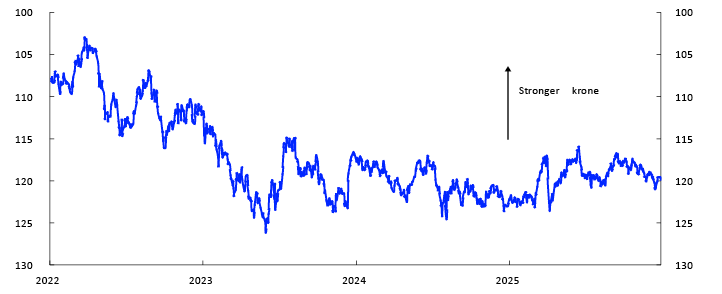
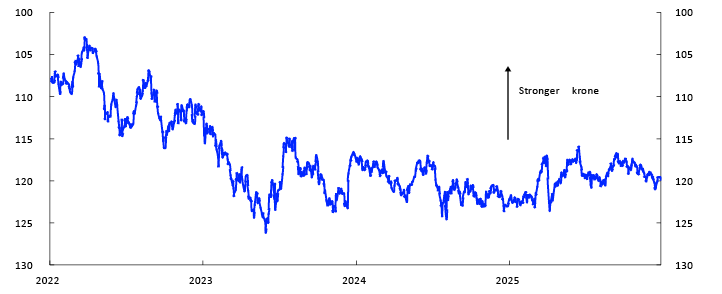
The Norwegian krone, as measured by the import-weighted index I-44, depreciated significantly in the period to summer 2023, but movements have since been less pronounced. Through 2025 H1, the krone was affected by global financial market volatility and the depreciation of the US dollar following announcements of higher US tariffs. By the end of 2025, the import-weighted krone exchange rate was slightly stronger than at the beginning of the year.
Household interest expenses declined somewhat through 2025, after having risen markedly due to policy rate hikes in the period to 2024. Firms had ample access to bank and bond financing in 2025. Through 2025, credit premiums on bank and bond financing fell further, reducing financing costs. High structural liquidity drove down money market premiums to a historically low level. At the end of 2025, the Oslo Børs benchmark index was higher than at the end of 2024.
Import-weighted exchange rate index (I-44). 1 January 2022–31 December 2025
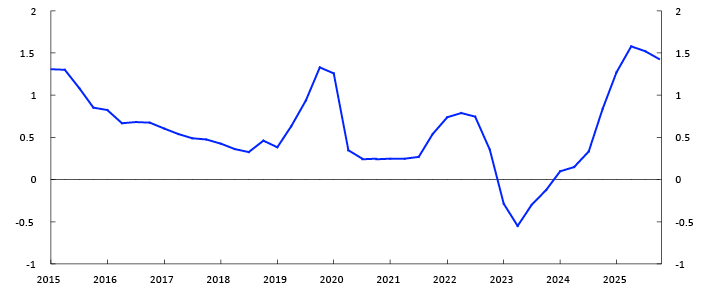
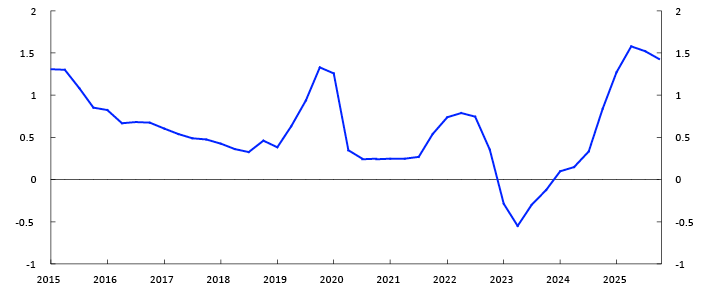
Three-month average. Percent. 2015 Q1– 2025 Q4
The Norwegian economy
After reaching a cyclical peak in summer 2022, growth in the Norwegian economy was low through 2023 and 2024. Unemployment increased somewhat. At the end of 2024, capacity utilisation in the economy appeared to be close to a normal level.
Mainland activity picked up in 2025, and preliminary data suggest that economic growth was higher than in 2024 and somewhat higher than envisaged at the beginning of the year.1 Unemployment increased somewhat through 2025, and registered unemployment in December was approximately at the pre-pandemic level. The Labour Force Survey (LFS) indicates that unemployment has risen somewhat more, partly reflecting an increase in the number of people entering the labour market. The employment-to-population ratio declined slightly but remained markedly higher than in the years preceding the pandemic. Productivity growth picked up in 2025 after being low in recent years. Capacity utilisation in the economy appears to have remained close to a normal level. In 2025 Q4, Regional Network contacts on the whole expected activity growth to dampen somewhat at the beginning of 2026.

Growth in household consumption picked up in 2025 following a couple of years of low growth. Regional Network retail contacts reported higher household demand. Combined with increased tourism, household demand also contributed to underpinning activity for firms in the services sector. Housing investment rose slightly from a low level, but low residential construction contributed to keep construction activity subdued. Petroleum investment continued to increase, but, following a period of very high activity, oil services contacts reported lower growth. Export growth continued, while public demand was little changed from 2024.
While very few new homes were sold in 2025, activity in the secondary housing market remained steady. In December 2025, prices in the secondary housing market were 5.0% higher than in December 2024.
Wage growth in 2025 slowed somewhat compared with 2024 but remained high. According to preliminary figures from Statistics Norway published at the beginning of February 2025, annual wage growth was 5% in 2025, which is broadly in line with the forecast presented in December 2025. High wage growth in recent years reflects high inflation, a tight labour market and sound profitability in some business sectors. At the end of 2025, there were prospects that wage growth would continue to moderate in 2026.
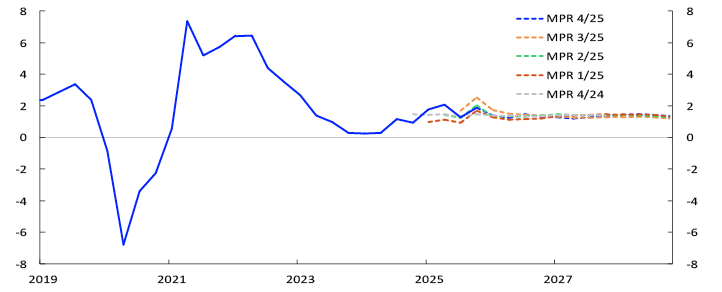
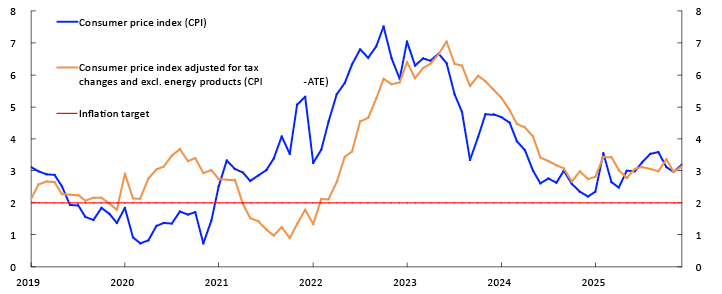
After falling markedly in 2023 and 2024, inflation has changed little in 2025. Domestically produced goods and services inflation remained elevated, at the same time as imported goods inflation remained low. The rapid rise in services, rent and food prices underpinned inflation. The annual rise in the consumer price index (CPI) was 3.1% in 2025, unchanged since 2024. The CPI adjusted for tax changes and excluding energy products (CPI-ATE) rose by 3.1% in 2025, down from 3.7% in 2024, albeit somewhat higher than expected at the beginning of 2025.
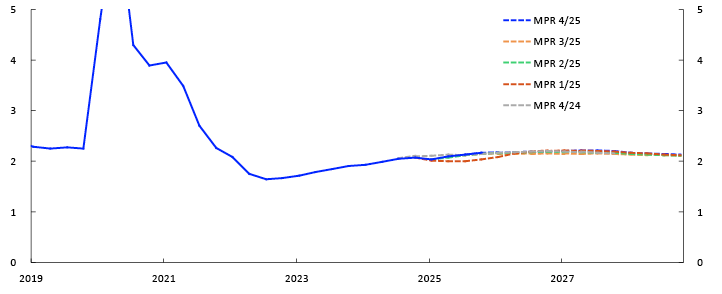
Lower inflation likely contributed to the initial decline in inflation expectations from year-end 2023. Expectations remained broadly unchanged in 2025, and according to Norges Bank’s Expectations Survey, long-term inflation expectations were still slightly above target at the end of 2025.
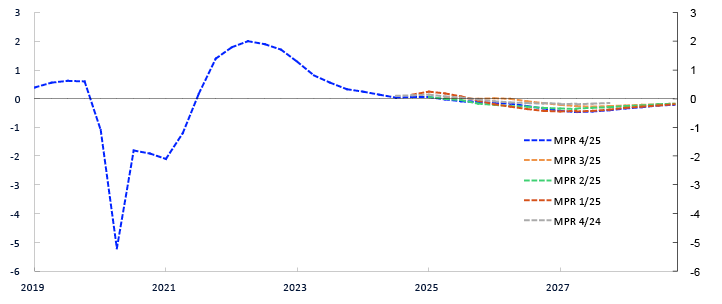
Projections at different times. Four-quarter change. 2019 Q1– 2028 Q4
Sources: Statistics Norway and Norges Bank
Projections at different times. 2019 Q1–2028 Q4
Monetary policy trade-offs
The operational target of monetary policy is annual consumer price inflation of close to 2% over time. Inflation targeting shall be forward-looking and flexible so that it can contribute to high and stable output and employment and to counteracting the build-up of financial imbalances.
After the policy rate was raised to 4.5% in December 2023, it was kept unchanged through 2024. The rate had cooled the economy and dampened inflation. Towards the end of 2024, the Committee’s assessment was that a restrictive monetary policy was still needed to stabilise inflation around target, but that the time to begin easing monetary policy was soon approaching.
The Committee’s monetary policy assessments in 2025 emphasised that inflation had declined markedly since the peak, but that it was still above target. The rapid rise in business costs would likely stoke inflation ahead, and the Committee judged that a restrictive monetary policy was still needed. Cutting the policy rate too quickly could contribute to inflation staying above target for too long. On the other hand, capacity utilisation in the economy had declined and was close to a normal level. An overly tight monetary policy stance could restrict the economy more than needed to bring inflation down to target. The assessment of this trade-off indicated that it was appropriate to begin a cautious normalisation of monetary policy, and the policy rate was reduced from 4.5% to 4% over the course of 2025.
At the beginning of the year, inflation increased more than expected and unemployment was lower than previously projected. The policy rate, which the Committee had signalled would most likely be reduced in March, was kept unchanged, but the Committee still expected that the rate would be cut over the course of 2025. The decision to keep the policy rate unchanged was largely expected by financial markets and others who closely monitor the central bank. In its discussion of the balance of risks, the Committee emphasised that if the increase in inflation was to prove more temporary than assumed, the policy rate could be reduced faster than forecasts then indicated. Underlying inflation declined more than expected through spring. At the same time, new information indicated that there could be a little more spare capacity in the Norwegian economy than previously assumed. The Committee decided to cut the policy rate by 0.25 percentage point at the monetary policy meeting in June. This decision came as a surprise to many.

After summer, current statistics suggested that wage growth in 2025 could be higher than previously assumed. It also appeared that economic growth could be higher than assumed and spare capacity appeared lower. The outlook suggested that underlying inflation would remain elevated for a little longer than previously assumed. At its meeting in September, the Committee considered keeping the policy rate unchanged but concluded that a reduction to 4% was appropriate. The Committee also signalled that a somewhat higher policy rate than envisaged in June would likely be needed ahead .
Inflation was still too high at the end of 2025, and underlying inflation had been close to 3% for some time. In addition to the fact that the strong growth in business costs over the past years would likely restrain disinflation, the krone had depreciated and contributed to somewhat higher inflation prospects. At the same time, the Committee noted that there were indications of slightly weaker developments in the economy. Through 2025, registered unemployment had increased somewhat and there appeared to be a little more spare capacity in the economy over the course of autumn. At the Committee’s meeting in December 2025, the monetary policy assessments indicated that a restrictive monetary policy was still needed, but the Committee still envisaged a cautious normalisation of the policy rate over the coming years.
Twelve-month change. Percent. January 2019 – December 2025
Projections at different times. Percent. 2019 Q1 – 2028 Q4
The forecasts in Monetary Policy Report 4/2025 were consistent with one to two rate cuts in 2026 and a further reduction to somewhat above 3% towards the end of 2028.
In its assessment of the outlook, the Committee noted that unpredictable conditions for international cooperation and trade were creating uncertainty about the inflation and growth outlook for both the Norwegian and the international economy. If labour market conditions were to weaken more than expected or the outlook were to indicate that inflation would return to target faster, the Committee judged that the policy rate could be lowered faster. On the other hand, the Committee also noted that inflation could remain elevated for longer than projected. If business costs were to remain elevated for longer or the krone were to prove weaker than projected, the Committee judged that a higher policy rate than envisaged in the forecasts in Monetary Policy Report 4/2025 could then be required.
Projections at different times. Four-quarter change. Percent. 2019 Q1 – 2028 Q4
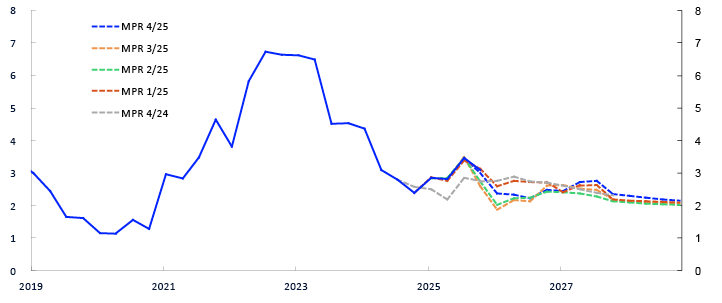
Projections at different times. Four-quarter change. Percent. 2019 Q1 – 2028 Q4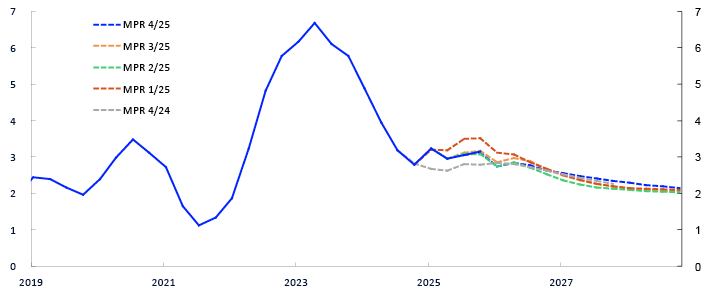
Monetary policy through 2025
In December 2024, the Monetary Policy and Financial Stability Committee signalled that the policy rate would most likely be reduced from March 2025.
At the Committee’s meeting in March, the policy rate was kept unchanged and the rate forecast raised due to increasing and higher-than-expected inflation in recent months and a number of factors suggesting that inflation ahead would also be higher than previously projected. The new forecast indicated that the rate would be cut to 4% by the end of 2025 and then be reduced gradually in the following years. The policy rate also remained unchanged at the monetary policy meeting in May, before it was reduced to 4.25% in June. Underlying inflation had then declined and been somewhat lower than projected. The new policy rate forecast was a little lower in the near term, primarily reflecting lower inflation prospects, and a little higher towards the end of the forecast horizon as a result of an upward revision of the neutral policy rate interval. At the monetary policy meeting in September, the policy rate was reduced further to 4%. The policy rate forecast presented in September was revised up somewhat and was consistent with one rate cut per year over the next three years. Prospects for higher economic activity and higher inflation than previously projected contributed to the upward revision of the rate path. The policy rate was kept on hold at the next two monetary policy meetings. The policy rate path presented at the meeting in December was little changed from September.
Projections at different times. Percent. 2019 Q1– 2028 Q4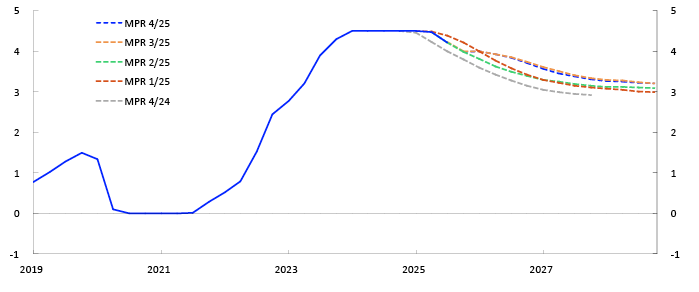
Financial stability and the basis for Norges Bank’s decision on the countercyclical capital buffer and advice on the systemic risk buffer
Norges Bank has decision-making authority for the countercyclical capital buffer (CCyB) and formal advisory responsibility for banks’ systemic risk buffer (SyRB). The two buffer requirements form a substantial portion of banks’ total capital requirements. The Monetary Policy and Financial Stability Committee sets the CCyB rate each quarter and advises on the SyRB rate every two years.
The CCyB is intended to strengthen banks’ resilience and mitigate the risk of banks’ credit standards amplifying an economic downturn. The CCyB requirement has remained unchanged at 2.5% since 2023 Q1.
The SyRB is intended to help ensure that banks hold sufficient capital to withstand future downturns. The SyRB requirement has been 4.5% since 2020 Q4. The Committee will next advise the Ministry of Finance on the SyRB requirement in 2026.

In Financial Stability Report 2025 H1 and Financial Stability Report 2025 H2 , the Committee considered the financial system to be robust. In its assessments, the Committee emphasised in particular that banks are solid and that households and firms have adequate debt-servicing capacity. At the same time, the global economic outlook is highly uncertain and there is a heightened risk of events that could weaken financial stability. The balance of risks for the global economy over the past year has been marked by geopolitical tension and changes in global trade policy. The Committee emphasised the importance of maintaining financial system resilience to prevent vulnerabilities that could amplify an economic downturn.
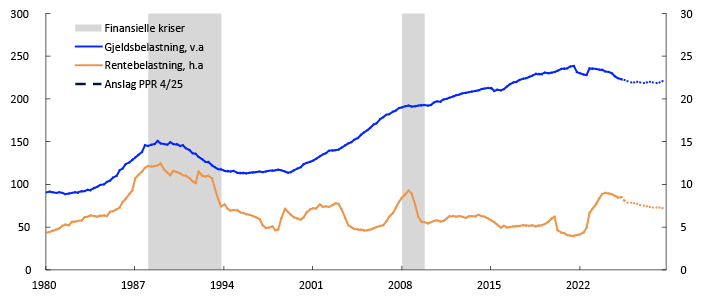
The high indebtedness of many households is a key financial system vulnerability. During the years following the pandemic, higher interest rates and high inflation tightened household finances. However, most households have been able to service debt and cover normal living expenses with current earnings by a solid margin. Many households also have financial buffers. Wages rose more than prices in 2024 and 2025, and mortgage rates declined slightly in 2025, which has strengthened household purchasing power and improved debt-servicing capacity. Total household debt has risen less than income in recent years. Analyses in Financial Stability Report 2025 H2 show that debt-to-income (DTI) ratios have declined broadly across households and most of all for those with the highest DTI ratios. In the Committee’s assessment, Norwegian household vulnerability related to high debt has been somewhat reduced but may increase again if looser financial conditions result in rapidly rising house prices and debt.
Debt as a share of disposable income and interest expenses as a share of after-tax income. Percent. 1980 Q1– 2028 Q4
Overall, Norwegian firms are solid. Profitability has remained close to the average for the past ten years, while the equity ratio increased for most sectors. So far, higher tariffs have not affected the corporate sector to any great extent.
In recent years, the share of bankruptcies among Norwegian firms has normalised following low bankruptcy figures during the pandemic. In 2025, bankruptcies were, on the whole, at approximately the same level as the average rate for the past ten years. However, bankruptcies in real estate development have risen markedly. Somewhat lower financing costs and higher house prices are likely to boost sector profitability ahead. At the same time, the Committee expects somewhat higher bank losses on exposures to this sector in 2026. Half of the banks in Norges Bank’s lending survey for 2025 Q3 reported an increased risk of default and breach of the terms of loan covenants in real estate development.

Banks’ high exposure to commercial real estate (CRE) is another key financial system vulnerability. In recent years, the rise in financing costs and lower property values have put pressure on CRE firms’ profitability and solvency. However, high employment and growth in rental income enable most CRE firms to cover high interest expenses with current earnings. A number of firms have sold real estate or raised equity to improve their financial positions in recent years, and sector solvency as a whole has improved somewhat.
Non-bank financial institutions (NBFIs2) play an increasingly prominent role in the global financial system, particularly in the government bond market and in credit intermediation to non-financial corporates. So far, direct lending from NBFIs to Norwegian non-financial corporates is limited. At the same time, NBFIs are important for banks’ wholesale funding. Foreign hedge funds hold an increasing share of banks’ covered bonds issued in NOK and use repurchase agreements with Nordic banks to obtain leverage. Increasing interconnectedness between banks and less regulated NBFIs may lead to vulnerabilities in the financial system, see Financial Stability Report 2025 H1.
Resilient banks are important for financial stability. Norwegian banks are highly profitable, satisfy capital and liquidity requirements by a solid margin and have ample access to both deposits and wholesale funding. This helps secure a resilient Norwegian financial system. Creditworthy households and firms have ample access to credit.
The Lending Regulations also build resilience by defining limits for banks’ credit standards and dampening the build-up of household sector vulnerabilities. On 1 January 2025, the Regulations were made permanent. Permanent Lending Regulations will lead to predictability and counter future deterioration of banks’ credit standards.
Both in Norway and abroad, financial systems have proven resilient to major market shocks, high inflation and higher interest rates in recent years, partly reflecting global regulatory standards established after the 2008 financial crisis. In a number of countries, there is now increased pressure to ease banks’ capital requirements. The Committee emphasised that there are good reasons to explore opportunities to simplify complex and comprehensive regulations, but that this should not be at the expense of financial system resilience.
1 Mainland GDP has been revised up for a number of years as a result of Statistics Norway’s main revision of national accounts data published in autumn 2025. Household services consumption in particular has been revised up. The revised figures do not materially change the Bank’s view of developments in the Norwegian economy.
2 NBFI is an abbreviation for non-bank financial Institutions or non-bank financial intermediation and covers institutions such as insurance companies, investment funds and asset managers such as hedge funds.
Norges Bank’s Monetary Policy and Financial Stability Committee
Oslo, 21 January 2026
Ida Wolden Bache (sign)
Governor / Committee Chair
Pål Longva (sign)
First Deputy Chair
Øystein Børsum (sign)
Second Deputy Chair
Hilde Christiane Bjørnland
Steinar Holden
Annual Report of the Monetary Policy and Financial Stability Committee for 2025

At the beginning of 2025, the policy rate had remained unchanged at 4.5% since the beginning of 2023. The policy rate had contributed to cooling down the Norwegian economy and to dampening inflation. Following a marked decline in the two preceding years, inflation changed little in 2025 and is still above the 2% target. In June, the Committee began a cautious normalisation of monetary policy. In the course of 2025, the policy rate was reduced to 4%.
In 2025, the international economy was marked by global trade policy uncertainty. The outlook for the international economy was still highly uncertain at the end of 2025. Nevertheless, economic activity remained firm in Norway and among trading partners through 2025. Policy rates were cut further in a number of countries. In December 2025, the Committee’s assessment was that a restrictive monetary policy was still needed, but a cautious normalisation of the policy rate over the coming years was still envisaged.
The Norwegian financial system is robust. Norwegian banks are profitable and solid. Households and firms have solid debt-servicing capacity. At the same time, there is still a heightened risk of events that could weaken financial stability. The Committee considers it important to maintain financial system resilience. The countercyclical capital buffer rate was kept unchanged at 2.5% through 2025.
Monetary policy
International economy
There were substantial changes in global trade policies in 2025. US import tariffs were raised markedly and there was substantial uncertainty surrounding trade policy and the outlook for the international economy in the period to summer 2025. This uncertainty contributed to considerable financial market volatility. Trade policy uncertainty declined over time but was still high at the end of the year.
Economic activity among Norway’s main trading partners nevertheless remained sustained through 2025 and growth appears to have picked up somewhat since 2024. This primarily reflects a marked decline in inflation since the peak in 2022, which has contributed to real wage growth for households.
Since 2024, the pace of disinflation has slowed in many countries. At the end of 2025, inflation in Sweden and the euro area was close to target, while inflation was still somewhat higher among other main trading partners.

Lower inflation has given central banks room to reduce policy rates. In 2024, central banks among Norway’s main trading partners started to reduce their respective policy rates and in 2025, rates were cut further. Market expectations at the end of 2025 indicated that policy rates would be cut somewhat further in the UK and the US, while the rate-cutting cycle of other central banks, including Sveriges Riksbank and the ECB, was expected to have come to an end.
Financial conditions in Norway
The Norwegian krone, as measured by the import-weighted index I-44, depreciated significantly in the period to summer 2023, but movements have since been less pronounced. Through 2025 H1, the krone was affected by global financial market volatility and the depreciation of the US dollar following announcements of higher US tariffs. By the end of 2025, the import-weighted krone exchange rate was slightly stronger than at the beginning of the year.
Household interest expenses declined somewhat through 2025, after having risen markedly due to policy rate hikes in the period to 2024. Firms had ample access to bank and bond financing in 2025. Through 2025, credit premiums on bank and bond financing fell further, reducing financing costs. High structural liquidity drove down money market premiums to a historically low level. At the end of 2025, the Oslo Børs benchmark index was higher than at the end of 2024.
Import-weighted exchange rate index (I-44). 1 January 2022–31 December 2025
Three-month average. Percent. 2015 Q1– 2025 Q4
The Norwegian economy
After reaching a cyclical peak in summer 2022, growth in the Norwegian economy was low through 2023 and 2024. Unemployment increased somewhat. At the end of 2024, capacity utilisation in the economy appeared to be close to a normal level.
Mainland activity picked up in 2025, and preliminary data suggest that economic growth was higher than in 2024 and somewhat higher than envisaged at the beginning of the year.1 Unemployment increased somewhat through 2025, and registered unemployment in December was approximately at the pre-pandemic level. The Labour Force Survey (LFS) indicates that unemployment has risen somewhat more, partly reflecting an increase in the number of people entering the labour market. The employment-to-population ratio declined slightly but remained markedly higher than in the years preceding the pandemic. Productivity growth picked up in 2025 after being low in recent years. Capacity utilisation in the economy appears to have remained close to a normal level. In 2025 Q4, Regional Network contacts on the whole expected activity growth to dampen somewhat at the beginning of 2026.

Growth in household consumption picked up in 2025 following a couple of years of low growth. Regional Network retail contacts reported higher household demand. Combined with increased tourism, household demand also contributed to underpinning activity for firms in the services sector. Housing investment rose slightly from a low level, but low residential construction contributed to keep construction activity subdued. Petroleum investment continued to increase, but, following a period of very high activity, oil services contacts reported lower growth. Export growth continued, while public demand was little changed from 2024.
While very few new homes were sold in 2025, activity in the secondary housing market remained steady. In December 2025, prices in the secondary housing market were 5.0% higher than in December 2024.
Wage growth in 2025 slowed somewhat compared with 2024 but remained high. According to preliminary figures from Statistics Norway published at the beginning of February 2025, annual wage growth was 5% in 2025, which is broadly in line with the forecast presented in December 2025. High wage growth in recent years reflects high inflation, a tight labour market and sound profitability in some business sectors. At the end of 2025, there were prospects that wage growth would continue to moderate in 2026.
After falling markedly in 2023 and 2024, inflation has changed little in 2025. Domestically produced goods and services inflation remained elevated, at the same time as imported goods inflation remained low. The rapid rise in services, rent and food prices underpinned inflation. The annual rise in the consumer price index (CPI) was 3.1% in 2025, unchanged since 2024. The CPI adjusted for tax changes and excluding energy products (CPI-ATE) rose by 3.1% in 2025, down from 3.7% in 2024, albeit somewhat higher than expected at the beginning of 2025.
Lower inflation likely contributed to the initial decline in inflation expectations from year-end 2023. Expectations remained broadly unchanged in 2025, and according to Norges Bank’s Expectations Survey, long-term inflation expectations were still slightly above target at the end of 2025.
Projections at different times. Four-quarter change. 2019 Q1– 2028 Q4
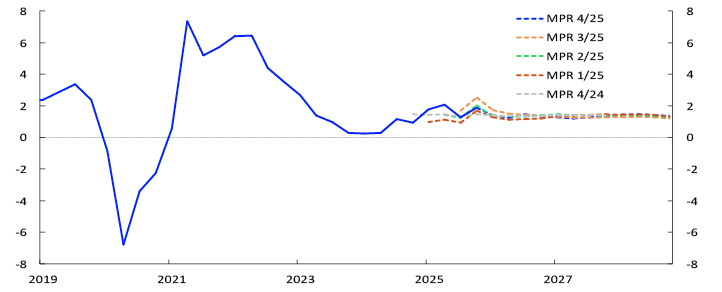
Sources: Statistics Norway and Norges Bank
Projections at different times. 2019 Q1–2028 Q4
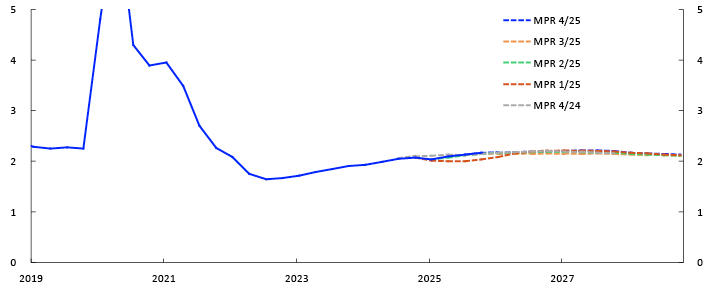
Monetary policy trade-offs
The operational target of monetary policy is annual consumer price inflation of close to 2% over time. Inflation targeting shall be forward-looking and flexible so that it can contribute to high and stable output and employment and to counteracting the build-up of financial imbalances.
After the policy rate was raised to 4.5% in December 2023, it was kept unchanged through 2024. The rate had cooled the economy and dampened inflation. Towards the end of 2024, the Committee’s assessment was that a restrictive monetary policy was still needed to stabilise inflation around target, but that the time to begin easing monetary policy was soon approaching.
The Committee’s monetary policy assessments in 2025 emphasised that inflation had declined markedly since the peak, but that it was still above target. The rapid rise in business costs would likely stoke inflation ahead, and the Committee judged that a restrictive monetary policy was still needed. Cutting the policy rate too quickly could contribute to inflation staying above target for too long. On the other hand, capacity utilisation in the economy had declined and was close to a normal level. An overly tight monetary policy stance could restrict the economy more than needed to bring inflation down to target. The assessment of this trade-off indicated that it was appropriate to begin a cautious normalisation of monetary policy, and the policy rate was reduced from 4.5% to 4% over the course of 2025.
At the beginning of the year, inflation increased more than expected and unemployment was lower than previously projected. The policy rate, which the Committee had signalled would most likely be reduced in March, was kept unchanged, but the Committee still expected that the rate would be cut over the course of 2025. The decision to keep the policy rate unchanged was largely expected by financial markets and others who closely monitor the central bank. In its discussion of the balance of risks, the Committee emphasised that if the increase in inflation was to prove more temporary than assumed, the policy rate could be reduced faster than forecasts then indicated. Underlying inflation declined more than expected through spring. At the same time, new information indicated that there could be a little more spare capacity in the Norwegian economy than previously assumed. The Committee decided to cut the policy rate by 0.25 percentage point at the monetary policy meeting in June. This decision came as a surprise to many.

After summer, current statistics suggested that wage growth in 2025 could be higher than previously assumed. It also appeared that economic growth could be higher than assumed and spare capacity appeared lower. The outlook suggested that underlying inflation would remain elevated for a little longer than previously assumed. At its meeting in September, the Committee considered keeping the policy rate unchanged but concluded that a reduction to 4% was appropriate. The Committee also signalled that a somewhat higher policy rate than envisaged in June would likely be needed ahead .
Inflation was still too high at the end of 2025, and underlying inflation had been close to 3% for some time. In addition to the fact that the strong growth in business costs over the past years would likely restrain disinflation, the krone had depreciated and contributed to somewhat higher inflation prospects. At the same time, the Committee noted that there were indications of slightly weaker developments in the economy. Through 2025, registered unemployment had increased somewhat and there appeared to be a little more spare capacity in the economy over the course of autumn. At the Committee’s meeting in December 2025, the monetary policy assessments indicated that a restrictive monetary policy was still needed, but the Committee still envisaged a cautious normalisation of the policy rate over the coming years.
Twelve-month change. Percent. January 2019 – December 2025
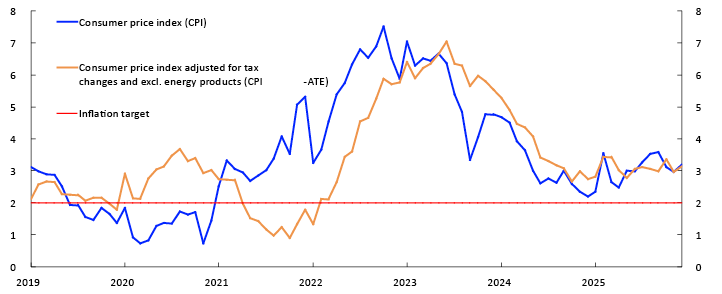
Projections at different times. Percent. 2019 Q1 – 2028 Q4
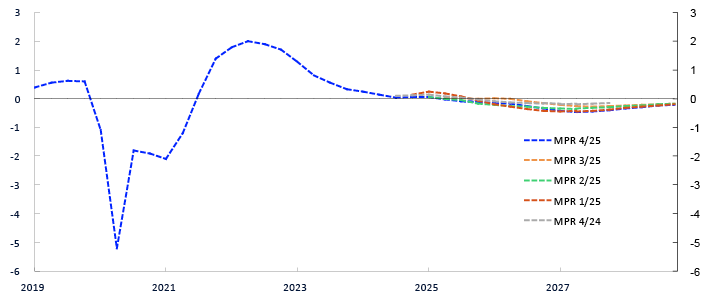
The forecasts in Monetary Policy Report 4/2025 were consistent with one to two rate cuts in 2026 and a further reduction to somewhat above 3% towards the end of 2028.
In its assessment of the outlook, the Committee noted that unpredictable conditions for international cooperation and trade were creating uncertainty about the inflation and growth outlook for both the Norwegian and the international economy. If labour market conditions were to weaken more than expected or the outlook were to indicate that inflation would return to target faster, the Committee judged that the policy rate could be lowered faster. On the other hand, the Committee also noted that inflation could remain elevated for longer than projected. If business costs were to remain elevated for longer or the krone were to prove weaker than projected, the Committee judged that a higher policy rate than envisaged in the forecasts in Monetary Policy Report 4/2025 could then be required.
Projections at different times. Four-quarter change. Percent. 2019 Q1 – 2028 Q4
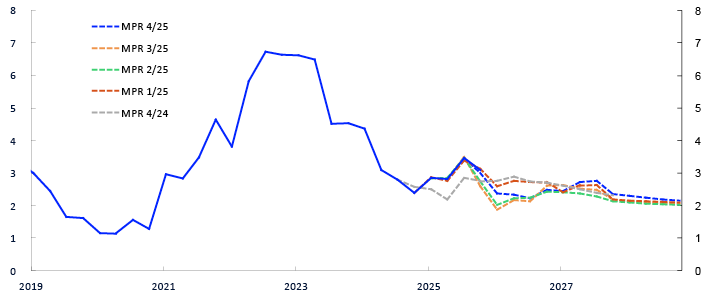
Projections at different times. Four-quarter change. Percent. 2019 Q1 – 2028 Q4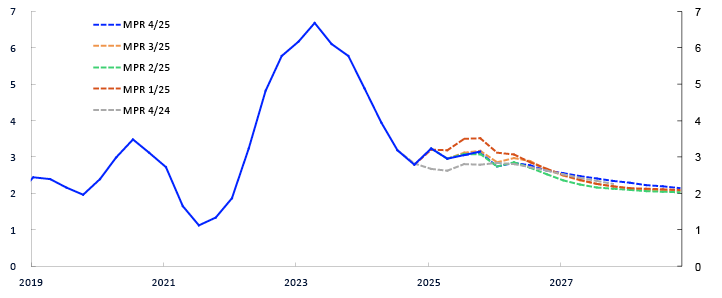
Monetary policy through 2025
In December 2024, the Monetary Policy and Financial Stability Committee signalled that the policy rate would most likely be reduced from March 2025.
At the Committee’s meeting in March, the policy rate was kept unchanged and the rate forecast raised due to increasing and higher-than-expected inflation in recent months and a number of factors suggesting that inflation ahead would also be higher than previously projected. The new forecast indicated that the rate would be cut to 4% by the end of 2025 and then be reduced gradually in the following years. The policy rate also remained unchanged at the monetary policy meeting in May, before it was reduced to 4.25% in June. Underlying inflation had then declined and been somewhat lower than projected. The new policy rate forecast was a little lower in the near term, primarily reflecting lower inflation prospects, and a little higher towards the end of the forecast horizon as a result of an upward revision of the neutral policy rate interval. At the monetary policy meeting in September, the policy rate was reduced further to 4%. The policy rate forecast presented in September was revised up somewhat and was consistent with one rate cut per year over the next three years. Prospects for higher economic activity and higher inflation than previously projected contributed to the upward revision of the rate path. The policy rate was kept on hold at the next two monetary policy meetings. The policy rate path presented at the meeting in December was little changed from September.
Projections at different times. Percent. 2019 Q1– 2028 Q4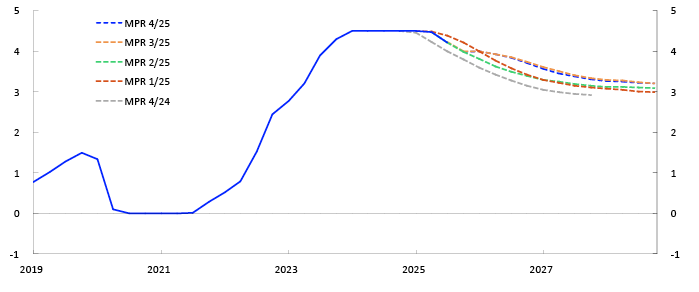
Financial stability and the basis for Norges Bank’s decision on the countercyclical capital buffer and advice on the systemic risk buffer
Norges Bank has decision-making authority for the countercyclical capital buffer (CCyB) and formal advisory responsibility for banks’ systemic risk buffer (SyRB). The two buffer requirements form a substantial portion of banks’ total capital requirements. The Monetary Policy and Financial Stability Committee sets the CCyB rate each quarter and advises on the SyRB rate every two years.
The CCyB is intended to strengthen banks’ resilience and mitigate the risk of banks’ credit standards amplifying an economic downturn. The CCyB requirement has remained unchanged at 2.5% since 2023 Q1.
The SyRB is intended to help ensure that banks hold sufficient capital to withstand future downturns. The SyRB requirement has been 4.5% since 2020 Q4. The Committee will next advise the Ministry of Finance on the SyRB requirement in 2026.
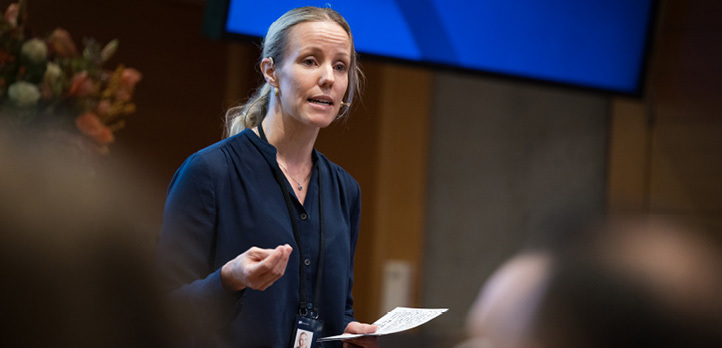
In Financial Stability Report 2025 H1 and Financial Stability Report 2025 H2 , the Committee considered the financial system to be robust. In its assessments, the Committee emphasised in particular that banks are solid and that households and firms have adequate debt-servicing capacity. At the same time, the global economic outlook is highly uncertain and there is a heightened risk of events that could weaken financial stability. The balance of risks for the global economy over the past year has been marked by geopolitical tension and changes in global trade policy. The Committee emphasised the importance of maintaining financial system resilience to prevent vulnerabilities that could amplify an economic downturn.
The high indebtedness of many households is a key financial system vulnerability. During the years following the pandemic, higher interest rates and high inflation tightened household finances. However, most households have been able to service debt and cover normal living expenses with current earnings by a solid margin. Many households also have financial buffers. Wages rose more than prices in 2024 and 2025, and mortgage rates declined slightly in 2025, which has strengthened household purchasing power and improved debt-servicing capacity. Total household debt has risen less than income in recent years. Analyses in Financial Stability Report 2025 H2 show that debt-to-income (DTI) ratios have declined broadly across households and most of all for those with the highest DTI ratios. In the Committee’s assessment, Norwegian household vulnerability related to high debt has been somewhat reduced but may increase again if looser financial conditions result in rapidly rising house prices and debt.
Debt as a share of disposable income and interest expenses as a share of after-tax income. Percent. 1980 Q1– 2028 Q4
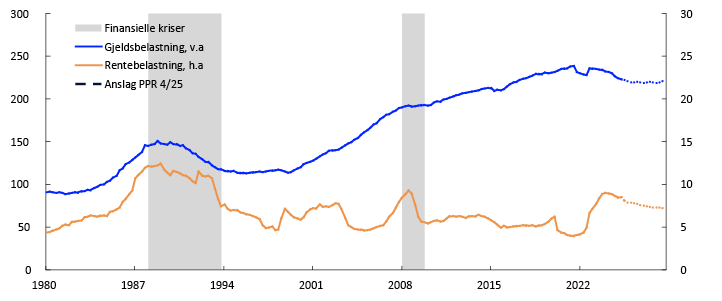
Overall, Norwegian firms are solid. Profitability has remained close to the average for the past ten years, while the equity ratio increased for most sectors. So far, higher tariffs have not affected the corporate sector to any great extent.
In recent years, the share of bankruptcies among Norwegian firms has normalised following low bankruptcy figures during the pandemic. In 2025, bankruptcies were, on the whole, at approximately the same level as the average rate for the past ten years. However, bankruptcies in real estate development have risen markedly. Somewhat lower financing costs and higher house prices are likely to boost sector profitability ahead. At the same time, the Committee expects somewhat higher bank losses on exposures to this sector in 2026. Half of the banks in Norges Bank’s lending survey for 2025 Q3 reported an increased risk of default and breach of the terms of loan covenants in real estate development.

Banks’ high exposure to commercial real estate (CRE) is another key financial system vulnerability. In recent years, the rise in financing costs and lower property values have put pressure on CRE firms’ profitability and solvency. However, high employment and growth in rental income enable most CRE firms to cover high interest expenses with current earnings. A number of firms have sold real estate or raised equity to improve their financial positions in recent years, and sector solvency as a whole has improved somewhat.
Non-bank financial institutions (NBFIs2) play an increasingly prominent role in the global financial system, particularly in the government bond market and in credit intermediation to non-financial corporates. So far, direct lending from NBFIs to Norwegian non-financial corporates is limited. At the same time, NBFIs are important for banks’ wholesale funding. Foreign hedge funds hold an increasing share of banks’ covered bonds issued in NOK and use repurchase agreements with Nordic banks to obtain leverage. Increasing interconnectedness between banks and less regulated NBFIs may lead to vulnerabilities in the financial system, see Financial Stability Report 2025 H1.
Resilient banks are important for financial stability. Norwegian banks are highly profitable, satisfy capital and liquidity requirements by a solid margin and have ample access to both deposits and wholesale funding. This helps secure a resilient Norwegian financial system. Creditworthy households and firms have ample access to credit.
The Lending Regulations also build resilience by defining limits for banks’ credit standards and dampening the build-up of household sector vulnerabilities. On 1 January 2025, the Regulations were made permanent. Permanent Lending Regulations will lead to predictability and counter future deterioration of banks’ credit standards.
Both in Norway and abroad, financial systems have proven resilient to major market shocks, high inflation and higher interest rates in recent years, partly reflecting global regulatory standards established after the 2008 financial crisis. In a number of countries, there is now increased pressure to ease banks’ capital requirements. The Committee emphasised that there are good reasons to explore opportunities to simplify complex and comprehensive regulations, but that this should not be at the expense of financial system resilience.
1 Mainland GDP has been revised up for a number of years as a result of Statistics Norway’s main revision of national accounts data published in autumn 2025. Household services consumption in particular has been revised up. The revised figures do not materially change the Bank’s view of developments in the Norwegian economy.
2 NBFI is an abbreviation for non-bank financial Institutions or non-bank financial intermediation and covers institutions such as insurance companies, investment funds and asset managers such as hedge funds.
Norges Bank’s Monetary Policy and Financial Stability Committee
Oslo, 21 January 2026
Ida Wolden Bache (sign)
Governor / Committee Chair
Pål Longva (sign)
First Deputy Chair
Øystein Børsum (sign)
Second Deputy Chair
Hilde Christiane Bjørnland
Steinar Holden

Corporate social responsibility and sustainability

This section provides an overview of Norges Bank’s sustainability work.
The contents are organised into the following subsections:
- Society and social conditions
- Ethics, responsible procurement and supplier and contractor monitoring
- Climate and the environment
Norges Bank’s sustainability strategy guides this work.
Sustainability strategy
Society and social conditions
- Norges Bank’s culture will be one of diversity, inclusion and equal opportunities.
- Norges Bank will promote professional development so that staff enjoy their work, are challenged and have the expertise to meet the challenges of the future.
- Norges Bank will promote human and workers’ rights through responsible investment and in the Bank’s procurements.
Governance, ethics and culture
- Norges Bank will enable its staff and partners to make sustainable choices.
- Norges Bank will report on its work to promote sustainability in line with best practice.
- Norges Bank will support the development of standards for well-functioning markets, sound corporate governance and responsible business conduct.
Climate and the environment
- Norges Bank will work to reduce emissions from its own operations in line with the ambitions of the Paris Agreement.
- Norges Bank will be an active owner and a driving force for investee companies to achieve net zero emissions by 2050.
- Norges Bank will increase its understanding of the impact of climate change and energy transition.
Sustainability reporting requirements
In accordance with the Regulation on the financial reporting for Norges Bank etc, Norges Bank is required to submit reports on the environment, social conditions, the working environment, gender equality and non-discrimination, human rights and anti-corruption. The requirements are met through this Report.
Norges Bank is also subject to the activity duty and the duty to issue a statement under the Equality and Anti-Discrimination Act. The statement on the Bank’s equality and anti-discrimination work can be found below in this section.
Society and social conditions

Norges Bank’s employees
The work to deliver on the Bank’s missions starts with the Bank’s people. Success requires highly skilled and committed employees and managers, and great emphasis is therefore placed on attracting, developing and retaining such employees. At the same time, it is important to ensure that employees who leave Norges Bank experience a positive transition, ensuring that they remain good ambassadors for the Bank’s working environment and missions in their new jobs.
Norges Bank employees
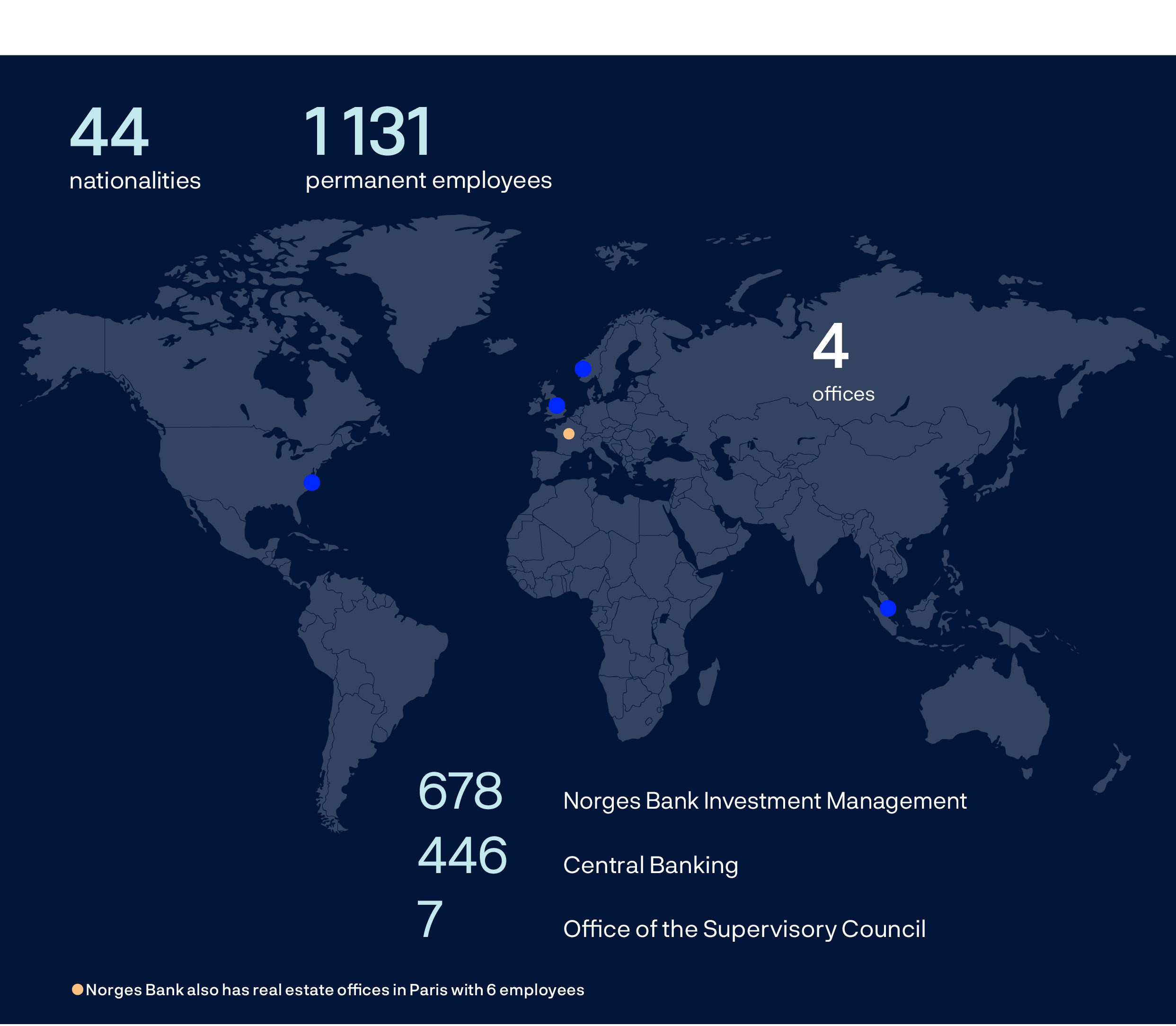
Recruitment
Norges Bank aims to attract and recruit highly qualified candidates from leading centres of expertise and national and international academic institutions.
The number of applications for positions at Norges Bank continued to increase in 2025.
A wide range of measures and activities are used to inform students and pupils about Norges Bank:
- Norges Bank’s Knowledge Centre
- Lectures at colleges and universities through the Norges Bank Teaching Initiative and NBIM Teach
- Visits to educational establishments and annual nationwide case competition for students and pupils
- Part-time student internships

To ensure that it is best equipped to deliver on its missions, the Bank gives weight tovariation in experience, perspectives, knowledge and expertise. To promote diversity in the organisation, the Bank recruits across nationality, gender, age and background.
In 2025, Norges Bank continued and strengthened its recruitment work. The Bank uses a neutral and inclusive language in job advertisements and is alert in selection processes to the risk of discrimination based on for example name, ethnicity and unconscious bias.
Table 2 Gender distribution among job applicants, upon signing of employment contract
|
Norges Bank |
Central Banking |
NBIM |
||||
|---|---|---|---|---|---|---|
|
Percentage applicants |
Percentage staff |
Percentage applicants |
Percentage staff |
Percentage applicants |
Percentage staff |
|
|
Men |
66 |
68 |
64 |
53 |
71 |
77 |
|
Women |
31 |
32 |
36 |
47 |
24 |
23 |
|
Not stated |
3 |
0 |
0 |
0 |
5 |
0 |
Learning and development opportunities
Norges Bank will facilitate development and learning. The Bank’s career framework and employee and management principles provide predictability, transparency and a common language for management, collaboration and responsibility.
The Bank’s ambition is to develop a culture where learning, curiosity and continuous skill development are a natural part of day-to-day work.
Most learning occurs through everyday work by exploring new areas of expertise, participating in projects or by collaborating with colleagues with complementary skill sets. In addition, the Bank invests in courses, digital learning platforms and internal knowledge-sharing fora, enabling all employees to grow in pace with a changing job environment.
In 2025, priority was given to developing AI skills. Norges Bank will use AI responsibly to boost productivity and raise the quality of its work.
Internal mentoring has also been introduced in Central Banking, and NBIM has continued its mentor programme where employees are also encouraged to engage with external mentors. The Bank has internal and external resources that can provide guidance to employees on development, mastery and performance.
Employees gain experience and better insight across operational and specialist areas through temporary internships both in Norway and at the Bank’s offices abroad. In addition, employees can apply for residency at other central banks and relevant institutions.

Diversity and inclusion
Norges Bank expects all interactions to be respectful and has zero tolerance for bullying, harassment and discrimination. Employees shall feel safe in reporting errors and irregularities. Concerns shall be taken seriously and followed up. This is established in the HR principles, which are set by the Executive Board and based on the Bank’s ethical rules.
Through data analyses, staff surveys, performance appraisals and HSE (health safety and the environment) work, the risk of discrimination and other barriers to equality are identified. This insight is used to ensure that the Bank’s processes, culture and ways of working support an equal opportunity organisation.
In 2025, Central Banking introduced and established a diversity statement declaring that, at Norges Bank, everyone is welcome to apply for job vacancies, all applicants shall be considered on equal terms and the Bank will bring out the best in its people and provide equal opportunities.
In recent years, the Bank has introduced measures to promote an inclusive environment and a healthy speak-up culture. Personal and professional development and inclusive practices in everyday work are promoted through awareness-raising activities, leadership training and team development.
Norges Bank offers both student internships and retiree consultant positions. This contributes to a working environment with a diversity of experience and skills and facilitates smooth transitions into both working life and retirement.
Salary setting, employee development and succession planning must be free of conscious or unconscious bias and are assessed based on objective criteria such as performance and compliance with Norges Bank’s values.

Gender balance and distribution
Norges Bank is one of the founding partners of the Women in Finance Charter, which aims to increase the share of women in the Norwegian financial sector. In 2025, Norges Bank hosted the Charter’s fourth annual status report [in Norwegian only]. The Bank’s commitments are published on Norges Bank’s website.
The share of women in Norges Bank has increased from 36% to 38% over the past three years, and the Bank is approaching its 40% target. Even though there has been a positive development in the overall gender balance in recent years, some areas of expertise and job categories still lag behind.
Overall gender balance
The trend towards a higher share of women levelled off in 2025 due to a minor reduction in the share of women in NBIM.
Table 3 Gender balance
|
Norges Bank |
Central Banking |
NBIM |
|||||||
|---|---|---|---|---|---|---|---|---|---|
|
2025 |
2024 |
2023 |
2025 |
2024 |
2023 |
2025 |
2024 |
2023 |
|
|
Men. Number |
704 |
695 |
686 |
259 |
257 |
247 |
445 |
438 |
438 |
|
Women. Number |
427 |
423 |
393 |
194 |
185 |
178 |
233 |
238 |
216 |
|
Men. Percent |
62 |
62 |
64 |
57 |
58 |
58 |
66 |
65 |
67 |
|
Women. Percent |
38 |
38 |
36 |
43 |
42 |
42 |
34 |
35 |
33 |
Greater detail is provided below on gender balance developments in Norges Bank, specified by job category and managerial and specialist position.
Gender balance by job category
The gender balance within certain job categories reflects the situation in the labour market in general. Fewer women than men apply for managerial positions and for positions in financial and IT sectors in general. At the end of 2025, the Bank’s gender balance was in line with the Bank’s target of at least 40% in most of the job categories below management level. There is a continued positive trend at management level, where the share of women among section heads, the job category with the most managers, has increased to 38%. For other managerial and specialist categories, the Bank is further from target.
Table 4 Share of women and men per job category at Norges Bank’s head office in Oslo. Number and percent
|
Job category |
2025 |
2024 |
2023 |
|||||
|---|---|---|---|---|---|---|---|---|
|
Number of men |
Number of women |
Men. Percent |
Women. Percent |
Men. Percent |
Women. Percent |
Men. Percent |
Women. Percent |
|
|
Executive director |
7 |
6 |
54 |
46 |
53 |
47 |
58 |
42 |
|
Head of department |
36 |
14 |
72 |
28 |
70 |
30 |
76 |
24 |
|
Head of section |
49 |
30 |
62 |
38 |
68 |
32 |
64 |
36 |
|
Chief analyst |
19 |
1 |
95 |
5 |
100 |
0 |
100 |
0 |
|
Special adviser |
159 |
58 |
73 |
27 |
72 |
28 |
75 |
25 |
|
Senior adviser |
151 |
121 |
56 |
44 |
57 |
43 |
57 |
43 |
|
Adviser |
73 |
67 |
52 |
48 |
52 |
48 |
56 |
44 |
|
Analyst |
19 |
19 |
50 |
50 |
47 |
53 |
51 |
49 |
|
Consultant |
13 |
9 |
59 |
41 |
54 |
46 |
56 |
44 |
|
Support staff |
0 |
2 |
0 |
100 |
0 |
100 |
0 |
100 |
Gender balance at managerial and specialist levels
The share of women in managerial positions in Norges Bank continued to rise in 2025 and is now 35%, reflecting an increase in Central Banking, where the 40% target has been reached. The share of women in specialist positions is approximately the same as in 2024.
Measures have been implemented on all legs of the employee journey to achieve the gender balance target. In recruitment, measures have been implemented to widen the candidate pool, including targeted employer branding, network building, establishing relevant fora and requiring recruiting managers to consider and put forward both the best male and the best female candidate right up to the point where a final recommendation is made.
Recruiting more women is important, but so too is supporting their development and strengthening retention, which is why the Bank persistently strives to build a culture of equal opportunity. By defining clear gender balance targets, raising awareness through manager training and ensuring that executives actively pursue gender balance in management groups, recruitment processes and succession planning, the Bank is taking concrete steps to achieve the 40% target in managerial and specialist positions.
Table 5 Percentage of women in managerial and specialist positions at the head office in Oslo1
|
Job category |
2025 |
2024 |
2023 |
|||
|---|---|---|---|---|---|---|
|
Men. Percent |
Women. Percent |
Men. Percent |
Women. Percent |
Men. Percent |
Women. Percent |
|
|
Total number of managers in Norges Bank |
65 |
35 |
67 |
33 |
70 |
30 |
|
Managers in Central Banking |
60 |
40 |
65 |
35 |
67 |
33 |
|
Managers in NBIM |
69 |
31 |
68 |
32 |
72 |
28 |
|
Total number of specialists in Norges Bank |
75 |
25 |
74 |
26 |
77 |
23 |
|
Specialists in Central Banking |
71 |
29 |
70 |
30 |
73 |
27 |
|
Specialists in NBIM |
80 |
20 |
80 |
20 |
80 |
20 |
1 Specialists include chief analysts and special advisers.

Temporary and part-time employees
Most permanent employees at Norges Bank have full-time contracts. Involuntary part-time work is not an issue. Most temporary employment contracts at Norges Bank are related to research, student internships, retiree consultant positions and some hourly paid work.
Table 6 Share of temporary and part-time employees at Norges Bank’s head office in Oslo
|
2025 |
||
|---|---|---|
|
Men. Percent |
Women. Percent |
|
|
Temporary employees |
8.8 |
11.9 |
|
Part-time employees |
7.0 |
10.3 |
Parental leave
Norges Bank offers fully paid gender-neutral parental leave of 16 weeks in addition to 10 weeks of maternity leave for employees at the Bank’s offices abroad.
|
2025 |
2024 |
2023 |
||||
|---|---|---|---|---|---|---|
|
Men |
Women |
Men |
Women |
Men |
Women |
|
|
Average number of weeks of parental leave in the calendar year |
8.0 |
13.7 |
10.4 |
25.7 |
7.8 |
15.4 |
1 Number of weeks taken out in the calendar year and not the number of weeks the employee has taken out in total.
Salary system and salary differences
Framework and principles
The Executive Board sets the framework for Norges Bank’s remuneration schemes and monitors how they are practiced. Salary levels are to be competitive but not market leading. Salary determination is individual and should reflect the responsibilities of the position, as well as the expertise, experience and performance of the position holder.
Norges Bank employs external consultants to compare salary levels against other employers every year.
The Remuneration Committee of the Executive Board considers matters relating to Norges Bank’s remuneration schemes. In addition, Internal Audit at Norges Bank provides an independent opinion on compliance with the remuneration rules and guidelines. An audit in 2025 confirmed that the 2024 salary system had been practised in line with regulations. There were no significant changes to the remuneration system in 2025.
See note 15 Personnel expenses to the annual financial statements for further information on the salary system and benefits to senior executives.

Salary practices
Salary practices shall be fair, and salary developments are analysed regularly. Any gaps in remuneration at the individual or group level are examined further to ensure that gender-neutral criteria are applied.
Women’s fixed salary amounted on average to 78% of men’s at year-end 2025, the same as at year-end 2024, reflecting more men in senior positions and in investment roles in NBIM.
Table 8 Total wage gaps. Average fixed salary, independent of job category
|
2025 |
Norges Bank |
Norges Bank, Oslo |
Central Banking, Oslo |
NBIM |
NBIM, Oslo |
|---|---|---|---|---|---|
|
Men |
Women |
Men |
Men |
Women |
|
|
Men |
100 |
100 |
100 |
100 |
100 |
|
Women |
78 |
86 |
88 |
78 |
86 |
|
2024 |
Norges Bank |
Norges Bank, Oslo |
Central Banking, Oslo |
NBIM |
NBIM, Oslo |
|---|---|---|---|---|---|
|
Men |
Women |
Men |
Men |
Women |
|
|
Men |
100 |
100 |
100 |
100 |
100 |
|
Women |
78 |
86 |
88 |
77 |
85 |
Salary mapping
The salary mapping indicates no material differences in salary levels of men and women with comparable roles and tasks at the same location.
Tables 9-12 below provide an overview of wage differences for permanent employees at Norges Bank’s head office in Oslo. The tables show both fixed salary and paid remuneration by Norges Bank’s position levels. To protect the privacy of individual employees in small categories, the executive director, analysis director and support staff position levels are omitted. Total remuneration includes fixed salary, performance-based pay, paid overtime and compensation for travel time. Figures for fixed salaries and paid remuneration are rounded to the nearest NOK 1 000.
Salaries in Central Banking
Salary differences between women and men in Central Banking are relatively small in most job categories. Gender wage gaps are most pronounced in lower job categories. The differences reflect the uneven gender distribution within different fields of expertise. Higher wage levels in certain fields where men are overrepresented reflect market conditions. The most substantial differences in remuneration paid reflect a preponderance of men in certain fields of expertise who are entitled to on-call allowance and/or work more overtime than other employees.
Table 9 Salary mapping in Central Banking. Fixed salary by job category
|
Central Banking |
Number of employees |
Median fixed salary |
Wage gap – women’s salary as a percentage of men’s |
Average fixed salary |
Wage gap – women’s salary as a percentage of men’s |
|||
|---|---|---|---|---|---|---|---|---|
|
Men |
Women |
Men |
Women |
Men |
Women |
|||
|
Head of department |
20 |
11 |
1 794 000 |
1 700 000 |
95 |
1 800 000 |
1 698 000 |
94 |
|
Head of section |
16 |
14 |
1 354 000 |
1 417 000 |
105 |
1 388 000 |
1 456 000 |
105 |
|
Special adviser |
86 |
37 |
1 342 000 |
1 302 000 |
97 |
1 376 000 |
1 320 000 |
96 |
|
Senior adviser |
74 |
65 |
1 043 000 |
1 021 000 |
98 |
1 075 000 |
1 048 000 |
97 |
|
Adviser |
23 |
43 |
872 000 |
802 000 |
92 |
876 000 |
826 000 |
94 |
|
Analyst |
11 |
6 |
667 000 |
650 000 |
97 |
670 000 |
647 000 |
97 |
|
Consultant |
13 |
9 |
905 000 |
799 000 |
88 |
917 000 |
773 000 |
84 |
Table 10 Salary mappingin Central Banking. Paid remuneration by job category
|
Central Banking |
Number of employees |
Median paid remuneration |
Wage gap – women’s salary as a percentage of men’s |
Average paid remuneration |
Wage gap – women’s salary as a percentage of men’s |
|||
|---|---|---|---|---|---|---|---|---|
|
Men |
Women |
Men |
Women |
Men |
Women |
|||
|
Head of department |
20 |
11 |
1 804 000 |
1 700 000 |
94 |
1 831 000 |
1 698 000 |
93 |
|
Head of section |
16 |
14 |
1 354 000 |
1 459 000 |
108 |
1 401 000 |
1 478 000 |
105 |
|
Special adviser |
86 |
37 |
1 377 000 |
1 302 000 |
95 |
1 417 000 |
1 381 000 |
97 |
|
Senior adviser |
74 |
65 |
1 089 000 |
1 026 000 |
94 |
1 109 000 |
1 086 000 |
98 |
|
Adviser |
23 |
43 |
894 000 |
808 000 |
90 |
933 000 |
850 000 |
91 |
|
Analyst |
11 |
6 |
698 000 |
672 000 |
96 |
699 000 |
665 000 |
95 |
|
Consultant |
13 |
9 |
1 053 000 |
813 000 |
77 |
1 045 000 |
786 000 |
75 |
Salaries in NBIM
In NBIM, the gender wage gap widened marginally from 2024, primarily owing to change in the composition of the different job categories.
In NBIM, the gender wage gap mainly reflects a preponderance of men in positions involving investment decisions. Positions with investment responsibility generally offer higher salaries compared with those at the same level in other fields of expertise. A higher share of men than women in executive positions also widens the gap.
Table 11 Salary mapping in NBIM, Oslo. Fixed salary by job category
|
NBIM |
Number of employees |
Median fixed salary |
Wage gap – women’s salary as a percentage of men’s |
Average fixed salary |
Wage gap – women’s salary as a percentage of men’s |
|||
|---|---|---|---|---|---|---|---|---|
|
Men |
Women |
Men |
Women |
Men |
Women |
|||
|
Head of section |
33 |
16 |
1 845 000 |
1 690 000 |
92 |
1 916 000 |
1 734 000 |
91 |
|
Special adviser |
73 |
21 |
1 500 000 |
1 440 000 |
96 |
1 567 000 |
1 431 000 |
91 |
|
Senior adviser |
77 |
56 |
1 170 000 |
1 150 000 |
98 |
1 176 000 |
1 187 000 |
101 |
|
Adviser |
50 |
24 |
923 000 |
878 000 |
95 |
933 000 |
883 000 |
95 |
|
Analyst |
8 |
13 |
720 000 |
720 000 |
100 |
719 000 |
713 000 |
99 |
Table 12 Salary mapping in NBIM, Oslo. Paid remuneration by job category
|
NBIM |
Number of employees |
Median paid remuneration |
Wage gap – women’s salary as a percentage of men’s |
Average paid remuneration |
Wage gap – women’s salary as a percentage of men’s |
|||
|---|---|---|---|---|---|---|---|---|
|
Men |
Women |
Men |
Women |
Men |
Women |
|||
|
Head of section |
33 |
16 |
1 945 000 |
1 718 000 |
88 |
2 110 000 |
1 806 000 |
86 |
|
Special adviser |
73 |
21 |
1 760 000 |
1 467 000 |
83 |
1 905 000 |
1 527 000 |
80 |
|
Senior adviser |
77 |
56 |
1 250 000 |
1 248 000 |
100 |
1 311 000 |
1 294 000 |
99 |
|
Adviser |
50 |
24 |
954 000 |
897 000 |
94 |
998 000 |
911 000 |
91 |
|
Analyst |
8 |
13 |
737 000 |
720 000 |
98 |
736 000 |
722 000 |
98 |
Health, safety and the environment (HSE)
The Bank works closely with the occupational health service to strengthen systematic HSE work. In 2025, focus was mainly given to establishing safety inspections as a productivetool, and the Bank also designed and deployed digital HSE training for all managers. In the ongoing work to upgrade the head office, priority has also been given to improving the physical working environment, including indoor climate.
The safety representative service, led by the chief safety representative, is included in the planning and follow-up of measures addressing the working environment. Management cooperates constructively with the safety representative service and there is a strong mutual commitment to safeguard the Bank’s systematic HSE work.

The annual staff survey is an important tool in the Bank’s work to develop its staff, organisation, management and workplace. Survey results are discussed by Norges Bank’s Executive Board, management groups, teams and various working committees, and measures are implemented based on discussions both within the Bank’s management and among the individual teams, with reporting and follow-up. Overall, the results from the 2025 survey indicate that employees experience strong job satisfaction and engagement. However, some areas require follow-up, including further developing the Bank’s feedback culture.
While sickness absence in Norges Bank is still at a low level, it increased from 2.3% in 2024 to 2.8% in 2025. This is an increase of 0.5% from 2024.
In 2025, 11 HSE-related incidents in connection with work carried out at the Bank's office premises or conference centre or at courses were reported. No injuries or accidents have been sufficiently severe to require reporting to the Labour Inspection Authority.
Cooperation with employee representatives
To ensure sound employment relationships, management and employee representatives cooperate closely through employee and personnel committees, the Working Environment Committee, the safety representative service and through other fora for employee participation and dialogue.
Employees are also represented on the Executive Board by two members that take part in the consideration of administrative matters.
Ethics, responsible procurement and supplier and contractor monitoring

Norges Bank has been given considerable authority and is widely trusted by society. Employees must act in an ethical manner, comply with applicable laws and regulations and maintain a high level of ethical awareness. The Bank does not accept any form of misconduct or financial crime, such as corruption, money laundering or terrorist financing. Governance documents approved by the Executive Board are published on the Bank’s website.
In Norges Bank’s operations, no actual negative consequences or risks pertaining to fundamental human rights or decent working conditions were identified in 2025, nor were there any known incidents related to corruption.
In 2025, two whistleblowing cases were reported.
Rules on ethics and personal trading
Ethical principles issued by the Executive Board
The Executive Board annually revises the ethical principles that apply to all employees. The Governor of Norges Bank and the CEO of NBIM regularly update supplementary rules that are tailored to the tasks and the risk of conflicts of interest in the Bank’s two operational areas. The Ministry of Finance has adopted rules on impartiality for members of Norges Bank’s Executive Board and members of the Monetary Policy and Financial Stability Committee. In addition, the Executive Board has also adopted rules on, for example, conflicts of interest and restrictions on personal trading for the external members of these two bodies.
A framework and programme to combat corruption has also been established.
Training and raising awareness
All new employees at Norges Bank participate in introductory courses that cover the Bank’s ethical framework. In 2025, all employees at NBIM received training in measures to prevent corruption and in how to manage conflicts of interest.
Norges Bank emphasises training and awareness in key risk areas, with measures including one-on-one training of new employees, e-learning, annual tests and confirmation from all employees that they have reviewed the ethical rules. Employees are obligated to report on various matters related to the ethical rules, and all reporting is continuously checked by the Bank’s compliance function.
Whistleblowing
The Executive Board has laid down principles for internal whistleblowing on misconduct, mistakes and unacceptable behaviour at Norges Bank. Whistleblowing procedures describe how employees and employees of suppliers and contractors can (also anonymously) report unethical or unlawful behaviour. Reports can be submitted through any manager, the Bank’s whistleblowing channel, safety representatives, employee representatives and lawyers. All reports are to be treated in a proper manner, in accordance with external and internal whistleblowing requirements, and without the whistleblower risking retaliation.
Responsible procurement and supplier and contractor monitoring
Norges Bank procured goods and services totalling approximately NOK 6.3bn in 2025.
Climate and environmental considerations
Norges Bank shall have a responsible and sustainable supply chain and includes environmental requirements in procurement processes where relevant.
In accordance with the sustainability strategy, Norges Bank’s procurement policy is intended to help reduce the overall carbon footprint or environmental impact of its procurements. In line with the Public Procurements Act, the climate and environmental considerations award criterion is either weighted by 30% or is among the top three prioritised criteria. This includes taking into account life-cycle costs, food waste, carbon footprint and the like. If the result is a clear environmental benefit, the award criterion is replaced with climate and environmental requirements in the requirement specifications.
Supplier and contractor monitoring
Before Norges Bank enters into an agreement with a supplier or contractor, the Bank conducts a background check to identify any risk of misconduct, corruption, money laundering, sanction risk or other unlawful or unethical conduct.
All suppliers and contractors are required to comply with the Bank’s ethical principles, which also pertain to labour rights, human rights and discrimination. All suppliers and contractors with access to the Bank’s premises or systems are responsible for ensuring that personnel who perform services or work for Norges Bank are aware of the ethical rules that apply to suppliers and contractors.
Wage and working conditions in the Bank’s procurements
In 2025, audits of wage and working conditions were carried out at 27 of the Bank’s suppliers and contractors, involving a total of 29 agreements. Two violations of wage and/or working conditions were identified for personnel engaged by Norges Bank. At Norges Bank’s request, the suppliers and contractors in question have confirmed that the conditions have been rectified and that any outstanding wage claims will be settled.
Norges Bank is subject to public procurement regulations and is required to set requirements for wage and working conditions pursuant to regulations on wage and working conditions in public contracts. Suppliers, contractors and any subcontractors must be able to document wage and working conditions upon request by Norges Bank.
Climate and the environment
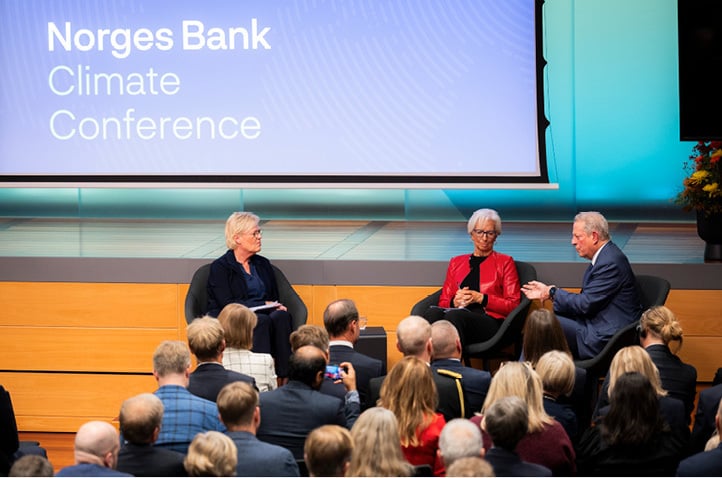
Responsible investment management of the Government Pension Fund Global
The objective for the management of the Government Pension Fund Global (GPFG) is to achieve the highest possible return with acceptable risk. Responsible investment supports the objective in two ways. First, by promoting long-term value creation, and second, by reducing the financial risk associated with environmental and social factors in companies.
Work on responsible investment can be divided into three main areas: the market, the portfolio and the companies.
The market
Working towards common standards
By participating in 68 national markets, the GPFG is a beneficiary of well-functioning and legitimate markets, global solutions to common challenges and recognised international standards. NBIM therefore looks to global solutions to solve common challenges such as climate change. In 2025, Norges Bank participated in 34 public consultations related to responsible investment management. All consultation responses are published on NBIM’s website. The consultations include significant issues such as corporate reporting, corporate governance, shareholder rights and climate and environmental reporting.
Clear expectations
Since 2008, NBIM has formulated clear expectations as to how investee companies should address relevant sustainability challenges in their operations and has emphasised that their boards should establish appropriate strategies, control functions and reporting procedures.
NBIM has also presented its positions on various corporate governance issues in order to enhance corporate governance and protect shareholder interests.
For more information on the responsible investment management of the GPFG, visit nbim.no.

Portfolio
Identifying and managing risk
When companies presumed to have heightened environmental social and governance (ESG) risk are identified, further analysis is conducted to assess whether dialogue should be initiated with the company, whether Norges Bank’s voting should be affected or whether Norges Bank should divest from the company due to the risk. Relevant information is also shared with the Council on Ethics, an independent body established by the Ministry of Finance.
Risk-based divestment
In 2025, Norges Bank divested from 58 companies following risk assessments related to ESG issues. The Bank has divested from a total of 633 companies since 2012. Since 2012, risk-based divestments have contributed positively to the cumulative return on equity management by 0.68 percentage point, or about 0.01 percentage point annually. In 2025, 14 companies were reincluded in Norges Bank’s investment universe following the reversal of divestment decisions. In total, 39 companies have been reincluded since 2012.
Read more about risk-based divestment at nbim.no.
Investment in renewable energy
Up to 2% of the GPFG may also be invested in unlisted renewable energy infrastructure. At the end of 2025, these investments accounted for 0.4% of the GPFG, up from 0.1% in 2024. For each investment, Norges Bank conducts due diligence assessments of risk factors related to health, security, environmental, corporate governance and social issues. In 2025, Norges Bank invested in two offshore wind projects under construction in Denmark and Germany and entered into agreements to invest in Brookfield Asset Management’s global energy transition Fund. In addition, Norges Bank entered an agreement to invest in the German electrical transmission system operator TenneT Germany. The investment will contribute to the expansion and maintenance of German electrical grid infrastructure.
Read more about renewable energy investments at nbim.no.
Companies
Dialogue
As a long-term investor, Norges Bank regularly meets with portfolio companies to promote good corporate governance, sustainable business models and responsible business conduct. A broad range of themes that are crucial for long-term value-creation are discussed. The aim is to improve value creation and reduce risk. In 2025, a total of 3 198 meetings were held with 1 341 investee companies. ESG-related topics were discussed at 1 498 meetings with 815 companies, accounting for 61% of the value of the equity portfolio.
Read more about the Bank’s dialogue with companies at nbim.no.
Voting
Voting is one of the most important shareholder tools to safeguard the GPFG’s assets. In 2025, Norges Bank voted on 108 325 proposals at 10 873 shareholder meetings. NBIM’s voting guidelines are publicly available.
Since 2021, NBIM has published its voting intentions five days before each shareholder meeting with a brief explanation for votes against the board’s recommendations. The GPFG’s voting intentions are available on NBIM’s website.
Read more about voting at nbim.no.
Ethical assessments
Up until November 2025, Norges Bank’s Executive Board decided whether to exclude companies from the GPFG’s investment universe or to place them under observation in line with the ethical guidelines established by the Ministry of Finance. The Board’s observation or exclusion decisions were made based on recommendations from the independent Council on Ethics, appointed by the Ministry. Norges Bank’s recommendations were used for the product-based coal criterion.
In November 2025, the government appointed a committee to evaluate the ethical framework. The committee will submit its report before 15 October 2026. Until a new framework is in place, the Ministry of Finance has established interim ethical guidelines.
Under the interim guidelines, Norges Bank cannot make decisions to exclude or place under observation but can revoke previous observation and exclusion decisions. The Council on Ethics will continue to monitor GPFG investments and inform the Bank about companies that have been identified for potential ownership activities.
Under the guidelines applicable up until November 2025, the Bank announced the exclusion of ten companies, the placement of three companies under observation, the revocation of the exclusion of one company and the closure of the observation of one company. Norges Bank was also in the process of excluding five companies when the interim guidelines entered into force.
Since 2006, the equity benchmark index has returned 2.42 percentage point less than it would have done without any ethical exclusions. On an annualised basis, the return has been 0.03 percentage point lower.
Read more about ethical assessments at nbim.no.

Work on climate risk in the Government Pension Fund Global
In 2025, NBIM published its 2030 Climate Action Plan, which builds on the results of its 2025 Climate Action Plan. The core of NBIM’s work will be active ownership to support portfolio companies in transitioning their business models to achieve net zero by 2050. Looking ahead, focus on nature, physical climate risk, adaptation and resilience, in standard-setting, risk management and engagement, will be strengthened.
Weighted according to emissions, about 73% of the fund’s investee companies’ financed emissions (scopes 1 and 2) are covered by science-based targets at year-end 2025.

Reporting on climate risk
The 2030 Climate action plan also facilitates more reporting on climate risk in the portfolio and measures implemented to handle related risks and opportunities in line with leading international standards. The GPFG’s carbon footprint is measured and stress test results against various climate scenarios are presented, including one consistent with global warming of 1.5 degrees Celsius.
Measuring carbon footprint
Carbon footprint analyses provide insight into the extent of greenhouse gas emissions of investee companies and into risks and opportunities across sectors. There are still many companies that do not report their emission data or whose reporting still varies in frequency and quality, particularly with regard to scope 3 emissions. This is why Norges Bank exclusively uses modelled figures from its data provider in the calculation of scope 3 emissions.
Norges Bank’s reporting of the GPFG’s financed emissions is in line with guidance from the Partnership for Carbon Accounting Financials (PCAF). The Bank has used a single source for reported and estimated emission data, as recommended by the PCAF.
Indicators for measuring climate risk
In accordance with the Greenhouse Gas (GHG) Protocol, emission measurements are divided into three scopes, depending on how closely related they are to the process or activity:
Scope 1 comprises all direct GHG emissions
Scope 2 comprises all indirect GHG emissions from purchased electricity
Scope 3 comprises other indirect emissions
Emissions intensity
Emissions intensity is an indicator for calculating the GHG emission intensity of a process, activity, service rendered or a portfolio of financial assets. Emissions intensity is used by asset managers to express the carbon footprint of investment portfolios, as recommended by the Task Force on Climate-related Financial Disclosures (TCFD). In manufacturing, emissions intensity is expressed in CO2 equivalent per unit of output (kg, litre, kwh). In equity management, emissions intensity is used to understand the volume of emissions related to earnings of investee companies. Norges Bank reports annually on the emissions intensity of the GPFG’s equity and corporate bond portfolio and the equity portfolio of the foreign exchange reserves, for scopes 1 and 2. Emissions intensity is calculated as emissions of tonnes of CO2 equivalent per USD million of revenue.
Financed GHG emissions
Financed GHG emissions are an alternative indicator originating from the Partnership for Carbon Accounting Financials (PCAF) and their guidelines on how financial institutions should report carbon emissions across asset classes. Norges Bank Investment Management became a formal member of PCAF in 2023. Financed emissions are calculated by multiplying a company’s total emissions by the investor’s financed share of the company’s value, including both equity capital and debt. Norges Bank reports annually on the financed emissions of the GPFG’s equity and corporate bond portfolio and the equity portfolio of the foreign exchange reserves, for scopes 1, 2 and 3.
The GPFG’s financed emissions for scopes 1 and 2 were 51 million tonnes of CO2 equivalent in 2025, which is 4% lower than the corresponding figure for the benchmark index. The financed emissions for scope 3 are estimated at 257 million tonnes of CO2 equivalent. Given regular annual changes to the method for estimating financed scope 3 emissions, the figures are not directly comparable.
Investee companies in the GPFG’s equity portfolio emitted 90 tonnes of CO2 equivalent per million USD in revenue, based on data reported or estimated in 2025. This is referred to as the equity portfolio’s carbon intensity, which was 7% lower than that of the benchmark index in 2025, but 8% higher than in 2024. The latter is partly due to relative growth in utilities related to artificial intelligence. For corporate bonds, the portfolio’s emissions intensity was 92 tonnes of CO2 equivalent per million USD in revenue, which is 15% higher than the emissions intensity of the benchmark index and 3% higher than in 2024.
Work on climate risk in real estate management in the Government Pension Fund Global
The 2025 Climate action plan sets a target for net zero emissions by 2050 for the real estate portfolio and a 40% reduction in operational carbon emissions intensity (scopes 1 and 2) by 2030. These targets were retained in the 2030 Climate Action Plan. From 2019 to 2024, the emissions intensity of the real estate portfolio fell by 25%.
Norges Bank measures transition risk by comparing its unlisted real estate portfolio with emission pathways consistent with global warming of 1.5 degrees Celsius in the Carbon Risk Real Estate Monitor (CRREM). This framework shows when buildings surpass their carbon budgets and helps the Bank prioritise upgrades and investment decisions. By the end of 2024, 40% of the real estate portfolio value was within the carbon budget.
Read more about the work on climate risk in the GPFG in the report Responsible Investment 2025 and the publication on climate and nature-related risk on the GPFG’s website.
Work on climate and climate risk issues in Central Banking
Climate change and measures to mitigate climate change have an impact on the Norwegian and global economy and hence also on Norges Bank’s core task performance.
Increasing the Bank’s understanding of the economic effects of climate change and the energy transition has been a key focus area in the Central Bank’s strategy for the 2023–2025 period. Over these three years, the Bank worked actively to strengthen its expertise and integrate climate and energy transition into the Bank’s analyses. In addition to mention in the Bank’s reports, analyses have been published on Norges Bank’s website in the form of staff memos, working papers and blog posts. See Norges Bank’s webpage on climate change and the economy for an overview. Analyses have also been conducted of climate risks’ effect on the value of the foreign exchange reserves, and new knowledge has also been shared through Norges Bank’s hosting of conferences and the Bank’s participation in the Network for Greening the Financial System (NGFS) has been strengthened.
International cooperation
Since 2018, Norges Bank has been a member of the Network for Greening the Financial System (NGFS), a network for central banks and supervisory authorities. The network provides a forum for sharing experiences and best practices, performing analyses and designing methods for managing environmental and climate risk relevant to financial authorities and the financial sector. Norges Bank also cooperates with the NGFS, the International Banking Research Network (IBRN) and other international institutions and researchers to enhance expertise on the economic effects of climate-related changes.
A week of climate events was held at Norges Bank in October to mark the conclusion of the climate initiative in Strategy 2025 and NBIM’s 2025 Climate Action Plan. The main event was Norges Bank’s Climate Conference, a one-day conference on how climate change and energy transition are impacting the macroeconomy and financial markets. The main speakers were ECB President Christine Lagarde and former US Vice President Al Gore. The conference also featured presentations from leading international researchers. The Climate Week also included a researchers’ workshop on climate risk and financial institutions, held in collaboration with the IBRN, and a student seminar on how Norges Bank addresses climate change and energy transition.
Climate and monetary policy
Climate change and the transition to a low-carbon economy may result in less stable prices, particularly for electricity and food. Demand may change, partly through increased investment in renewable energy and measures to lower emissions. At the same time, potential output may be weakened by extreme weather damage and the phasing out of fossil-based productive capital. Norges Bank is tasked with keeping inflation low and stable and must take into account how such climate-related factors impact the economy when setting the policy rate, as emphasised by the Central Bank governor in her speech “Climate and monetary policy”, held at the NHH Norwegian School of Economics in October.
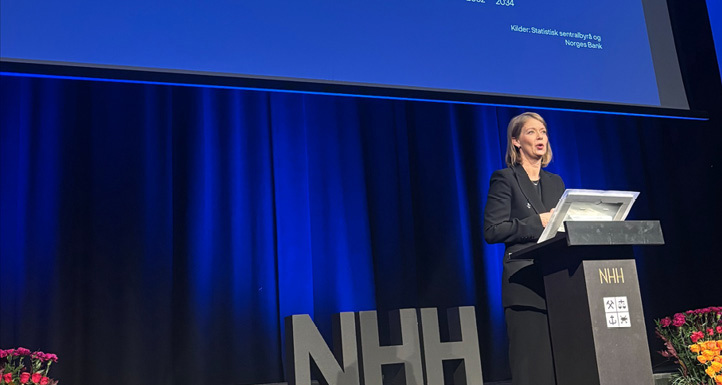
Norges Bank’s Regional Network contacts are asked annually about the effects of climate change and climate transition to gain better insight into the impact on the Norwegian business sector. Survey results show that most firms are affected by the climate transition in some form, for example through climate policies and changes in customer preferences. In addition, an increasing number of firms report that they are affected by changing weather patterns [In Norwegian only]. The results of the surveys indicate that climate-related factors result in an increase in overall business investment [In Norwegian only].
The climate transition is essentially an energy transition. The Bank closely monitors energy investment and energy market developments and analyses how they affect the Norwegian economy. The Bank also assesses how more extreme weather events may impact Norwegian consumer prices. Other climate-related analyses prepared by the Bank examine how climate change affects the long-term interest rate level [in Norwegian only]. There are also a number of ongoing research projects in this area. One examines how extreme weather in Norway affects household finances, while another analyses whether interest rate changes have differing effects on climate-related investment compared with other investments.
Climate risk and financial stability
Climate transition affects banks’ risk assessments through various channels. Climate risk is included as a key vulnerability in Norges Bank’s summary of financial stability assessments.
Adequate information about climate risk may reduce banks’ exposure to losses and help secure the financing of necessary transition measures. In 2025, Norges Bank focused in particular on physical climate risk related to how natural hazards and stormwater intrusion can increase property-related costs. Increased damage resulting from changes in wind and precipitation may increase insurance premiums, particularly for stormwater intrusion damage not covered by the Norwegian Natural Perils Pool. Public infrastructure maintenance and upgrade expenses can be expected to increase in the coming years. Overall, these factors may weaken homeowners’ debt-servicing ability. The Staff Memo “Damage caused by weather and climate change: Identifying homes in areas exposed to weather-related risks in Norway” uses data on stormwater intrusion exposure of dwellings to shed light on these questions.
Central banks use climate stress tests and scenarios to understand the effect of climate change on the financial system. In 2026, Norges Bank plans to use the NGFS short-term scenarios to model economic shocks in the stress test of financial system risk in Financial Stability Report 1/2026.
Responsible investment and climate risk in the foreign exchange reserves
The equity portfolio of the foreign exchange reserves is managed according to the same principles and strategies for responsible investment as the equity investments in GPFG (expectations of investee companies, voting and company dialogue). This means that the GPFG’s climate action plan, including the target that investee companies adjust their operations to ensure compliance with global net zero emissions by 2050, also applies to the equity portfolio of the foreign exchange reserves.
Decisions on risk-based divestment from individual companies implemented for the GPFG’s equity portfolio are also followed up in the equity portfolio of the foreign exchange reserves. In 2025, Norges Bank made one new risk-based divestment in the foreign exchange reserves’ equity portfolio. In addition, two companies were excluded from the foreign exchange reserves’ benchmark index and one new company was placed under observation.
Norges Bank measures greenhouse gas emissions in connection with the entire equity portfolio of the foreign exchange reserves using two different metrics, financed emissions and emissions intensity. The financed emissions of the equity portfolio for scopes 1 and 2 were 413 059 tonnes of CO2 equivalent in 2025. Financed emissions for scope 3 was 1 989 909 tonnes. Emissions intensity for scopes 1 and 2 was 79 tonnes of CO2 equivalent in 2025, 13% higher than in 2024.

Climate impact of Norges Bank’s operations
One of the ambitions in Norges Bank’s sustainability strategy is to reduce emissions from the Bank’s own operations, in line with the Paris Agreement. The Bank annually reports the climate impact of the Bank’s own operations in the carbon accounts. The carbon accounts are prepared in accordance with the Greenhouse Gas Protocol standard and include the offices where Norges Bank has operational control in Oslo, London, New York and Singapore. Norges Bank has selected 2019 as the reference year. This is the most recent year with normal activity and reliable underlying data.
Carbon accounts
Table 13 Annual carbon accounts for Norges Bank’ operations
|
GHG emissions, in tonnes of CO2 equivalent1 |
2019 |
2024 |
2025 |
Change 2024–2025. Percent |
Change 2019–2024. Percent |
|
|---|---|---|---|---|---|---|
|
Direct emissions (scope 1) |
Fuel, combustion vehicles |
20 |
13 |
10 |
-23 |
-50 |
|
Diesel, backup generators |
1 |
6 |
3 |
-50 |
-200 |
|
|
Refrigerants |
- |
- |
57 |
|||
|
Total direct emissions (scope 1) |
|
21 |
19 |
70 |
268 |
233 |
|
Indirect emissions, energy (scope 2) |
Electricity |
745 |
682 |
546 |
-20 |
-27 |
|
District heating |
4 |
30 |
25 |
-17 |
525 |
|
|
Total indirect emissions, energy (scope 2) |
|
749 |
712 |
571 |
-20 |
-24 |
|
Indirect emissions, other (scope 3) |
Air travel |
8 378 |
9 054 |
6 118 |
-32 |
-27 |
|
Hotel stays2 |
450 |
746 |
663 |
-11 |
47 |
|
|
Work-related travel by private car |
11 |
8 |
13 |
63 |
18 |
|
|
Waste |
57 |
2 |
3 |
50 |
-95 |
|
|
Data centres and cloud solutions3 |
- |
130 |
142 |
9 |
||
|
Production of notes4 |
- |
397 |
222 |
-44 |
||
|
Total indirect emissions, other (scope 3) |
|
8 896 |
10 337 |
7 161 |
-31 |
-20 |
|
Total GHG emissions |
|
9 666 |
11 068 |
7 802 |
-30 |
-19 |
1 Includes the gases CO2, CH4, N20, HFCs, PFCs, SF6 og NF3. Norges Bank mainly uses emission factors from the UKs Department for Energy Security & Net Zero’s (DESNZ).
2 From 2024, hotel stays include stays in flats.
3 In 2025, due to weak or deficient data quality, emissions from data centres and cloud solutions have only been confirmed for 92% of emissions. The remainder is data from 2024 without further estimation.
3 Production of banknotes also includes transport in connection with production and delivery to Norges Bank.

Greenhouse gas emissions totalled 7 802 tonnes of CO2 equivalent at the end of 2025. This is a reduction of 19% compared with the reference year 2019 and a reduction of 30% compared with 2024. Excluding emissions sources included in the carbon accounts after 2019, the reduction in emissions from 2019 to 2025 amounts to 3 349 tonnes, or 35%.
Air travel accounted for 78% of Norges Bank’s total emissions in 2025, which is 27% lower than in the reference year 2019 and 32% lower than in 2024. The number of kilometres travelled was reduced by 5% in the period 2019 to 2025. At the same time, the data show a clear 10% increase from 2024 to 2025.
The reduction in air travel emissions from 2024 to 2025 is therefore due to an update of air travel emissions factors1, which were reduced by an average of 29% compared with 2024 factors. If the change in emission factors for air travel is excluded, air travel emissions increased by 12% in 2025.
Norges Bank’s greenhouse gas emission targets and reduction measures
In 2024, the Executive Board set a target to reduce its operational emissions by 35% per permanent employee by 2028. The target is based on emissions from the Bank’s operations in 2019 and is equivalent to a reduction from 10.3 tonnes of CO2 equivalent per employee in 2019 to 6.7 tonnes by 2028.
Table 14 Target attainment and emissions intensity per employee
|
2019 |
2025 |
Change 2019–2025. Percent. |
|
|---|---|---|---|
|
Total GHG emissions |
9 666 |
7 802 |
-19 |
|
Number of permanent employees1 |
940 |
1 125 |
20 |
|
Emissions per employee |
10.3 |
6.9 |
-33 |
1 The number of permanent employees is given as the average of the number of permanent employees at the start and end of the year.
In 2025, Norges Bank’s greenhouse gas emissions per employee came to 6.9 tonnes of CO2 equivalent, a 33% reduction compared with the reference year 2019. From 2019 to 2025, air travel emissions factors declined by an average of 20%, accounting for most of the emission reduction in the period.
In line with the plan for 2025, Norges Bank has emphasised awareness among its employees and improved management information. This work will be further strengthened in 2026.
Limited assurance of sustainability indicators
Norges Bank has engaged EY to perform a limited assurance engagement on sustainability information in Norges Bank’s Annual Report for 2025. See EY’s report, Independent accountant’s assurance report.
Norges Bank does not continually refer to sustainability indicators in its Annual Report. The table below refers to the reporting standards and indicators on which the information is based. Reported information is for the period between 1 January 2025 and 31 December 2025. Information provided is attested by EY.
1 Air travel emissions are the product of activity data and emissions factors. Air travel emissions factors are from the DESNZ and are based on observable and quality-assured data, not realtime data. The previous set of air travel emissions factors was from 2021 data, when the number of passengers per flight had been reduced due to covid-19. This resulted in higher emissions per passenger. Updated emissions factors use data from 2023, and the higher number of passengers results in lower emissions per passenger.
|
Reporting standard |
Indicator |
Description |
|---|---|---|
|
Society and social conditions |
||
|
Salary mapping |
||
|
GRI 405: Diversity and equal opportunity 2016 |
405-2 Ratio of basic salary and remuneration of women to men |
Salary gaps per job category, tables 9–12 |
|
Climate and environment |
||
|
Responsible investment management of the Government Pension Fund Global |
||
|
GRI 415: Public Policy 2016 |
415-1 Political contributions |
Participation in number of public consultations related to responsible investment management: 34 (Norges Bank has made no political monetary contributions) |
|
GRI G4: Financial Services Sector Disclosures 2014 |
FS10 Percentage and number of companies held in the institution’s portfolio with which the reporting organisation has interacted on environmental or social issues |
Number of meetings held with companies: 1 498 meetings with 815 companies (11.3% of all companies). |
|
GRI G4: Financial Services Sector Disclosures 2014 |
FS11 Percentage of holdings subject to positive and negative environmental or social screening |
Number of companies Norges Bank divested from following risk assessments related to ESG issues: 58 |
|
Number of excluded companies: 10 |
||
|
Number of new companies placed under observation: 3 |
||
|
Work on climate risk in the Government Pension Fund Global |
||
|
Climate-related disclosures1 |
Financed emissions Asset management |
Financed emissions – equity and fixed income portfolio: Scopes 1 and 2: 51 million tonnes of CO2 equivalent |
|
Financed emissions – equity and fixed income portfolio: Scope 3: 257 million tonnes of CO2 equivalent |
||
|
GRI 305: Emissions 2016 |
305-4 GHG emissions intensity |
Emissions intensity – equity portfolio: Scopes 1 and 2: 90 tonnes of CO2 equivalent |
|
Emissions intensity – fixed income portfolio – Scopes 1 and 2: 92 tonnes of CO2 equivalent |
||
|
Work on climate and climate risk in Central Banking |
||
|
Responsible management and climate risk in the foreign exchange reserves |
||
|
Climate-related disclosures2 |
Financed emissions Asset management |
Financed emissions – equity portfolio: Scopes 1 and 2: 413 059 tonnes of CO2 equivalent |
|
Financed emissions – equity portfolio: Scope 3: 1 989 909 tonnes of CO2 equivalent |
||
|
GRI 305: Emissions 2016 |
305-4 GHG emissions intensity |
Emissions intensity – equity portfolio – Scopes 1 and 2: 79 tonnes of CO2 equivalent |
|
GRI G4: Financial Services Sector Disclosures 2014 |
FS11 Percentage of holdings subject to positive and negative environmental or social screening |
Number of companies Norges Bank divested from following risk assessments related to ESG issues: 1 |
|
Number of excluded companies: 2 |
||
|
Climate impact of Norges Bank’s operations |
||
|
Carbon accounts |
||
|
GRI 305: Emissions 2016 |
305-1 Direct GHG emissions (Scope 1) |
70 tonnes of CO2 equivalent |
|
305-2 Indirect GHG emissions, energy (Scope 2) |
571 tonnes of CO2 equivalent |
|
|
305-3 Indirect GHG emissions, other (Scope 3) |
7 161 tonnes of CO2 equivalent |
|
Financial statements

Main points
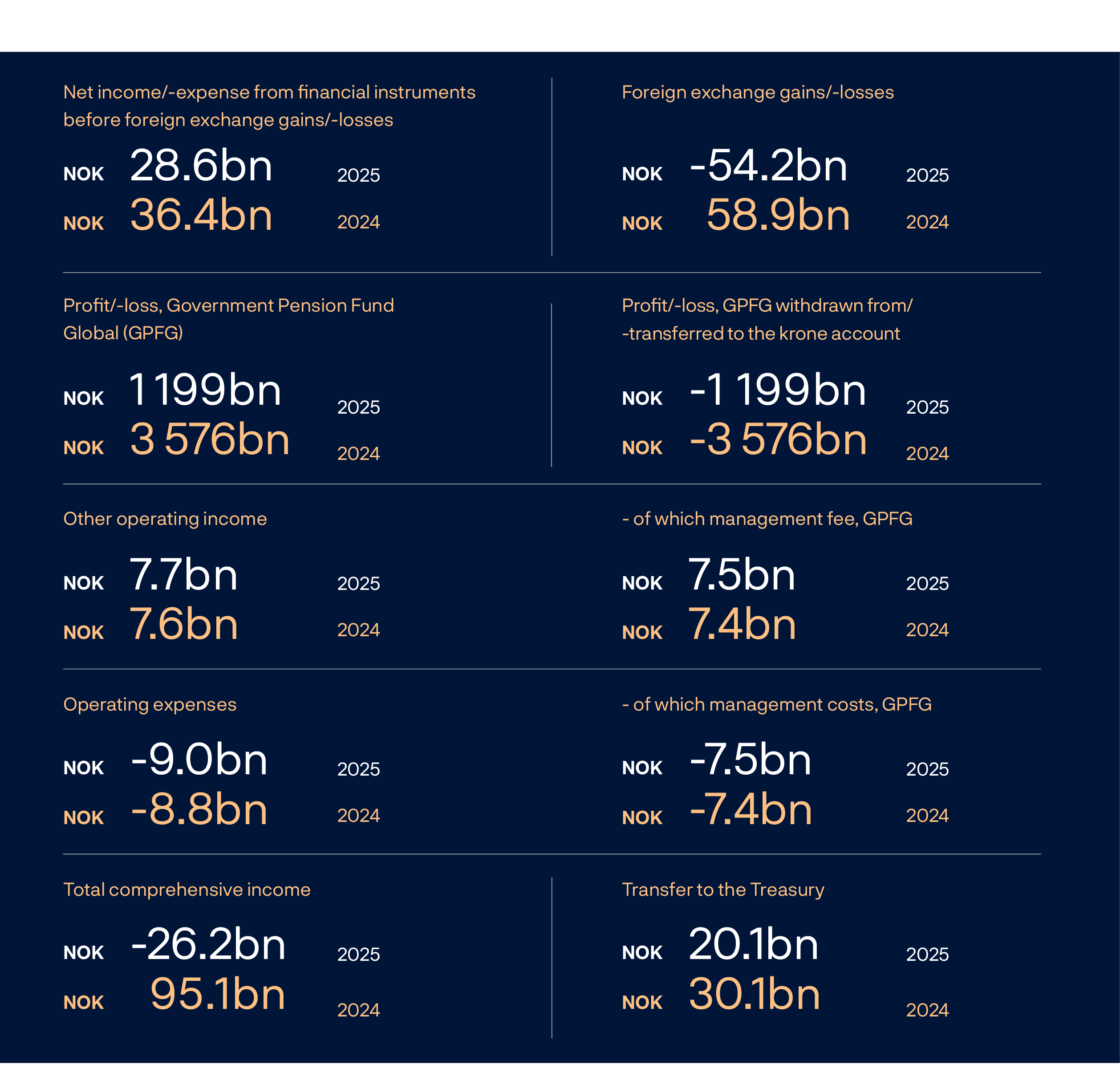
Financial statements
Income statement
|
Amounts in NOK million |
Note |
2025 |
2024 |
|---|---|---|---|
|
Net income/-expense from financial instruments |
|||
|
Net income/-expense from: |
|||
|
-Equities |
3,5 |
17 944 |
39 692 |
|
-Bonds |
3,5 |
22 798 |
9 130 |
|
-Financial derivatives |
5 |
-193 |
-93 |
|
-Secured lending |
9 |
1 695 |
2 276 |
|
Interest income from deposits in banks |
11 |
865 |
1 063 |
|
Interest income from lending to banks |
12 |
3 |
191 |
|
Interest expense on deposits from banks |
12 |
-5 780 |
-3 039 |
|
Interest expense on deposits from the Treasury |
12 |
-9 369 |
-13 818 |
|
Interest income from the IMF |
14 |
4 030 |
5 456 |
|
Interest expense to the IMF |
14 |
-3 285 |
-4 436 |
|
Tax expenses |
3 |
-41 |
-32 |
|
Other financial income/-expense |
-33 |
8 |
|
|
Net income/-expense from financial instruments before foreign exchange gains/-losses |
28 634 |
36 398 |
|
|
Foreign exchange gains/-losses |
8 |
-54 169 |
58 892 |
|
Net income/-expense from financial instruments |
-25 535 |
95 290 |
|
|
Other operating income |
|||
|
Management fee, GPFG |
19 |
7 537 |
7 390 |
|
Other operating income |
17 |
200 |
183 |
|
Total other operating income |
7 737 |
7 574 |
|
|
Operating expenses |
|||
|
Personnel expenses |
15 |
-3 381 |
-3 051 |
|
Other operating expenses |
17 |
-5 483 |
-5 585 |
|
Depreciation, amortisation and impairment losses |
18 |
-137 |
-140 |
|
Total operating expenses |
-9 001 |
-8 776 |
|
|
Management of the Government Pension Fund Global (GPFG) |
|||
|
Total comprehensive income, GPFG |
20 |
1 199 296 |
3 575 870 |
|
Withdrawn from/-transferred to the krone account of the GPFG |
20 |
-1 199 296 |
-3 575 870 |
|
Profit/-loss for the period |
-26 799 |
94 088 |
|
|
Statement of comprehensive income |
|||
|
Profit/-loss for the period |
-26 799 |
94 087 |
|
|
Change in actuarial gains/-losses |
16 |
613 |
1 021 |
|
Total comprehensive income |
-26 186 |
95 108 |
Balance sheet
|
Amounts in NOK million |
Note |
31.12.2025 |
31.12.2024 |
|---|---|---|---|
|
Assets |
|||
|
Financial assets |
|||
|
Deposits in banks |
11 |
10 382 |
13 089 |
|
Secured lending |
9,10 |
43 321 |
64 874 |
|
Cash collateral posted |
9,10 |
9 |
8 |
|
Unsettled trades |
7 270 |
164 |
|
|
Equities |
4,7 |
160 878 |
154 301 |
|
Equities lent |
4,7,9,10 |
3 586 |
3 176 |
|
Bonds |
4,6,7 |
554 540 |
591 981 |
|
Financial derivatives |
6 |
7 |
3 |
|
Lending to banks |
12 |
2 052 |
2 920 |
|
Claims on the IMF |
14 |
136 025 |
145 855 |
|
Other financial assets |
19 |
8 237 |
960 |
|
Total financial assets |
926 307 |
977 331 |
|
|
Non-financial assets |
|||
|
Pensions |
16 |
1 960 |
1 306 |
|
Non-financial assets |
18 |
2 240 |
2 149 |
|
Total non-financial assets |
4 200 |
3 455 |
|
|
Net value, GPFG |
20 |
21 267 886 |
19 741 590 |
|
Total assets |
22 198 393 |
20 722 376 |
|
|
Liabilities and equity |
|||
|
Financial liabilities |
|||
|
Secured borrowing |
9,10 |
92 |
21 |
|
Unsettled trades |
9,10 |
34 128 |
37 861 |
|
Financial derivatives |
13 |
10 |
|
|
Deposits from banks |
12 |
218 147 |
91 465 |
|
Deposits from the Treasury |
12 |
165 633 |
274 015 |
|
Notes and coins in circulation |
13 |
37 578 |
38 221 |
|
Liabilities to the IMF |
14 |
109 937 |
118 213 |
|
Other financial liabilities |
3 233 |
3 164 |
|
|
Total financial liabilities |
568 761 |
562 970 |
|
|
Other liabilities |
|||
|
Pensions |
16 |
- |
- |
|
Other liabilities |
19 |
21 048 |
30 864 |
|
Total other liabilities |
21 048 |
30 864 |
|
|
Deposits in krone account, GPFG |
20 |
21 267 886 |
19 741 590 |
|
Total liabilities |
21 857 695 |
20 335 424 |
|
|
Equity |
340 698 |
386 952 |
|
|
Total liabilities and equity |
22 198 393 |
20 722 376 |
Oslo, 5 February 2026
Ida Wolden Bache (sign)
(Governor / Chair of the Executive Board)
Pål Longva (sign)
(First Deputy Chair)
Øystein Børsum (sign)
(Second Deputy Chair)
Kristine Ryssdal (sign)
Arne Hyttnes (sign)
Nina Udnes Tronstad (sign)
Hans Aasnæs (sign)
Thomas Ekeli (sign)
Ragnhild Janbu Fresvik (sign)
Mats Bay Fevolden (sign)
(Employee representative)
Guro Heimly (sign)
(Employee representative)
Statement of cash flows
|
Amounts in NOK million, inflows (+)/outflows (-) |
Note |
2025 |
2024 |
|---|---|---|---|
|
Operating activities |
|||
|
Receipts of dividend from equities |
2 616 |
2 825 |
|
|
Receipts of interest from bonds |
12 693 |
10 221 |
|
|
Net receipts of interest and fee from secured lending and borrowing |
1 695 |
2 284 |
|
|
Receipts of dividend, interest and fee from holdings of equities and bonds |
17 004 |
15 330 |
|
|
Net cash flow from purchase and sale of equities |
2 747 |
28 800 |
|
|
Net cash flow from purchase and sale of bonds |
5 910 |
-41 216 |
|
|
Net cash flow financial derivatives |
-607 |
-146 |
|
|
Net cash flow secured lending and borrowing |
8 488 |
-1 602 |
|
|
Interest received |
5 086 |
6 835 |
|
|
Interest paid |
-18 537 |
-21 374 |
|
|
Net cash flow related to other expenses, other assets and other liabilities |
-9 497 |
-8 642 |
|
|
Net cash flow related to other financial assets and other financial liabilities |
127 507 |
30 998 |
|
|
Net cash flow to/-from the Treasury |
218 315 |
403 563 |
|
|
Inflow from the Norwegian government to the GPFG |
19 |
-326 697 |
-411 365 |
|
Withdrawals by the Norwegian government from the GPFG |
19 |
- |
- |
|
Management fee received from the GPFG |
19 |
190 |
7 032 |
|
Net cash flow from operating activities |
29 909 |
8 214 |
|
|
Investing activities |
|||
|
Net cash flow related to non-financial assets and liabilities |
18 |
-220 |
-198 |
|
Net cash flow from investing activities |
-220 |
-198 |
|
|
Financing activities |
|||
|
Cash flow from the Transfer Fund to the Treasury |
19 |
-30 103 |
-17 604 |
|
Net cash flow from financing activities |
-30 103 |
-17 604 |
|
|
Net change in cash |
|||
|
Deposits in banks at 1 January |
11 |
13 089 |
20 792 |
|
Net increase/-decrease of cash in the period |
-414 |
-9 588 |
|
|
Net foreign exchange gains and losses on cash |
-2 293 |
1 885 |
|
|
Deposits in banks at 31 December |
11 |
10 382 |
13 089 |
The statement of cash flows has been prepared in accordance with the direct method. Major classes of gross payments are presented separately, with the exception of specific transactions primarily arising from the purchase and sale of financial instruments, which are shown net.
Transfers between the GPFG and the Norwegian government are classified as a financing activity in the statement of cash flows in the GPFG’s financial statements. In Norges Bank’s financial statements, transfers are classified as operating activities, since Norges Bank is the manager of the GPFG.
Statement of changes in equity
|
Amounts in NOK million |
Adjustment Fund |
Transfer Fund |
Total equity |
|---|---|---|---|
|
1 January 2024 |
286 739 |
35 208 |
321 947 |
|
Total comprehensive income |
40 008 |
55 100 |
95 108 |
|
31 December 2024 before transfer to the Treasury |
326 747 |
90 308 |
417 055 |
|
Transferred to the Treasury |
- |
-30 103 |
-30 103 |
|
31 December 2024 |
326 747 |
60 205 |
386 952 |
|
1 January 2025 |
326 747 |
60 205 |
386 952 |
|
Total comprehensive income |
-26 186 |
- |
-26 186 |
|
31 December 2025 before transfer to the Treasury |
300 561 |
60 205 |
360 766 |
|
Transferred to the Treasury |
- |
-20 068 |
-20 068 |
|
31 December 2025 |
300 561 |
40 137 |
340 698 |
Norges Bank’s equity comprises an Adjustment Fund and a Transfer Fund. The Adjustment Fund comprises the Bank’s restricted equity, and the Transfer Fund comprises the basis for transfers to the Treasury. Norges Bank’s capital is governed by the Guidelines for provisions and allocations of Norges Bank’s profit or loss laid down on 13 December 2019, pursuant to section 3-11, sub-section 2, of the Central Bank Act.
Notes
Note 1 General information
Introduction
Norges Bank is Norway’s central bank. The Bank is a separate legal entity and is owned by the State. The Bank’s main office is at Bankplassen 2 in Oslo, Norway.
Norges Bank shall promote economic stability and manage substantial assets on behalf of the nation. The Bank conducts monetary policy, monitors financial stability, promotes robust and efficient payment systems and financial markets and manages Norway’s foreign exchange reserves.
Norges Bank manages the Government Pension Fund Global (GPFG) on behalf of the Ministry of Finance in accordance with section 3, second paragraph, of the Government Pension Fund Act and the management mandate for the GPFG issued by the Ministry of Finance.
The GPFG shall support government saving to finance future expenditure and underpin long-term considerations relating to the use of Norway’s petroleum revenues. The Storting (Norwegian Parliament) has established the legal framework in the Government Pension Fund Act, and the Ministry of Finance has formal responsibility for the fund’s management. The Executive Board of Norges Bank has delegated day-to-day management of the GPFG to Norges Bank Investment Management (NBIM).
The Ministry of Finance has placed funds for investment in the GPFG in the form of a Norwegian krone deposit with Norges Bank (the krone account). Norges Bank manages the krone account in its own name by investing the funds in an investment portfolio consisting of equities, bonds, real estate and renewable energy infrastructure. The GPFG is invested in its entirety outside of Norway.
Transfers are made to and from the krone account in accordance with the management mandate. When the Norwegian State’s petroleum revenue exceeds the use of petroleum revenue in the fiscal budget, deposits will be made into the krone account. In the opposite situation, withdrawals will be made. Transfers to and from the krone account lead to a corresponding change in Owner’s capital in the GPFG , see note 20 Statement of changes in owner’s capital.
Norges Bank is not exposed to financial risk from its management of the GPFG. The return on the portfolio, less the management fee to Norges Bank, is transferred in its entirety to the krone account and does not affect total comprehensive income or equity in Norges Bank. The investment portfolio under management is equal to the amount on deposit in the krone account at the time in question, less the accrued management fee and deferred tax. This is presented on a separate line as an asset in Norges Bank’s balance sheet, and the krone account is presented as a liability in the same amount to the Ministry of Finance. For further information about the management mandate for the GPFG, Norges Bank’s governance structure and risk management see note 20.9 Investment risk. For further information about transactions between Norges Bank and the GPFG, see note 19 Related parties.
Approval of the financial statements
The annual financial statements of Norges Bank for 2025 were approved by the Executive Board on 5 February 2026 and approved by the Supervisory Council on 26 February 2026. The annual financial reporting for the GPFG is an excerpt of Norges Bank’s financial reporting and is included in Norges Bank’s annual financial statements as note 20 Government Pension Fund Global (GPFG).
Norges Bank’s total comprehensive income of NOK -26.2 billion will be covered by a transfer from the Adjustment Fund of NOK 26.2 billion. NOK 20.1 billion will be transferred from the Transfer Fund to the Treasury. The annual transfers and allocations for 2025 were made in accordance with the guidelines.
Note 2 Accounting policies
This note describes accounting policies, significant estimates and accounting judgements that are relevant to the financial statements as a whole and the accounting policies that are relevant for investments in subsidiaries as part of the management of the GPFG. Additional accounting policies, significant estimates and accounting judgements are included in the respective statements and notes.
Significant estimates and accounting judgements
The preparation of the financial statements involves the use of uncertain estimates and assumptions relating to future events that affect the reported amounts for assets, liabilities, income and expenses. Estimates are based on historical experience and reflect management’s expectations about future events. Actual outcomes may deviate from estimates. The preparation of the financial statements also involves the use of judgement when applying accounting policies, which may have a significant impact on the financial statements.
In cases where there are particularly uncertain estimates or accounting judgements, this is described in the respective notes.
Basis of preparation
Pursuant to section 4-3 of the Central Bank Act, the annual financial statements of Norges Bank have been prepared in accordance with the Accounting Act and Regulation on the financial reporting for Norges Bank (the Regulation), laid down by the Ministry of Finance.
The Regulation entails that the financial reporting of the GPFG is prepared in accordance with IFRS Accounting Standards as adopted by the EU, subject to the additions and exemptions specified in the Accounting Act and the Regulation. It sets forth that the return on the investment portfolio and the return assigned to the krone account of the GPFG shall be presented on separate lines in the income statement. Furthermore, the net value of the GPFG and the deposits in the krone account of the GPFG shall be presented on separate lines in the balance sheet, inflows to and withdrawals from the krone account of the GPFG shall be presented on separate lines in the statement of cash flows. In addition, the annual financial reporting of the GPFG shall be presented in a separate note in Norges Bank´s annual financial statements, see note 20 Government Pension Fund Global (GPFG). Moreover, subsidiaries that are included in the consolidation for the preparation of consolidated financial reporting for the investment portfolio are excluded from the consolidation in Norges Bank’s annual financial statements. See also section Accounting policies for investments in subsidiaries as part of the management of the GPFG below for the consolidation of certain subsidiaries in the GPFG.
The income statement is presented in a manner that provides the most relevant information about the Bank’s financial performance.
The annual financial statements are prepared with a closing date of 31 December, and are presented in Norwegian kroner (NOK), and unless otherwise stated, rounded to the nearest million. Rounding differences may occur.
Norges Bank’s annual financial statements are prepared under a going concern basis.
Changes in accounting policies, including new and amended standards and interpretations in the period
Accounting policies applied are consistent with the policies applied in the previous accounting year. There are no new or amended IFRS standards and interpretations that have become effective for the accounting year beginning on 1 January 2025 that have had any material effect on the Bank’s financial statements.
New and amended standards and interpretations effective from 2026 or later
IFRS 18 Presentation and Disclosure in Financial Statements
In 2024, the IASB issued a new accounting standard, IFRS 18 Presentation and Disclosure in Financial Statements. IFRS 18 will replace IAS 1 Presentation of Financial Statements. The new standard applies to annual reporting periods beginning on or after 1 January 2027. The new standard introduces several new requirements for the presentation of the financial statements and note disclosures. The most relevant are:
- A requirement to classify all income and expenses into five categories in the income statement: operating, investing, financing, income taxes, and discontinued operations.
- A requirement to present a defined operating profit subtotal.
- A requirement to disclose items defined as Management-defined Performance Measures (MPMs) in a single note in the financial statements.
Norges Bank has started the assessment of the new requirements in IFRS 18. Recognition and measurement will remain unchanged and the implementation of IFRS 18 will therefore not have an impact on Profit/-loss for the period, Total comprehensive income or Equity/Owner’s capital.
The preliminary assessment is that the Bank’s main activities – investments in the foreign exchange reserves and the provision of deposits and loans to banks – meet the definition of “main business activity” under IFRS 18. Likewise, the GPFG is considered to be an entity that invests in assets as a main business activity. Accordingly, income and expense items related to these activities will primarily be classified in the operating category in the income statement. Other income and expenses that do not fall within the operating category – such as Change in actuarial gains/-losses – are assessed to be immaterial.
IFRS 18 will be implemented from the effective date, with retrospective application as required.
Other
Other issued IFRS standards, changes in existing standards and interpretations issued with effective dates from 2026 or later are expected to be immaterial or not applicable for the Bank’s financial reporting at the time of implementation.
Accounting policies for the financial statements as a whole
Financial assets and liabilities
Recognition and derecognition
Financial assets and liabilities are recognised in the balance sheet upon becoming a party to the instrument’s contractual provisions.
Financial assets are derecognised when the contractual rights to the cash flows expire, or when the financial assets and substantially all the risks and rewards of ownership are transferred. See note 9 Secured lending and borrowing and note 20.13 Secured lending and borrowing for details on transferred assets that are not derecognised.
Financial liabilities are derecognised when the obligation is extinguished, i.e. when the obligation specified in the contract is discharged, cancelled or expires.
Purchase or sale of a financial asset where the contractual terms require settlement in accordance with normal market conditions, is recognised on the trade date.
Classification and measurement
Financial assets are classified based on the business model used for managing the assets and their contractual cash flow characteristics. Measurement at amortised cost requires that the contractual cash flows consist solely of payments of principal and interest (SPPI). Assets measured at amortised cost predominantly comprise Claims on the IMF and are assessed to satisfy the SPPI requirement. The interest terms applicable to IMF claims are standardized and determined with reference to internationally established market benchmarks, including the SDR interest rate, and contain no embedded options or features that introduce risks beyond principal and interest. Claims on the IMF are therefore measures at amortised cost in accordance with IFRS 9.
The investment portfolio of the GPFG is managed in accordance with the management mandate issued by the Ministry of Finance, the investment mandate issued by the Executive Board of Norges Bank and investment strategies issued by the management of NBIM. These mandates and strategies, including the risk management strategies, entail that financial assets are managed and evaluated on a fair value basis. The financial assets in the GPFG are therefore measured at fair value through profit or loss, except for Management fee receivable, which is not part of the investment portfolio. Management fee receivable is measured at amortised cost.
The foreign exchange reserves are managed in accordance with the principles issued by the Executive Board and are managed and their performance evaluated on a fair value basis. Other financial assets are measured at amortised cost.
Financial liabilities are measured at amortised cost, except for financial liabilities designated as at fair value through profit or loss. This applies to financial liabilities in the foreign exchange reserves that are managed and their performance evaluated on a fair value basis. For the GPFG, financial liabilities, except for Management fee payable and Deferred tax, are integrated into the investment portfolio that is managed and evaluated on a fair value basis, and are therefore designated at fair value through profit or loss. Management fee payable is measured at amortised cost. See note 20.10 Tax for information about the recognition and measurement of Deferred Tax.
Financial derivatives are measured at fair value through profit or loss.
For further specification of the classification of financial instruments, see note 6 Measurement and table 6.2 Classification of financial instruments.
Impairment
For financial assets classified as measured at amortised cost, an allowance for expected credit losses is recognised. Expected credit losses are estimated per loan and are based on the loan’s exposure at default, probability of default and loss given default. The recognised amount comprises expected credit losses within the 12 months after the reporting date. In the event of a substantial increase in credit risk since initial recognition, an expected loss allowance is recognised over the expected life of the asset.
Accounting policies for investments in subsidiaries as part of the management of the GPFG
The GPFG is an investment entity in accordance with IFRS 10 Consolidated financial statements. IFRS 10 defines an investment entity and introduces a mandatory exemption from consolidation for investment entities.
Accounting judgement
The GPFG is an investment entity based on the following:
a) It obtains funds from the Norwegian government, a related party and its sole owner, and delivers professional investment services, in the form of management of the fund, to the Norwegian government,
b) It commits to the Norwegian government that its business purpose is to invest solely for capital appreciation and investment income,
c) It measures and evaluates returns for all its investments exclusively on a fair value basis.
The GPFG does not have an explicit strategy that defines a specific timeframe for the realisation of each individual investment, but the investments are assessed continuously, and purchase and sale assessments are made. Following an overall assessment, it has been concluded that the GPFG meets the criteria in the definition of an investment entity.
Investments in real estate and renewable energy infrastructure are made through subsidiaries of Norges Bank, which are exclusively established as part of the management of the fund. Subsidiaries are controlled by the GPFG and are included in the financial reporting for the GPFG in accordance with section 3-4 of the Regulation. For further information, see note 20.16 Interests in other entities.
Subsidiaries measured at fair value through profit or loss
Subsidiaries that invest in real estate or renewable energy infrastructure through ownership interests in other entities, are investment entities. These subsidiaries are measured at fair value through profit or loss in accordance with the principles for financial assets. Subsidiaries that invest in real estate and renewable energy infrastructure are presented in the balance sheet of the GPFG as Unlisted real estate and Unlisted infrastructure, respectively. See note 20.6 Unlisted real estate and note 20.7 Unlisted renewable energy infrastructure for supplementary policies.
Consolidated subsidiaries
Subsidiaries that perform investment-related services, and which are not investment entities themselves, are consolidated. Consolidated subsidiaries do not own, neither directly nor indirectly, investments in real estate or infrastructure for renewable energy.
Note 3 Income/expense from equities and bonds
Accounting policy
Investments in equities and bonds are measured at fair value through profit or loss. For further information, see note 2 Accounting policies.
Dividends are recognised when the dividends are formally approved by the shareholders’ meeting or comparable responsible party.
Interest income is recognised when the interest is accrued. Interest expense is recognised as incurred. The measurement of interest income and expense is based on contractual terms.
Realised gain/-loss primarily represents amounts realised when assets or liabilities have been derecognised. Average acquisition cost is assigned at derecognition. Realised gain/-loss includes transaction costs, which are expensed as incurred. Transaction costs are defined as all costs directly attributable to the completed transaction. For investments in equities and bonds, these normally include commission fees and stamp duties.
Unrealised gain/-loss represents changes in fair value for the period for the related balance sheet line item that are not attributable to the aforementioned categories.
Table 3.1 Income/-expense from equities
|
Amounts in NOK million |
2025 |
2024 |
|---|---|---|
|
Dividends |
2 610 |
2 850 |
|
Realised gain/-loss |
5 025 |
19 038 |
|
Unrealised gain/-loss |
10 309 |
17 804 |
|
Income/-expense from equities before foreign exchange gains/-losses |
17 944 |
39 692 |
Table 3.2 Income/-expense from bonds
|
Amounts in NOK million |
2025 |
2024 |
|---|---|---|
|
Interest |
12 874 |
11 261 |
|
Realised gain/-loss |
-1 280 |
-2 319 |
|
Unrealised gain/-loss |
11 204 |
188 |
|
Income/-expense from bonds before foreign exchange gains/-losses |
22 798 |
9 130 |
Tax expense
Norges Bank is exempt from income tax on its operations in Norway but is liable to taxes in some other jurisdictions. Tax expense comprises income tax that will not be refunded under local tax rules or tax treaties to Norges Bank. This pertains primarily to withholding tax on dividends related to the foreign exchange reserves’ equity investments.
Accounting policy
Withholding tax, after deduction of refunded amounts, is recognised at the same time as the related dividend. Refundable withholding tax is recognised in the balance sheet as a receivable under Other financial assets.
Tax expense was NOK 41 million in 2025, compared with NOK 32 million in 2024.
Germany and Japan are the markets with the highest tax expense, amounting to NOK 13 million and NOK 12 million in 2025, respectively, compared with NOK 16 million and NOK 12 million in 2024, respectively. Norway’s tax treaties with these countries entail a tax rate of 15 percent. Tax expense in other respects refers to smaller amounts divided among several other jurisdictions.
Accounting policies for taxation are further detailed in note 20.10 Tax.
Note 4 Holdings of equities and bonds
Accounting policy
Investments in equities and bonds are measured at fair value through profit or loss. All equity investments, except for equities in the BIS, are in the foreign exchange reserves. Changes in fair value for the period are recognised in the income statement and specified in note 3 Income/expense from equities and bonds.
Earned dividends and interest are presented in the balance sheet on the same line as the underlying financial instrument. Earned dividends are dividends formally approved, but not paid as of the balance sheet date, see note 3 Income/expense from equities and bonds for further information.
The balance sheet line Equities lent constitutes a part of the equity investments in the foreign exchange reserves, but is presented separately on its own line in the balance sheet. For further information on financial instruments lent, see note 9 Secured lending and borrowing.
For further information on measurement, see note 6 Measurement.
Table 4.1 Equities
|
Amounts in NOK million |
31.12.2025 |
31.12.2024 |
|---|---|---|
|
Equity investments in the foreign exchange reserves |
164 202 |
157 228 |
|
Equities in the BIS |
262 |
249 |
|
Total equity investments |
164 464 |
157 477 |
|
Of which presented in the balance sheet on the line Equities |
160 878 |
154 301 |
|
Of which presented in the balance sheet on the line Equities lent1 |
3 586 |
3 176 |
1 Equities lent is exclusively related to equity investments in the foreign exchange reserves

Bank for International Settlements (BIS)
The Bank for International Settlements (BIS) acts as a bank for central banks, and its mission is to serve central banks in their pursuit of monetary policy and financial stability by fostering international cooperation in those areas.
The BIS is a limited liability company owned by central banks. Norges Bank has 8 000 voting shares (with a face value of SDR 5 000) in the BIS, in addition to 564 non-voting shares (with a face value of SDR1 5 000), for a total of 8 564 shares. Norges Bank’s share of the total shares in the BIS was equal to 1.5 percent at year-end 2025, the same as at year-end 2024.
When the shares were issued, the BIS required payment of only 25 percent of the share capital, with the remaining 75 percent committed capital not recognised in the balance sheet. The committed capital was NOK 444 million at year-end 2025, compared with NOK 475 million at year-end 2024.
Dividends from the BIS are distributed annually. Dividends received from the BIS were NOK 45 million in 2025, compared with NOK 44 million in 2024.
Table 4.2 Bonds
|
31.12.2025 |
31.12.2024 |
|||
|---|---|---|---|---|
|
Amounts in NOK million |
Nominal value1 |
Fair value |
Nominal value1 |
Fair value |
|
Bonds |
563 838 |
554 540 |
612 149 |
591 981 |
|
Total bonds |
563 838 |
554 540 |
612 149 |
591 981 |
1 Nominal values have been converted into NOK at the closing rate at the balance sheet date. The nominal value comprises the face value of the instrument or principal.
Bonds in Norges Bank’s balance sheet are in their entirety associated with management of the foreign exchange reserves. Norges Bank issues government debt and enters into financial contracts in the area of government debt management in the name of the Ministry of Finance. Transactions related to government debt management are recognised in the government accounts and not in Norges Bank’s income statement or balance sheet.
1 Special Drawing Rights is an international type of monetary reserve currency created by the International Monetary Fund (IMF). The value of the SDR is calculated on the basis of a weighted currency basket comprising the US dollar, euro, Chinese renminbi, Japanese yen and British pound.
Note 5 Foreign exchange reserves
The foreign exchange reserves are to be available for use in foreign exchange market transactions or as part of the conduct of monetary policy, with a view to promoting financial stability and to meet Norges Bank’s international commitments. The foreign exchange reserves are divided into a fixed income portfolio, an equity portfolio and a petroleum buffer portfolio. See further discussion in note 7 Investment risk.
The petroleum buffer portfolio is intended to receive the government’s cash flow from petroleum activities in foreign currency and any transfers to and from the GPFG. The purpose of the portfolio is to provide for an appropriate management of the government’s need for converting foreign currency and NOK.
See note 8 Currency for a specification of the foreign exchange reserves’ currency breakdown.
Tables 5.1 and 5.2 show income statement and balance sheet, respectively, for the foreign exchange reserves by portfolio, and are presented as they are operationally managed by Norges Bank.
Table 5.1 Foreign exchange reserves by portfolio, income statement
|
Portfolios |
2025 |
|||
|---|---|---|---|---|
|
Amounts in NOK million |
Equities |
Fixed Income |
Petroleum buffer |
Total foreign exchange reserves |
|
Income statement |
||||
|
Net income/-expense from: |
||||
|
- Equities |
17 886 |
- |
- |
17 886 |
|
- Bonds |
- |
22 798 |
- |
22 798 |
|
- Financial derivatives |
-161 |
-32 |
- |
-193 |
|
- Secured lending |
20 |
205 |
1 469 |
1 695 |
|
Interest income from deposits in banks |
1 |
135 |
723 |
859 |
|
Tax expense |
-41 |
- |
- |
-41 |
|
Other financial income/-expense |
-45 |
- |
-1 |
-46 |
|
Net income/-expense from financial instruments before foreign exchange gains/-losses |
17 660 |
23 106 |
2 192 |
42 958 |
|
Foreign exchange gains/-losses |
-5 593 |
-41 320 |
-5 436 |
-52 349 |
|
Net income/-expense from financial instruments |
12 067 |
-18 214 |
-3 244 |
-9 391 |
|
Portfolios |
2024 |
|||
|---|---|---|---|---|
|
Amounts in NOK million |
Equities |
Fixed Income |
Petroleum buffer |
Total foreign exchange reserves |
|
Income statement |
||||
|
Net income/-expense from: |
||||
|
- Equities |
39 630 |
- |
- |
39 630 |
|
- Bonds |
- |
9 130 |
- |
9 130 |
|
- Financial derivatives |
12 |
-105 |
- |
-93 |
|
- Secured lending |
22 |
277 |
1 977 |
2 276 |
|
Interest income from deposits in banks |
-1 |
171 |
887 |
1 057 |
|
Tax expense |
-32 |
- |
- |
-32 |
|
Other financial income/-expense |
-8 |
- |
-1 |
-9 |
|
Net income/-expense from financial instruments before foreign exchange gains/-losses |
39 623 |
9 473 |
2 863 |
51 959 |
|
Foreign exchange gains/-losses |
6 007 |
46 087 |
4 658 |
56 752 |
|
Net income/-expense from financial instruments |
45 630 |
55 560 |
7 521 |
108 711 |
Table 5.2 Foreign exchange reserves by portfolio, balance sheet
|
Portfolios |
31.12.2025 |
|||
|---|---|---|---|---|
|
Amounts in NOK million |
Equities |
Fixed income |
Petroleum buffer |
Total foreign exchange reserves |
|
Balance sheet |
||||
|
Financial assets |
||||
|
Deposits in banks |
46 |
9 018 |
1 138 |
10 203 |
|
Secured lending |
92 |
10 681 |
32 549 |
43 321 |
|
Cash collateral posted |
- |
- |
- |
- |
|
Unsettled trades |
7 |
3 385 |
3 878 |
7 270 |
|
Equities |
160 616 |
- |
- |
160 616 |
|
Equities lent |
3 586 |
- |
- |
3 586 |
|
Bonds |
- |
554 540 |
- |
554 540 |
|
Financial derivatives |
- |
7 |
- |
7 |
|
Other financial assets |
191 |
- |
- |
191 |
|
Total financial assets |
164 539 |
577 630 |
37 565 |
779 734 |
|
Financial liabilities |
||||
|
Secured borrowing |
92 |
- |
- |
92 |
|
Unsettled trades |
- |
14 214 |
16 040 |
30 254 |
|
Financial derivatives |
- |
13 |
- |
13 |
|
Other financial liabilities |
299 |
- |
303 |
602 |
|
Total financial liabilities |
391 |
14 227 |
16 343 |
30 961 |
|
Net foreign exchange reserves |
164 148 |
563 403 |
21 222 |
748 773 |
|
Portfolios |
31.12.2024 |
|||
|---|---|---|---|---|
|
Amounts in NOK million |
Equities |
Fixed income |
Petroleum buffer |
Total foreign exchange reserves |
|
Balance sheet |
||||
|
Financial assets |
||||
|
Deposits in banks |
8 |
5 945 |
6 839 |
12 792 |
|
Secured lending |
21 |
16 891 |
47 962 |
64 874 |
|
Cash collateral posted |
- |
8 |
- |
8 |
|
Unsettled trades |
3 |
161 |
- |
164 |
|
Equities |
154 051 |
- |
- |
154 051 |
|
Equities lent |
3 176 |
- |
- |
3 176 |
|
Bonds |
- |
591 981 |
- |
591 981 |
|
Financial derivatives |
- |
3 |
- |
3 |
|
Other financial assets |
179 |
- |
- |
179 |
|
Total financial assets |
157 438 |
614 989 |
54 801 |
827 228 |
|
Financial liabilities |
||||
|
Secured borrowing |
21 |
- |
- |
21 |
|
Unsettled trades |
- |
13 879 |
23 982 |
37 861 |
|
Financial derivatives |
- |
10 |
- |
10 |
|
Other financial liabilities |
336 |
- |
- |
336 |
|
Total financial liabilities |
357 |
13 889 |
23 982 |
38 228 |
|
Net foreign exchange reserves |
157 081 |
601 100 |
30 819 |
789 000 |
Note 6 Measurement
Accounting policy
All assets and liabilities presented in the balance sheet as Equities, Bonds, Financial derivatives, Secured lending and borrowing, Deposits in banks and Cash collateral posted / Cash collateral received are measured at fair value through profit or loss.
Fair value, as defined by IFRS 13 Fair Value Measurement, is the price that would be received to sell an asset or paid to transfer a liability in an orderly transaction between market participants at the measurement date.
Introduction
Fair value for the majority of assets and liabilities is based on quoted market prices or observable market data. If the market is not active, fair value is established by using valuation techniques that maximise the use of relevant observable inputs. Estimating fair value may be complex and require the use of judgement, particularly when observable inputs are not available. The valuation risk is addressed by the control environment at Norges Bank, which is responsible for fair value measurement.
The fair value hierarchy
All securities in the foreign exchange reserves are measured at fair value. The securities have been classified in the fair value hierarchy presented in table 6.1 Foreign exchange reserves’ investments by level of valuation uncertainty. The classification is determined by the observability of the market inputs used in the fairvalue measurement:
- Level 1 comprises assets that are valued based on unadjusted quoted prices in active markets. An active market is a market in which transactions take place with sufficient frequency and volume to provide pricing information on an ongoing basis.
- Assets and liabilities classified as Level 2 are valued using models with inputs that are either directly or indirectly observable. Inputs are considered observable when they are based on market data reflecting actual events or transactions.
- Assets classified as Level 3 are valued using models with significant use of unobservable inputs. Inputs are considered unobservable when market data are not available and the input is developed using the best information available about the assumptions that market participants would use when pricing the asset.
An overview of models and valuation techniques with their respective observable and unobservable inputs, categorised by type of instrument, is described in this note.
Significant estimate
Classification in the fair value hierarchy is based on fixed criteria, of which some of the criteria may require the use of judgement.
Table 6.1 Foreign exchange reserves’ investments by level of valuation uncertainty
|
Level 1 |
Level 2 |
Level 3 |
Total |
|||||
|---|---|---|---|---|---|---|---|---|
|
Amounts in NOK million |
31.12.2025 |
31.12.2024 |
31.12.2025 |
31.12.2024 |
31.12.2025 |
31.12.2024 |
31.12.2025 |
31.12.2024 |
|
Equities |
163 678 |
156 733 |
524 |
495 |
- |
- |
164 202 |
157 228 |
|
Bonds |
518 051 |
585 249 |
36 489 |
6 732 |
- |
- |
554 540 |
591 981 |
|
Financial derivatives (assets) |
- |
- |
7 |
3 |
- |
- |
7 |
3 |
|
Financial derivatives (liabilities) |
- |
- |
-13 |
-10 |
- |
- |
-13 |
-10 |
|
Other1 |
- |
- |
30 037 |
39 798 |
- |
- |
30 037 |
39 798 |
|
Total |
681 729 |
741 982 |
67 044 |
47 018 |
- |
- |
748 773 |
789 000 |
|
Total (percent) |
91.0 % |
94.0 % |
9.0 % |
6.0 % |
0.0 % |
0.0 % |
100.0 % |
100.0 % |
1 Other comprises other assets and liabilities limited to money market instruments, including reverse repurchase agreements, deposits in banks, short-term borrowing, unsettled trades and other assets and liabilities.
At year-end 2025, the valuation uncertainty for the foreign exchange reserves was slightly higher compared with year-end 2024. This is primarily due to somewhat lower market activity for Japanese government bonds. The majority of foreign exchange reserves are associated with low valuation risk and are classified as Level 1. At year-end 2025, 99.7 percent of equity holdings and 93.4 percent of bond holdings are classified as Level 1, and valuation is thus based on quoted market prices.
Accounting policy
Transfers between levels in the fair value hierarchy are deemed to take place at the beginning of the reporting period.
Movements between levels in the hierarchy
There have been no substantial movements between levels in the fair value hierarchy.
Valuation techniques
Norges Bank has defined hierarchies for which price sources are to be used for valuation. Holdings that are included in the benchmark indices are normally valued in accordance with the index providers’ prices, while the remaining holdings of equities and bonds are valued almost exclusively using prices from other reputable external price providers. For equities traded in active markets (Level 1), the close price is used. For bonds traded in active markets, the bid price is generally used.
Below are the valuation techniques used for equities and bonds classified as Level 2 in the fair value hierarchy.
Equities (Level 2)
Equities that are valued based on models with observable inputs provided by vendors are classified as Level 2 in the fair value hierarchy. These holdings are not traded in active markets. The valuation consider various observable market inputs, such as the price of comparable equity quotes, last traded price and volume.
Bonds (Level 2)
Bonds classified as Level 2 are valued based on observable market inputs from comparable issues, in addition to direct indicative or binding quotes. These holdings usually consist of less liquid bonds than those classified as Level 1, ie where there is not an activity volume for binding trades and a low activity volume for indicative price quotes at the measurement date.
Control environment
The control environment for fair value measurement is organised around a formalised and documented valuation policy and guidelines, which are supported by work and control procedures. The portfolios managed by Norges Bank Markets contain only liquid government securities, where valuation risk is very low. Any questions are discussed by a separate management committee.
The valuation environment has been adapted in accordance with market standards and established practices for valuation. This is implemented in practice in the form of daily valuation of all holdings. These processes are scalable to market changes and are based on internal and external data solutions.
All holdings and investments are generally valued by external, independent price providers. They have been chosen on the basis of analyses performed by the Norges Bank units responsible for valuation.
Price providers are monitored on an ongoing basis through regular discussions, controls and price challenges for individual securities. For a large portion of holdings, prices from independent price providers are based on quoted market prices. For holdings that are not sufficiently liquid for the valuation to be based on quoted prices, models are used. Observable inputs are used where possible, but unobservable inputs are used in some cases, due to illiquid markets.
The valuation process is subject to numerous daily controls by the valuation departments. These controls are based on defined thresholds and sensitivities, which are monitored and adjusted in accordance with prevailing market conditions. At the end of each month, more extensive controls are performed to ensure that the valuations represent fair value in accordance with IFRS.
In NBIM, valuation memos and reports are prepared at each quarter-end, documenting the results of the controls performed and the most important sources of uncertainties in the valuations.
The NBIM investment meeting, which includes NBIM’s leader group, is held every quarter prior to the publication of the financial reporting. The committee reviews the documentation, discusses major pricing issues and approves the valuation.
Other investments
Norges Bank holds equity investments in the BIS and Swift, which are not part of the foreign exchange reserves. These investments are made by Norges Bank in its role as Norway’s central bank and to preserve Norway’s international obligations in this area. The obligations involve long-term commitments that do not have economic gain as an objective and are not, by their nature, financial investments. This is primarily related to shares in the Bank for International Settlements (BIS) which are valued at NOK 262 million and would have been allocated to Level 3 in the fair value hierarchy. Valuation is uncertain owing to a lack of activity in the market. Equities in BIS are valued using models that use a substantial degree of non-observable inputs. See note 4 Holdings of equities and bonds for further information on equities in the BIS.
Classification of financial instruments
Norges Bank’s financial assets are either classified as fair value through profit or loss (designated or mandatory) or as amortised cost. The measurement category is determined at initial recognition of the asset.
Financial liabilities shall generally be measured at amortised cost, except for financial liabilities in the foreign exchange reserves and financial derivatives, which are measured at fair value through profit or loss.
The carrying amount of financial assets and liabilities measured at amortised cost is considered a reasonable estimate of fair value, thus comparable fair value amounts have not been calculated.
Table 6.2 Classification of financial instruments
|
Fair value through profit or loss |
31.12.2025 |
|||
|---|---|---|---|---|
|
Amounts in NOK million |
Designated |
Mandatory |
Amortised cost |
Total |
|
Financial assets |
||||
|
Deposits in banks |
- |
10 203 |
179 |
10 382 |
|
Secured lending |
- |
43 321 |
- |
43 321 |
|
Cash collateral posted |
- |
9 |
- |
9 |
|
Unsettled trades |
- |
7 270 |
- |
7 270 |
|
Equities |
- |
160 878 |
- |
160 878 |
|
Equities lent |
- |
3 586 |
- |
3 586 |
|
Bonds |
- |
554 540 |
- |
554 540 |
|
Financial derivatives |
- |
7 |
- |
7 |
|
Lending to banks |
- |
- |
2 052 |
2 052 |
|
Claims on the IMF |
- |
- |
136 025 |
136 025 |
|
Other financial assets |
- |
191 |
8 046 |
8 237 |
|
Total financial assets |
- |
780 005 |
146 302 |
926 307 |
|
Financial liabilities |
||||
|
Secured borrowing |
92 |
- |
- |
92 |
|
Unsettled trades |
30 254 |
- |
3 874 |
34 128 |
|
Financial derivatives |
- |
13 |
- |
13 |
|
Deposits from banks |
- |
- |
218 147 |
218 147 |
|
Deposits from the Treasury |
- |
- |
165 633 |
165 633 |
|
Notes and coins in circulation |
- |
- |
37 578 |
37 578 |
|
Liabilities to the IMF |
- |
- |
109 937 |
109 937 |
|
Other financial liabilities |
602 |
- |
2 631 |
3 233 |
|
Total financial liabilities |
30 948 |
13 |
537 800 |
568 761 |
|
Fair value through profit or loss |
31.12.2024 |
|||
|---|---|---|---|---|
|
Amounts in NOK million |
Designated |
Mandatory |
Amortised cost |
Total |
|
Financial assets |
||||
|
Deposits in banks |
- |
12 792 |
297 |
13 089 |
|
Secured lending |
- |
64 874 |
- |
64 874 |
|
Cash collateral posted |
- |
8 |
- |
8 |
|
Unsettled trades |
- |
164 |
- |
164 |
|
Equities |
- |
154 301 |
- |
154 301 |
|
Equities lent |
- |
3 176 |
- |
3 176 |
|
Bonds |
- |
591 981 |
- |
591 981 |
|
Financial derivatives |
- |
3 |
- |
3 |
|
Lending to banks |
- |
- |
2 920 |
2 920 |
|
Claims on the IMF |
- |
- |
145 855 |
145 855 |
|
Other financial assets |
- |
179 |
781 |
960 |
|
Total financial assets |
- |
827 477 |
149 854 |
977 331 |
|
Financial liabilities |
||||
|
Secured borrowing |
21 |
- |
- |
21 |
|
Unsettled trades |
37 861 |
- |
- |
37 861 |
|
Financial derivatives |
- |
10 |
- |
10 |
|
Deposits from banks |
- |
- |
91 465 |
91 465 |
|
Deposits from the Treasury |
- |
- |
274 015 |
274 015 |
|
Notes and coins in circulation |
- |
- |
38 221 |
38 221 |
|
Liabilities to the IMF |
- |
- |
118 213 |
118 213 |
|
Other financial liabilities |
336 |
- |
2 828 |
3 164 |
|
Total financial liabilities |
38 218 |
10 |
524 742 |
562 970 |
Note 7 Investment risk
The aim of the management of the foreign exchange reserves is to attain the highest possible return within established guidelines and risk limits. Investment risk is mitigated by managing and controlling the investment management risks to which Norges Bank is exposed. In addition, a well-defined division of roles and responsibilities has been established for the risk management process.
Organisation
The Executive Board has the overarching responsibility for risk management at Norges Bank and has established principles for risk management in Central Banking, including financial risk. The Executive Board also lays down the overarching principles for the management of Norges Bank’s foreign exchange reserves, including strategic asset allocation, benchmark indexes, investment universe and overarching risk measures. The management of the foreign exchange reserves and financial risk is reported quarterly to the Executive Board.
The Risk and Investment Committee is a preparatory and advisory body tasked with strengthening and improving the Executive Board’s work related to investment strategy and risk limits for the foreign exchange reserves.
The Governor is responsible for the management of the foreign exchange reserves. The Governor has operationalised the Executive Board’s principles in guidelines issued for the management of the equity-, fixed income- and petroleum buffer portfolio. Operational responsibility for management has been delegated to NBIM and Norges Bank Markets. Under the framework in the Governor’s guidelines, the equity portfolio is managed in accordance with risk management and associated processes for the GPFG, the fixed income portfolio and the petroleum buffer portfolio according to supplementary guidelines set by the head of Markets.
The division of roles and responsibilities in the risk management system is organised along three lines of defence. The first line of defence comprises the operational risk management and control activities that are performed by the operating units. The second line of defence comprises the central risk management and compliance functions, which are tasked with advising and supporting the operating units. Their task is to challenge the assessments of the first line of defence and ensure that the first line of defence performs adequate controls. The third line of defence is the internal audit function. Internal audit is placed under the Executive Board, independently of the administration, and shall assess whether risk management and compliance function as required.
Framework
The composition of the foreign exchange reserves and associated risk depends primarily on the strategic equity allocation and the portfolios’ benchmark indexes, which are both defined by the Executive Board. The strategic equity allocation of the total equity and fixed income portfolio is 20 percent.
The benchmark index for the equity portfolio is a tax-adjusted version of the FTSE ALL World Developed Market Index, limited to euro area countries, the US, the UK, Japan, Canada, Australia, Switzerland, Sweden and Denmark. The equity portfolio may be invested in cash deposits and equities listed on a regulated and recognised exchange.
The benchmark index for the fixed income portfolio is a market-weighted index of all nominal government bonds with a residual maturity of between one month and 10 years issued by France, Germany, Japan, China, the UK and the US. The fixed income portfolio may be invested in cash deposits, Treasury bills and government bonds issued by the countries in the benchmark index.
No benchmark index has been set for the petroleum buffer portfolio. The purpose of the portfolio is to provide for an appropriate management of the government’s need for converting foreign currency and NOK and for any transfers to and from the GPFG. The petroleum buffer portfolio is invested in short-term fixed income instruments.
Through management of the foreign exchange reserves, Norges Bank is exposed to various types of financial risk, including market risk, credit risk and counterparty risk. For the management of the foreign exchange reserves, risk management is defined as the management of these risks. The units with operational responsibility for management have the responsibility for managing risk in accordance with current principles and guidelines.
Risk management process
Norges Bank employs several measurement methodologies, processes and systems to control investment risk. Robust and widely accepted risk management systems and processes are complemented by internally developed measurement methods and processes.
Market risk
Market risk is defined as the risk of loss or a change in the market value of the portfolio, or parts of the portfolio, as a result of changes in equity, fixed income or foreign exchange markets, including changes in credit premiums.
Continuous monitoring, measurement and assessment of market risk are performed along multiple dimensions. By combining different and complementary risk measures, better insight into the portfolios’ risk profile is gained. Norges Bank measures both absolute and relative risk for the investments in the portfolios.
Allocation by geography and industry
The foreign exchange reserves primarily comprise investments in sovereign bonds and listed companies. In accordance with the investment management framework, the investments are diversified across several countries and currencies. The following tables show investments broken down by geography and industry.
Table 7.1 Foreign exchange reserves’ allocation by asset class and region/sovereign issuer
|
31.12.2025 |
31.12.2024 |
||||
|---|---|---|---|---|---|
|
Amounts in NOK million |
Market value in percent |
Market value |
Market value in percent |
Market value |
|
|
Equity portfolio |
|||||
|
Equities |
Americas |
75 % |
122 948 |
76 % |
119 545 |
|
Europe |
17 % |
27 282 |
15 % |
24 114 |
|
|
Asia and Oceania |
8 % |
13 918 |
9 % |
13 422 |
|
|
Total equity portfolio |
100 % |
164 148 |
100 % |
157 081 |
|
|
Fixed income portfolio |
|||||
|
Bonds |
US |
49 % |
278 400 |
49 % |
298 807 |
|
France |
18 % |
102 257 |
18 % |
108 797 |
|
|
Germany |
15 % |
85 841 |
15 % |
89 466 |
|
|
UK |
7 % |
38 656 |
7 % |
41 636 |
|
|
Japan |
7 % |
38 127 |
7 % |
41 234 |
|
|
China |
2 % |
11 259 |
2 % |
12 041 |
|
|
Total bonds |
98 % |
554 540 |
98 % |
591 981 |
|
|
Deposits |
Americas |
1 % |
5 608 |
1 % |
3 349 |
|
Europe |
1 % |
2 026 |
1 % |
5 601 |
|
|
Asia and Oceania |
0 % |
1 229 |
0 % |
169 |
|
|
Deposits |
2 % |
8 863 |
2 % |
9 119 |
|
|
Total fixed income portfolio |
100 % |
563 403 |
100 % |
601 100 |
|
|
Petroleum buffer portfolio |
|||||
|
Deposits |
Americas |
5 % |
991 |
22 % |
6 671 |
|
Europe |
95 % |
20 231 |
78 % |
24 148 |
|
|
Total petroleum buffer portfolio |
100 % |
21 222 |
100 % |
30 819 |
|
|
Total foreign exchange reserves |
100 % |
748 773 |
100 % |
789 000 |
|
Table 7.2 Equity portfolio by industry
|
31.12.2025 |
31.12.2024 |
|||
|---|---|---|---|---|
|
Amounts in NOK million |
Market value |
Share |
Market value |
Share |
|
Technology |
54 823 |
33 % |
48 486 |
31 % |
|
Financials |
25 171 |
15 % |
22 497 |
14 % |
|
Consumer discretionary |
22 674 |
14 % |
24 071 |
15 % |
|
Industrials |
19 870 |
12 % |
19 600 |
13 % |
|
Health care |
15 911 |
10 % |
16 528 |
11 % |
|
Consumer goods |
6 195 |
4 % |
6 907 |
5 % |
|
Energy |
4 738 |
3 % |
4 739 |
3 % |
|
Basic materials |
4 266 |
3 % |
3 750 |
2 % |
|
Utilities |
3 829 |
2 % |
3 477 |
2 % |
|
Telecommunications |
3 539 |
2 % |
3 646 |
2 % |
|
Real estate |
3 102 |
2 % |
3 416 |
2 % |
|
Other1 |
30 |
0 % |
-35 |
0 % |
|
Total equity portfolio |
164 148 |
100 % |
157 082 |
100 % |
|
Of which presented in the balance sheet on the line Equities |
160 616 |
154 051 |
||
|
Of which presented in the balance sheet on the line Equities lent |
3 586 |
3 176 |
||
1 Includes other asset and liability items in the equity portfolio
Table 7.3 Foreign exchange reserves’ 10 largest holdings of equities
|
31.12.2025 |
|||
|---|---|---|---|
|
Amounts in NOK million |
Sector |
Market value |
Share1 |
|
NVIDIA Corp |
Technology |
9 052 |
5.5 % |
|
Apple Inc |
Technology |
8 223 |
5.0 % |
|
Microsoft Corp |
Technology |
7 441 |
4.5 % |
|
Alphabet Inc |
Technology |
6 867 |
4.2 % |
|
Amazon.com Inc |
Consumer discretionary |
4 594 |
2.8 % |
|
Broadcom Inc |
Technology |
3 317 |
2.0 % |
|
Meta Platforms Inc |
Technology |
2 991 |
1.8 % |
|
Tesla Inc |
Consumer discretionary |
2 631 |
1.6 % |
|
Berkshire Hathaway Inc |
Financials |
1 910 |
1.2 % |
|
JPMorgan Chase & Co |
Financials |
1 817 |
1.1 % |
|
Total |
48 843 |
29.8 % |
|
31.12.2024 |
|||
|---|---|---|---|
|
Amounts in NOK million |
Sector |
Market value |
Share1 |
|
Apple Inc |
Technology |
8 435 |
5.4 % |
|
NVIDIA Corp |
Technology |
7 392 |
4.7 % |
|
Microsoft Corp |
Technology |
7 380 |
4.7 % |
|
Amazon.com Inc |
Consumer discretionary |
4 847 |
3.1 % |
|
Alphabet Inc |
Technology |
4 804 |
3.0 % |
|
Meta Platforms Inc |
Technology |
3 016 |
1.9 % |
|
Tesla Inc |
Consumer discretionary |
2 634 |
1.7 % |
|
Broadcom Inc |
Technology |
2 482 |
1.6 % |
|
Berkshire Hathaway Inc |
Financials |
1 947 |
1.2 % |
|
JPMorgan Chase & Co |
Financials |
1 584 |
1.0 % |
|
Total |
44 521 |
28.3 % |
1 Percentage of the total equity portfolio.
Foreign exchange rate risk
Foreign exchange rate risk is the risk that the value of financial instruments will change owing to movements in foreign exchange rates. Norges Bank has, primarily through the foreign exchange reserves, invested in securities issued and traded in currencies other than NOK. Consequently, the value of these investments is exposed to foreign exchange rate risk. note 8 Currency contains more information on the exchange rates used and the currency distribution in the foreign exchange reserves.
Interest rate risk
A substantial portion of the foreign exchange reserves is invested in sovereign bonds issued by the US, Germany, France, the UK, Japan and China. The value of fixed income instruments is affected by changes in interest rates in these countries. The investments’ interest rate sensitivity is measured by modified duration. At year-end 2025, modified duration was 3.46 percent for the fixed income portfolio. In isolation, this means that a 1 percent fall in yields corresponds to a 3.46 percent rise in bond prices. By comparison, modified duration at year-end 2024 was 3.47.
Volatility and correlation risk
Norges Bank uses models to quantify the risk of value changes associated with the foreign exchange reserves. Volatility is a standard risk measure based on the statistical concept of standard deviation, which takes into account the correlation between different investments in the portfolio. Absolute volatility provides an estimate of how much the portfolio value can be expected to change in the course of a year, given the current portfolio composition. Relative volatility (tracking error) provides an indication of how much the portfolio is expected to fluctuate compared with its benchmark index. In accordance with the Executive Board’s principles for management of the foreign exchange reserves, the maximum expected relative volatility is set at 50 basis points for the equity and fixed income portfolios, respectively. This implies that that the relative return on the portfolios is expected to lie within the range of ±50 basis points in two out of three years.
The risk models make it possible to estimate the risk in a portfolio across asset classes, markets, currencies, securities and instruments. Risk is then expressed as a single numerical value, which takes into account the correlation between risk factors. The models use historical relationships, which areexpected to provide reliable forecasts in markets that are not experiencing substantial changes in volatility and correlation. Estimates will be less reliable in periods marked by significant market movements. Calculated volatility provides a point estimate of risk and says little about the overall risk profile. To compensate for these weaknesses, complementary models and methods, including stress tests, are used.
The risk models are regularly tested and evaluated for their ability to estimate risk. The risk measures provided here are annualised, which means that it is assumed that volatility and portfolio composition are constant over time.
Table 7.4 Portfolio risk, expected volatility
|
31.12.2025 |
Min 2025 |
Max 2025 |
Avg. 2025 |
31.12.2024 |
Min 2024 |
Max 2024 |
Avg. 2024 |
|
|---|---|---|---|---|---|---|---|---|
|
Equity portfolio |
14.6 % |
14.3 % |
15.9 % |
15.2 % |
15.8 % |
13.9 % |
15.9 % |
14.8 % |
|
Fixed income portfolio |
7.6 % |
7.0 % |
12.1 % |
8.7 % |
9.4 % |
7.7 % |
13.7 % |
9.4 % |
Table 7.5 Portfolio risk, expected relative volatility
|
31.12.2025 |
Min 2025 |
Max 2025 |
Avg. 2025 |
31.12.2024 |
Min 2024 |
Max 2024 |
Avg. 2024 |
|
|---|---|---|---|---|---|---|---|---|
|
Equity portfolio |
3 |
2 |
8 |
4 |
4 |
4 |
5 |
4 |
|
Fixed income portfolio |
2 |
1 |
4 |
2 |
2 |
1 |
3 |
2 |
At year-end 2025, expected absolute volatility was measured at 14.6 percent for the equity portfolio and 7.6 percent for the fixed income portfolio. This means that value fluctuations on the order of NOK 24 billion and NOK 43 billion, respectively, can be expected in two out of three years. In these cases, expected value fluctuations are calculated excluding expected returns. At year-end 2024, the corresponding expected value fluctuations were NOK 25 billion and NOK 56 billion, respectively. At year-end 2025, expected relative volatility for the equity and fixed income portfolios was 3 and 2 basis points, respectively, compared with 4 and 2 basis points, respectively, at year-end 2024.
Credit risk
Credit risk is the risk of loss due to an issuer being unable to meet its payment obligations.
The fixed income portfolio comprises only sovereign bonds issued by countries with high credit ratings from external credit rating agencies. The credit risk of bond investments in the foreign exchange reserves is therefore regarded as low.
Table 7.6 Bonds specified by sovereign issuer and credit rating
|
31.12.2025 |
31.12.2024 |
||||
|---|---|---|---|---|---|
|
Country |
Credit rating |
Market value |
Share |
Market value |
Share |
|
Germany |
AAA |
85 841 |
16 % |
89 466 |
15 % |
|
US |
AA+ |
278 400 |
50 % |
298 807 |
51 % |
|
France |
A+ |
102 257 |
18 % |
108 797 |
18 % |
|
UK |
AA- |
38 656 |
7 % |
41 636 |
7 % |
|
Japan |
A+ |
38 127 |
7 % |
41 234 |
7 % |
|
China |
A+ |
11 259 |
2 % |
12 041 |
2 % |
|
Total bonds |
554 540 |
100 % |
591 981 |
100 % |
|
Counterparty risk
Counterparties are necessary for trading in markets and for ensuring effective management of liquidity, market and credit risk. Counterparty risk is defined as the risk of loss due to a counterparty default on its obligations. Counterparty risk includes the risk associated with counterparty insolvency, settlement risk and custodial risk. Counterparty risk is primarily related to securities lending, reverse repurchase agreements unsecured bank deposits, and foreign exchange- and futures contracts.
In the management of the foreign exchange reserves, a large number of counterparties are used to limit concentration. To reduce counterparty risk, requirements have been set for the credit quality of counterparties. Norges Bank’s counterparties usually have credit ratings from several independent credit rating agencies. Credit ratings of Norges Bank’s counterparties are monitored and complemented by alternative credit risk indicators.
Counterparty risk is also limited by setting exposure limits for individual counterparties. In most instances, the exposure limit is determined by the credit rating of the counterparty. Exposure per counterparty is measured daily.
Netting agreements are in place for trades in securities lending, currency contracts and reverse repurchase agreements, and there are collateral requirements for counterparty net positions with a positive market value. Minimum requirements have also been set relating to the credit quality, time to maturity and concentration of the collateral. Netting and collateral agreements are entered into for all counterparties approved for these types of trades. For securities lending transactions, a premium is added to the market value to reflect the position’s volatility, and these positions are also adjusted for netting and actual collateral received and posted when determining net exposure. See note 10 Collateral and offsetting for further information.
At year-end 2025, counterparty risk is regarded as low. Collateral has been posted in excess of the exposure in the open reverse repurchase agreements, and unsecured bank deposits almost exclusively comprise deposits with the Federal Reserve (US dollar) or with other central banks.
Table 7.7 Counterparties1 by credit rating2
|
Non-brokers |
Brokers |
|||
|---|---|---|---|---|
|
31.12.2025 |
31.12.2024 |
31.12.2025 |
31.12.2024 |
|
|
AAA |
3 |
3 |
- |
- |
|
AA |
26 |
24 |
27 |
25 |
|
A |
56 |
55 |
36 |
33 |
|
BBB |
9 |
8 |
21 |
20 |
|
BB |
2 |
2 |
12 |
13 |
|
B |
- |
- |
4 |
5 |
|
Total |
96 |
92 |
100 |
96 |
1 Counterparties in the category Brokers are defined as equity and bond brokers and futures brokers. Counterparties in other transactions are classified as Non brokers. In cases where a counterparty is used for trading securities and for other transactions, the same counterparty will be included in both categories. As counterparties are counted per legal entity, several counterparties may be included per corporate group. Counterparties that are central banks are not included in the table.
2 Median rating
Leverage
Leverage may be used to ensure effective management of the investments in the equity portfolio, but not with the aim of increasing the economic exposure to risky assets. Leverage is the difference between total net exposure and the market value of the portfolio. Leverage in the portfolio was 0.06 percent at year-end 2025, compared with 0.10 percent at year-end 2024.
Sale of securities that Norges Bank does not own (“short sale”)
The sale of securities that Norges Bank does not own is not permitted in the management of the foreign exchange reserves.
Liquidity risk
Liquidity risk is the risk of being unable to meet financial obligations at the agreed time. As a central bank, Norges Bank is not exposed to this type of liquidity risk in local currency. There is little or no liquidity risk associated with the Bank’s liabilities, which are primarily in NOK. The majority of assets are held in foreign currency and are highly liquid financial instruments. They may be realised at short notice without a substantial change in value, and their associated liquidity risk is therefore regarded as low. Assets in foreign currency are regarded as sufficient for meeting foreign currency obligations.
Climate risk
Climate risk is defined as the risk related to future physical climate changes and changes related to the transition to a low-carbon society.
The Executive Board has decided that the equity portfolio in the foreign exchange reserves shall be managed according to the same principles and strategies for responsible management as the equity investments in the GPFG. Among other things, it means that the Bank’s work with responsible management is based on a long-term goal that the companies in the investment portfolio align their operations with the goals of the Paris Agreement. The fixed income portfolio in the foreign exchange reserves consists exclusively of government bonds, and climate related issues will have little effect on the composition of the bond portfolio.
Other risk
Credit risk associated with lending to banks
Credit and counterparty risk associated with F-loans and intraday/overnight loans (D-loans) is managed by requiring collateral for such loans, in the form of securities pledged to Norges Bank. The total lending facility for banks is determined by collateral pledged to Norges Bank, F-deposits and deposits with the Scandinavian Cash Pool.
Norges Bank stipulates more detailed terms for pledging securities and fund units as collateral for loans in Norges Bank pursuant to section 6 of the Regulation on the Access of Banks to Borrowing and Deposit Facilities in Norges Bank etc. The current guidelines have been issued in Norges Bank’s Circular 4/2024 from October 2024. See note 12 Loans and deposits for more information.
The rules for pledging collateral are intended to limit Norges Bank’s risk associated with lending to banks and facilitate appropriate levels of bank borrowing. Risk is limited, since only high-quality securities are eligible and since the loan value is lower than the market value of the collateral (haircut).
Loans to the IMF
The Kingdom of Norway is a member of the IMF. Norges Bank shall, in accordance with the Central Bank Act, manage the country´s rights and obligations as a result of membership in the IMF. This includes making currency available for IMF lending. Norges Bank considers the risk related to IMF loans to be low. See note 14 International Monetary Fund (IMF) for further information.
Expected credit losses
Financial assets measured at amortised cost
Financial assets measured at amortised cost are allocated on the reporting date to stages 1, 2 or 3.
On initial recognition, assets are allocated to stage 1. Stage 1 requires an estimation of a 12-month expected credit loss. The expected loss in stage 1 reflects the entire loss on an asset weighted by the probability that the loss will occur in the next 12 months. On each reporting date, an assessment shall be made of whether the credit risk of an asset has increased significantly since initial recognition. If this is the case, the exposure must be moved to stages 2 or 3. Stages 2 and 3 require estimation of an expected credit loss over the entire life of the exposure.
Table 7.8 Expected credit loss for financial assets measured at amortised cost
|
31.12.2025 |
31.12.2024 |
|||
|---|---|---|---|---|
|
Amounts in NOK million |
Carrying amount |
Expected credit loss |
Carrying amount |
Expected credit loss |
|
Claims on the IMF |
136 025 |
- |
145 855 |
- |
|
Lending to banks |
2 052 |
- |
2 920 |
- |
|
Other |
8 225 |
- |
1 079 |
- |
|
Total |
146 302 |
- |
149 854 |
- |
Claims on the IMF comprise exclusively Norges Bank’s financial assets relating to the IMF, primarily the IMF subscription (quota) and Holding of Special Drawing Rights (SDRs). Norges Bank has not incurred any realised losses on these assets historically.
For Lending to banks, as part of the Bank’s liquidity management, counterparties exhibit high credit rating and are required to post collateral. See the section Credit risk associated with lending to banks above for a description of the collateral requirement.
The line item Other in Table 7.8 consists mainly of the Management fee, GPFG. For further information, see note 19 Related parties.
At year-end 2025 and 2024, the financial assets measured at amortised cost are allocated to stage 1. Based on historical loss experience, the IMF’s financial strength and creditworthiness, as well as the collateral requirements applicable to loans to banks, no expected credit loss allowance has been recognised.
IMF loan commitments
IMF loan commitments are described in note 14 International Monetary Fund (IMF). Total loan resource commitments amount to NOK 101.8 billion at year-end 2025, of which NOK 7.7 billion has been drawn on and is presented under the line item Claims on the IMF in table 7.8. As noted above, Norges Bank has never incurred a realised loss on loans to the IMF. Based on historical experience and IMF’s financial position, no expected credit loss allowance has been recognised.
Note 8 Currency
Critical accounting judgement
Norway is the economic environment in which the central bank primarily generates and expends cash. The return is measured in Norwegian kroner and is the dominant currency in the Bank’s underlying activities. The management of Norges Bank has concluded that the Bank’s functional currency is the Norwegian krone.
Accounting policy
Foreign currency transactions are recognised in the financial statements using the exchange rate prevailing on the transaction date. Assets and liabilities in foreign currencies are translated into NOK using the exchange rate at the balance sheet date. The foreign exchange element, which is linked to realised and unrealised gains and losses on assets and liabilities, is disaggregated in the income statement and presented on a separate line, Foreign exchange gain/-loss.
Gains and losses on financial instruments are due to changes in the price of the instrument (security element) and changes in foreign exchange rates (foreign exchange element). These are presented on separate lines in the income statement. The method for allocating total gains and losses in NOK to a security element and a foreign exchange element is described below.
Security element
Unrealised gains or losses from changes in the security price are calculated based on the change in the instrument’s price from the purchase date to the balance sheet date and the closing exchange rate at the balance sheet date. If the holding was acquired in a previous period, gains and losses recognised in the income statement in previous periods are deducted to arrive at the gain or loss from security prices for the current period. When the holding is sold, the holding's selling price is used for calculating realised gains or losses, and previously recognised unrealised gains or losses for the holding are reversed in the current period.
Foreign exchange element
Unrealised gains or losses due to changes in foreign exchange rates are calculated based on the original cost of the holding in local currency and the change in the foreign exchange rate from the time of purchase until the balance sheet date. If the holding has been purchased in a previous period, gains and losses recognised in the income statement in previous periods are deducted to arrive at the gain or loss for the current period. For realised gains or losses, the foreign exchange rate on the date of sale is used for calculating realised gains or losses.
Table 8.1 Foreign exchange reserves by currency
|
31.12.2025 |
||||||
|---|---|---|---|---|---|---|
|
Amounts in NOK million |
USD |
EUR |
GBP |
JPY |
Other |
Total |
|
Financial assets |
||||||
|
Deposits in banks |
7 175 |
114 |
1 523 |
1 285 |
107 |
10 203 |
|
Secured lending |
18 378 |
14 496 |
10 448 |
- |
- |
43 321 |
|
Cash collateral posted |
- |
- |
- |
- |
- |
- |
|
Unsettled trades |
4 011 |
2 328 |
138 |
704 |
90 |
7 270 |
|
Equities |
117 925 |
13 786 |
5 631 |
9 210 |
14 064 |
160 616 |
|
Equities lent |
361 |
851 |
18 |
1 801 |
556 |
3 586 |
|
Bonds |
278 400 |
188 098 |
38 656 |
38 127 |
11 259 |
554 540 |
|
Financial derivatives |
- |
- |
7 |
- |
- |
7 |
|
Other financial assets |
- |
61 |
- |
- |
129 |
191 |
|
Total financial assets |
426 250 |
219 733 |
56 420 |
51 126 |
26 205 |
779 734 |
|
Financial liabilities |
||||||
|
Secured borrowing |
92 |
- |
- |
- |
- |
92 |
|
Unsettled trades |
15 126 |
8 364 |
5 973 |
621 |
169 |
30 254 |
|
Financial derivatives |
3 |
- |
- |
10 |
- |
13 |
|
Other financial liabilities |
399 |
- |
-13 |
29 |
186 |
602 |
|
Total financial liabilities |
15 621 |
8 364 |
5 960 |
660 |
356 |
30 961 |
|
Net foreign exchange reserves |
410 630 |
211 369 |
50 460 |
50 466 |
25 850 |
748 773 |
|
31.12.2024 |
||||||
|---|---|---|---|---|---|---|
|
Amounts in NOK million |
USD |
EUR |
GBP |
JPY |
Other |
Total |
|
Financial assets |
||||||
|
Deposits in banks |
10 679 |
86 |
1 170 |
815 |
42 |
12 792 |
|
Secured lending |
36 270 |
22 914 |
5 690 |
- |
- |
64 874 |
|
Cash collateral posted |
8 |
- |
- |
- |
- |
8 |
|
Unsettled trades |
- |
- |
- |
3 |
161 |
164 |
|
Equities |
115 952 |
11 764 |
5 187 |
8 874 |
12 274 |
154 051 |
|
Equities lent |
318 |
572 |
33 |
1 614 |
639 |
3 176 |
|
Bonds |
298 807 |
198 264 |
41 636 |
41 233 |
12 041 |
591 981 |
|
Financial derivatives |
3 |
- |
- |
- |
- |
3 |
|
Other financial assets |
2 |
83 |
- |
- |
93 |
179 |
|
Total financial assets |
462 039 |
233 683 |
53 716 |
52 539 |
25 250 |
827 228 |
|
Financial liabilities |
||||||
|
Secured borrowing |
21 |
- |
- |
- |
- |
21 |
|
Unsettled trades |
20 618 |
12 376 |
3 627 |
1 240 |
- |
37 861 |
|
Financial derivatives |
- |
6 |
- |
4 |
- |
10 |
|
Other financial liabilities |
191 |
37 |
3 |
6 |
99 |
336 |
|
Total financial liabilities |
20 830 |
12 419 |
3 630 |
1 250 |
99 |
38 228 |
|
Net foreign exchange reserves |
441 209 |
221 264 |
50 086 |
51 289 |
25 151 |
789 000 |
Total comprehensive income is affected by exchange rate movements. A 1 percent depreciation of NOK against all currency crosses will result in a positive impact on the income statement of around NOK 7 billion, and a corresponding negative impact on the income statement from a 1 percent appreciation of NOK.
Table 8.2 Exchange rates
|
31.12.2025 |
31.12.2024 |
Change1 |
|
|---|---|---|---|
|
US dollar |
10.09 |
11.36 |
-11.2 % |
|
Euro |
11.85 |
11.76 |
0.7 % |
|
British pound |
13.57 |
14.22 |
-4.6 % |
|
Japanese yen |
0.06 |
0.07 |
-11.0 % |
|
SDR |
13.81 |
14.79 |
-6.6 % |
1 Percentage change in the exchange rate.
Note 9 Secured lending and borrowing
Secured lending and borrowing comprises transactions in which securities or cash is transferred or received secured by other securities or cash. Transactions are carried out under various agreements such as securities lending agreements and reverse repurchase agreements.
The purpose of secured lending and borrowing is to generate additional income from securities and cash holdings as a part of liquidity management and contributes to efficient market pricing. The share of securities lent shall not exceed 20 percent of the equity portfolio’s market value. Lending is governed by demand for the equities in the portfolio and market pricing. All lending is secured by sufficient collateral received.
Accounting policy
Income and expenses from secured lending and borrowing
Income and expenses primarily comprise interest and net fees, which are recognised on a straight-line basis over the term of the agreement. This is presented in the income statement as and .
Table 9.1 Income/expense from secured lending and borrowing
|
Amounts in NOK million |
2025 |
2024 |
|---|---|---|
|
Income/-expense from secured lending |
1 695 |
2 276 |
|
Income/-expense from secured borrowing |
- |
- |
|
Net income/-expense from secured lending and borrowing |
1 695 |
2 276 |
Accounting policy
Transferred financial assets
Securities lent to counterparties in connection with secured lending and borrowing are not derecognised when the agreement is entered into, as the derecognition criteria are not met. As the counterparty has the right to sell or pledge the security, the security is considered transferred. Transferred securities are presented on a separate line in the balance sheet, as During the lending period, the accounting for the underlying securities is in accordance with accounting policies for the relevant securities.
Secured lending
Cash collateral posted to counterparties is derecognised. A corresponding receivable reflecting the cash amount that will be returned is recognised in the balance sheet as an asset, This asset is measured at fair value.
Secured borrowing
Cash collateral received is recognised as together with a corresponding liability, . This liability is measured at fair value.
Collateral received in the form of securities
Collateral received in the form of securities, where Norges Bank has the right to sell or pledge the security, is not recognised in the balance sheet, unless reinvested.
Table 9.2 Lending associated with securities financing transactions
|
Amounts in NOK million |
31.12.2025 |
31.12.2024 |
|---|---|---|
|
Secured lending |
43 321 |
64 874 |
|
Of which unsettled trades (liability) |
21 839 |
31 793 |
|
Secured lending excluding unsettled trades |
21 482 |
33 081 |
|
Associated collateral in the form of securities (off-balance sheet) |
||
|
Equities received as collateral |
- |
- |
|
Bonds received as collateral |
22 746 |
34 652 |
|
Total security collateral received related to lending |
22 746 |
34 652 |
Table 9.3 Transferred financial assets and secured borrowing
|
Amounts in NOK million |
31.12.2025 |
31.12.2024 |
|---|---|---|
|
Transferred financial assets |
||
|
Equities lent |
3 586 |
3 176 |
|
Total transferred financial assets |
3 586 |
3 176 |
|
Associated cash collateral, recognised as liability |
||
|
Secured borrowing |
92 |
21 |
|
Of which unsettled trades (assets) |
- |
- |
|
Secured borrowing excluding unsettled trades |
92 |
21 |
|
Associated collateral in the form of securities (off-balance sheet) |
||
|
Equities received as collateral |
1 511 |
2 160 |
|
Bonds received as collateral |
2 231 |
1 256 |
|
Total security collateral received related to transferred financial assets |
3 742 |
3 416 |
Cash collateral received is reinvested in its entirety in 2025 and 2024. No securities received as collateral were reinvested at year-end 2025 or 2024. Therefore, these securities are not recognised in the balance sheet.
Note 10 Collateral and offsetting
Accounting policy
Cash collateral, derivative transactions
Cash collateral posted in connection with derivative transactions is derecognised. A corresponding receivable reflecting the cash amount that will be returned is recognised in the balance sheet as . Cash collateral received in connection with derivative transactions is recognised as together with a corresponding liability, Both and are measured at fair value.
Offsetting
Financial assets and liabilities are offset and presented net in the balance sheet when there is a legally enforceable right to offset and an intention to settle on a net basis or realise the asset and settle the liability as a whole.v
Collateral
Secured lending is extensively used by Norges Bank in the management of the foreign exchange reserves. In such lending agreements, Norges Bank’s counterparties must provide collateral that exceeds the value of the loan, usually in the form of securities, but cash collateral can also be used. The balance sheet amount related to secured lending amounted to NOK 43 321 million at year-end 2025. Of this, NOK 21 839 million was related to unsettled trades, while the remaining amount of NOK 21 482 million was subject to netting agreements. At year-end 2024, the balance sheet amount related to secured lending amounted to NOK 64 874 million. Of this, NOK 31 793 million was related to unsettled trades, while the remaining amount of NOK 33 081 million was subject to netting agreements.
Secured borrowing is related to reinvestment of cash collateral received through the equities lent.
In connection with secured lending and borrowing transactions, collateral will be posted or received in the form of securities or cash.
For further information, see note 9 Secured lending and borrowing.
The balance sheet lines Cash collateral posted and Cash collateral received are exclusively associated with derivative transactions.
Offsetting
Offsetting is not extensively used by Norges Bank. At year-end 2025, this applies to only one counterparty, where the equity portfolio has traded futures contracts and received variation margin equivalent to the contract’s value of NOK 92 million. The agreement with this counterparty allows us to use netting.
In the event of counterparty default, a collective settlement between Norges Bank and the bankruptcy estate can be agreed upon for certain groups of instruments, irrespective of whether the instruments belong to the GPFG or Norges Bank’s foreign exchange reserves. Such cross nettings will be settled proportionally between these portfolios.
Note 11 Deposits in banks
Accounting policy
Deposits in banks are primarily measured at fair value through profit or loss since they are associated with the management of the foreign exchange reserves. Deposits working accounts are not associated with the management of the foreign exchange reserves and are measured at amortised cost.
Accrued interest on deposits at year-end are included in this balance sheet line.
Norges Bank’s deposits in banks are primarily associated with the management of the foreign exchange reserves. Different types of deposits are used for this purpose, and the aim of foreign currency deposits is to attain the highest possible return, at the same time as the funds remain liquid for contingency purposes.
Table 11.1 Deposits in banks
|
Amounts in NOK million |
31.12.2025 |
31.12.2024 |
|---|---|---|
|
Nostro foreign banks |
9 934 |
12 586 |
|
Time deposits foreign banks |
- |
- |
|
Margin deposits futures |
271 |
209 |
|
Deposits working accounts |
177 |
294 |
|
Total deposits in banks |
10 382 |
13 089 |
Table 11.2 Interest income from deposits in banks
|
Amounts in NOK million |
2025 |
2024 |
|---|---|---|
|
Interest income on nostro foreign banks |
33 |
112 |
|
Interest income on time deposits foreign banks |
821 |
939 |
|
Interest income on margin deposits futures |
8 |
9 |
|
Interest income on deposits working accounts |
3 |
3 |
|
Total interest income from deposits in banks |
865 |
1 063 |
Nostro foreign banks
Nostro foreign banks comprise foreign currency deposits in foreign banks, central banks and the BIS. Nostro account overdrafts are normally to be avoided, and any overdrafts shall be covered immediately.
Time deposits foreign banks
Time deposits foreign banks are short-term deposits with the BIS or other approved central banks at an agreed interest rate. Deposits are primarily in euro and US dollar.
Margin deposits futures
Margin deposits futures consist of liquidity placed with the Bank’s futures broker.
Deposits working account
Deposits working account primarily include deposits in foreign accounts used for operations (payroll and invoice management) by NBIM’s foreign offices.
Note 12 Loans and deposits
Accounting policy
At initial recognition, loans to banks are recognised in the balance sheet at fair value. There are no establishment fees or other directly attributable transaction costs. Subsequent measurement is at amortised cost, where the effective interest is recognised under the line Interest income from lending to banks in the income statement. If there is an indication that an impairment loss has been incurred, the amount of the loss is measured as the difference between the carrying amount and the present value of estimated future cash flows. The carrying amount of the engagement is reduced, and the amount of the loss for the period is recognised in profit or loss.
At initial recognition, Deposits from banks and Deposits from the Treasury are recognised in the balance sheet at fair value. Subsequent measurement is at amortised cost, where the effective interest is recognised under the lines Interest expense on deposits from banks and Interest expense on deposits from the Treasury.
Table 12.1 Lending to banks
|
Amounts in NOK million |
31.12.2025 |
31.12.2024 |
|---|---|---|
|
Fixed-rate loans to banks |
2 051 |
2 920 |
|
Total lending to banks |
2 051 |
2 920 |
Table 12.2 Deposits from banks
|
Amounts in NOK million |
31.12.2025 |
31.12.2024 |
|---|---|---|
|
Sight and reserve deposits from banks |
37 341 |
37 630 |
|
Fixed-rate deposits from banks |
179 038 |
53 006 |
|
Other deposits |
1 768 |
829 |
|
Deposits from banks |
218 147 |
91 465 |
Table 12.3 Deposits from the Treasury
|
Amounts in NOK million |
31.12.2025 |
31.12.2024 |
|---|---|---|
|
Deposits from the Treasury |
165 633 |
274 015 |
|
Deposits from the Treasury |
165 633 |
274 015 |
Table 12.4 Interest income from lending to banks
|
Amounts in NOK million |
2025 |
2024 |
|---|---|---|
|
Interest income on Fixed-rate loans to banks |
3 |
190 |
|
Total interest income from lending to banks |
3 |
190 |
Interest terms for loans to banks
Fixed-rate loans (F-loans) are the primarily instrument used to supply liquidity to the banking system. They are issued to banks at a fixed or floating rate and specified maturity against collateral in the form of securities. The maturity on F-loans is determined by Norges Bank and varies depending on the projection of structural liquidity. In 2024, average maturity on floating rate F-loans to banks was 2.3 days, while fixed rate F-loans to banks had an average maturity of 2.0 days over the same period. In 2025, structural liquidity in the banking system remained very high, reducing the need for liquidity provision through F-loans. Consequently, only three F-loans were granted: one floating rate F-loan with a maturity of 2 days and two fixed rate F-loans with maturities of 1 and 2 days, respectively.
The interest rates on F-loans are normally determined by multi-price auctions. In a multi-price auction, banks submit bids for a desired amount and interest rate. Norges Bank decides the aggregate amount of the allotment. The banks’ interest rate bids are ranked in descending order. Banks that place bids within the aggregate amount will be awarded in the amount and at the interest rate submitted. The interest rate is normally close to the policy rate.
D-loans may be intraday or overnight. Intraday D-loans improve the efficiency of payment settlement, as banks can obtain cover for their positions. These loans are interest-free and are normally repaid by the end of the day. If the loan extends overnight, it becomes an interest-bearing D-loan, with an interest rate 1 percentage point above the policy rate. There were no outstanding D-loans at year-end 2025 or 2024.
Table 12.5 Interest expense on deposits from banks and the Treasury
|
Amounts in NOK million |
2025 |
2024 |
|---|---|---|
|
Interest expense on sight and reserve deposits from banks |
1 536 |
1 580 |
|
Interest expense on fixed-rate deposits from banks |
4 226 |
1 437 |
|
Interest expense on depots operated by banks |
17 |
22 |
|
Interest expense on deposits from the Treasury |
9 369 |
13 818 |
|
Total interest expense on deposits from banks and the Treasury |
15 148 |
16 857 |
Interest terms for deposits from banks
Sight deposits: Banks can deposit unlimited reserves in Norges Bank via the standing deposit facility. The interest rate on deposits less than or equal to a bank’s quota is equal to the policy rate (sight deposit rate). Sight deposits in excess of this quota, referred to as reserve deposits, are remunerated at a lower rate, the reserve rate. The reserve rate is 1 percentage point lower than the policy rate.
Fixed-rate deposits: Norges Bank reduces the quantity of reserves in the banking system by providing banks with fixed-rate deposits (F-deposits). As in the case of F-loans, the interest rate is normally determined by multi-price auction. The maturity on F-deposits is determined by Norges Bank and varies depending on the projection of structural liquidity. Norges Bank can offer F-deposits at a floating rate, i.e. the interest rate on the F-deposits depends on the benchmark rate in the money market. Average maturity on F-deposits was 3.6 days in 2025 and 3.0 days in 2024.
Interest terms for deposits from the Treasury
Interest terms for deposits from the government are set in a special agreement between Norges Bank and the Ministry of Finance. The interest rate on the government’s account is calculated on the basis of yields on foreign short-term government securities, weighted by the investments in the foreign exchange reserves.
Table 12.6 Interest rate (p.a.) on Treasury deposits
|
2025 |
2024 |
|
|---|---|---|
|
Q1 |
3.50 % |
4.50 % |
|
Q2 |
3.25 % |
4.50 % |
|
Q3 |
3.25 % |
4.50 % |
|
Q4 |
3.25 % |
4.00 % |
Note 13 Notes and coins
Accounting policy
Notes and coins in circulation are recognised in the balance sheet at face value when they are put into circulation and derecognised when they are withdrawn from circulation. Notes and coins are put into circulation at the time they are removed from a central bank depot and transferred to private banks. Likewise, they are removed from circulation when they are returned to a central bank depot.
Norges Bank is obliged to redeem withdrawn notes and coins at face value. At the date of withdrawal of notes and coins, a provision equal to an amount, which is deemed unlikely to be redeemed, is made. At year-end closing, an assessment is conducted to determine whether the basis for the provision of withdrawn notes from Series VII has changed significantly. Changes in the provision are recognised in profit or loss as Other financial income/-expense.
Expenses for the production of notes and coins are recognised in profit or loss as incurred in Other operating expenses.
Table 13.1 Notes and coins in circulation
|
Amounts in NOK million |
31.12.2025 |
31.12.2024 |
|---|---|---|
|
Denomination |
||
|
50-krone |
1 061 |
1 051 |
|
100-krone |
1 994 |
1 966 |
|
200-krone |
5 241 |
5 304 |
|
500-krone |
18 606 |
18 798 |
|
1 000-krone |
7 046 |
7 449 |
|
Total notes |
33 948 |
34 568 |
|
Total coins |
4 130 |
4 153 |
|
Total notes and coins |
38 078 |
38 721 |
|
Provision of withdrawn notes from Series VII |
-500 |
-500 |
|
Notes and coins in circulation |
37 578 |
38 221 |
At year-end 2025, notes and coins in circulation amounted to NOK 37.6 billion, compared with NOK 38.2 billion at year-end 2024. Of notes and coins in circulation at 31 December 2025, NOK 4 687 million comprised withdrawn notes. This pertains to all denominations in Series VII, which were withdrawn in 2018, 2019 and 2020. Norges Bank is still obliged to redeem these notes at face value.
In 2023, NOK 500 million was recognised as income due to a change in provision related to the withdrawal of Series VII notes in circulation. In recent years, the rate of redemption has been declining, although the future development remains uncertain. Based on this assessment, the provision will remain unchanged in 2025.
In 2025, withdrawn notes and coins were redeemed in the amount of NOK 7.1 million, compared with NOK 5.0 million in 2024.
Note 14 International Monetary Fund (IMF)
Accounting policy
Reserve tranche position
The reserve tranche position comprises Norges Bank’s allocated IMF quota less the IMF’s krone deposit with Norges Bank. The outstanding balance with the IMF is recognised gross in the balance sheet, under and respectively. The IMF quota and the krone liability to the IMF are measured at amortised cost.
Allocated Special Drawing Rights (SDRs)
Norges Bank’s holdings of SDRs are recognised as an asset in the balance sheet, under The equivalent value of SDR allocations by the IMF shows Norges Bank’s total allocations of SDRs and is recognised as a liability, under Norges Bank’s holdings of SDRs and the equivalent value of SDRs are measured at amortised cost.
Loans to the IMF and international commitments under the auspices of the IMF
Loans and international commitments are recognised in the balance sheet at fair value at initial recognition, under . Subsequent measurement is at amortised cost.
Pursuant to section 3-10, sub-section 1, of the Central Bank Act, Norges Bank shall administer Norway’s financial rights and obligations ensuing from participation in the International Monetary Fund (IMF).
Norway helps to finance the IMF through Norway’s IMF quota subscription and various lending agreements with the IMF. The current lending agreements are the multilateral lending programme New Arrangements to Borrow (NAB), bilateral borrowing agreements with the IMF and agreements to finance the Poverty Reduction and Growth Trust (PRGT).
Table 14.1 Claims on and liabilities to the IMF
|
31.12.2025 |
|||||
|---|---|---|---|---|---|
|
Amounts in NOK million |
Loan resource commitments1 |
Amounts drawn on commitments |
Subscription2 |
SDRs |
Total amount recognised |
|
Financial assets |
|||||
|
IMF subscription (quota) |
- |
- |
52 089 |
- |
52 089 |
|
Holdings of Special Drawing Rights (SDRs) |
- |
- |
- |
76 193 |
76 193 |
|
Loans to the IMF – NAB |
54 324 |
- |
- |
- |
- |
|
Loans to the IMF – Bilateral borrowing agreement |
35 701 |
- |
- |
- |
- |
|
Loans to the IMF – PRGT |
11 739 |
7 743 |
- |
- |
7 743 |
|
Claims on the IMF |
- |
7 743 |
52 089 |
76 193 |
136 025 |
|
Financial liabilities |
|||||
|
Krone liability to the IMF |
- |
- |
38 323 |
- |
38 323 |
|
Equivalent value of SDR allocations |
- |
- |
- |
71 614 |
71 614 |
|
Liabilities to the IMF |
- |
- |
38 323 |
71 614 |
109 937 |
|
Net positions with the IMF |
- |
7 743 |
13 766 |
4 579 |
26 088 |
|
31.12.2024 |
|||||
|---|---|---|---|---|---|
|
Amounts in NOK million |
Loan resource commitments1 |
Amounts drawn on commitments |
Subscription2 |
SDRs |
Total amount recognised |
|
Financial assets |
|||||
|
IMF subscription (quota) |
- |
- |
55 818 |
- |
55 818 |
|
Holdings of Special Drawing Rights (SDRs) |
- |
- |
- |
81 288 |
81 288 |
|
Loans to the IMF – NAB |
58 156 |
- |
- |
- |
- |
|
Loans to the IMF – Bilateral borrowing agreement |
38 220 |
- |
- |
- |
- |
|
Loans to the IMF – PRGT |
17 003 |
8 749 |
- |
- |
8 749 |
|
Claims on the IMF |
- |
8 749 |
55 818 |
81 288 |
145 855 |
|
Financial liabilities |
|||||
|
Krone liability to the IMF |
- |
- |
41 470 |
- |
41 470 |
|
Equivalent value of SDR allocations |
- |
- |
- |
76 743 |
76 743 |
|
Liabilities to the IMF |
- |
- |
41 470 |
76 743 |
118 213 |
|
Net positions with the IMF |
- |
8 749 |
14 348 |
4 545 |
27 642 |
1 Commitments giving the IMF a borrowing facility with Norges Bank up to an agreed amount. Only the portion drawn is recognised in the balance sheet.
2 The net subscription refers to the reserve tranche position and is Norway’s quota less Norway’s krone liability to the IMF. If necessary, Norges Bank may draw from the IMF an amount equal to Norway’s reserve tranche position.
All rights in and commitments to the IMF are denominated in SDRs. The value of the SDR is calculated on the basis of a weighted currency basket comprising the US dollar, euro, Chinese renminbi, Japanese yen and British pound. The currency weights are adjusted each year in accordance with changes in bilateral foreign exchange rates.
Norway’s IMF quota subscription
The IMF is owned and directed by member countries and functions like a credit union in which each member country pays in a subscription, also called its quota. These subscriptions are the IMF’s basic source of funding for loans. The amount of the subscription reflects the member country’s relative position in the global economy. The quota determines a member country’s voting power in IMF decisions, the member’s financial contribution to the IMF, the amount of financing the member can access in the event of balance of payments problems and the amount of SDRs the member receives when SDRs are allocated.
Converted to Norwegian kroner, the quota was NOK 52 089 million as at 31 December 2025, compared with NOK 55 818 million as at 31 December 2024.
Holdings and equivalent value of Special Drawing Rights (SDRs)
The IMF has created an international reserve asset called the Special Drawing Rights (SDR). SDRs are periodically allocated to IMF member countries, most recently in 2021. Equivalent value of SDR allocations shows the amount of SDRs Norway has been allocated since the scheme was established. Holdings of SDRs may be used to pay in quota increases, for other transactions with the IMF or for purchase or sale of SDRs from or to other IMF members. However, SDRs cannot be used for direct purchases of goods and services.
Converted to Norwegian kroner, a total of NOK 71 614 million had been allocated to Norway as at 31 December 2025, compared with NOK 76 743 million at year-end 2024.
Norges Bank’s holdings of SDRs have been deposited with the IMF and amounted to NOK 76 193 million as at 31 December 2025, compared with NOK 81 288 million at year-end 2024.
Norges Bank’s loans to the IMF
New Arrangements to Borrow (NAB)
The New Arrangements to Borrow (NAB) programme is used for loans if the IMF has a need for funds in excess of subscriptions from member countries.
Converted to Norwegian kroner, total resource commitments under the NAB were NOK 54 324 million as at 31 December 2025, compared with NOK 58 156 million at year-end 2024.
Norges Bank had no loans to the IMF under the NAB as at year-end 2025 and 2024.
Bilateral borrowing agreement
In 2020, the IMF and Norges Bank concluded a bilateral borrowing agreement. The agreement is part of a broader international effort to ensure the IMF sufficient resources to meet the borrowing requirements of member countries in times of crisis. Under the agreement, the IMF is provided with a borrowing facility in the form of a drawing arrangement on Norges Bank. The current borrowing agreement came into effect on 1 January 2021, with a drawing right of SDR 2 585 million. The agreement was further extended in December 2024 until the IMF’s 16th quota increase takes effect or at the latest until 31 December 2027.
This borrowing agreement has for the time being not been drawn on. Converted to Norwegian kroner, the borrowing agreement was NOK 35 701 million as at 31 December 2025, compared with NOK 38 220 million at year-end 2024.
Poverty Reduction and Growth Trust (PRGT)
Norway participates in the financing of the IMF’s subsidised lending programme for low-income countries under four agreements. Norway signed such agreements with the IMF in 2010, 2016, 2020 and 2022.
Converted to Norwegian kroner, total resource commitment under the PRGT was NOK 11 739 million as at 31 December 2025, compared with NOK 17 003 million at year-end 2024.
Norges Bank’s loans to the PRGT totalled NOK 7 743 million as at 31 December 2025, compared with NOK 8 749 million at year-end 2024.
The IMF’s deposits with Norges Bank
The IMF has deposited its entire NOK holdings with Norges Bank, referred to as the krone liability to the IMF. However, the value of these deposits is adjusted so that the IMF bears no risk associated with exchange rate movements between the krone and the SDR.
As at 31 December 2025, krone deposits from the IMF totalled NOK 38 323 million, compared with NOK 41 470 million at year-end 2024.
Interest income and expense on claims on and liabilities to the IMF
Table 14.2 Interest income and expense on claims on and liabilities to the IMF
|
2025 |
||||
|---|---|---|---|---|
|
Amounts in NOK million |
Amount drawn on loan resource commitments |
Subscription |
SDRs |
Total |
|
Interest income from the IMF |
239 |
1 532 |
2 259 |
4 030 |
|
Interest expense to the IMF |
- |
-1 152 |
-2 132 |
-3 285 |
|
2024 |
||||
|---|---|---|---|---|
|
Amounts in NOK million |
Amount drawn on loan resource commitments |
Subscription |
SDRs |
Total |
|
Interest income from the IMF |
333 |
2 066 |
3 057 |
5 456 |
|
Interest expense to the IMF |
- |
-1 548 |
-2 888 |
-4 436 |
SDR interest rate
The SDR interest rate forms the basis for interest income and expense related to member countries’ relationship with the IMF. The rate is calculated and published every week by the IMF. It is based on a weighted average of the three-month sovereign yields in countries/currency areas included in the SDR basket (USD/EUR/CNY/JPY/GBP). The interest rate has a floor of 5 basis points.
Interest on the IMF quota subscription and interest on the krone liability to the IMF
Interest on the reserve tranche position is calculated by the IMF. Interest is calculated net by the IMF but presented gross in Norges Bank’s financial statements as interest income and interest expenses associated with the quota subscription. Interest is calculated monthly and netted quarterly. The interest rate is based on the IMF’s SDR, with the deductions and additions resulting from the IMF´s burden-sharing mechanism. Under the burden-sharing mechanism, the SDR interest rate is adjusted to compensate for any future revenue losses. In practice, however, these adjustments have been zero since 2020, as the IMF had no outstanding overdue obligations that would activate the burden-sharing mechanism.
In 2025, the IMF established an Interim Placement Administered Account (IPAA) to hold part of the Fund’s surplus reserves, and transferred approximately SDR 1.38 billion to the account. Norway’s quota share corresponds to SDR 10.9 million, and additional resources are expected to be transferred in 2026. Norway’s share of the arrangement is treated as a contingent asset under IAS 37 and is not recognised in Norway’s balance sheet, as any potential repayment depends on factors beyond Norges Bank’s control. Repayment to member countries requires a specific decision by the IMF Executive Board once sufficient safeguards have been established for the support facilities for low-income countries.
Interest on Special Drawing Rights and interest on equivalent value of SDR allocations
Norges Bank earns interest income on its holdings of SDRs and is charged for interest expenses on the equivalent value of SDR allocations. Interest is calculated monthly and netted quarterly. The interest rate is the current SDR interest rate at any given time.
Interest on IMF lending programmes
Interest is calculated monthly and netted quarterly. The interest rate is the current SDR interest rate at any given time.
Note 15 Personnel expenses
Accounting policy
Pay comprises all types of remuneration to the Bank’s own employees and is expensed as earned. Ordinary pay may be either a fixed salary or hourly wages and is earned and disbursed on an ongoing basis. Holiday pay is earned on the basis of ordinary pay and is normally disbursed during the holiday months of the subsequent year. Performance-based pay is earned and calculated on the basis of various performance targets and is disbursed in subsequent years.
Payroll tax is calculated and expensed for all pay-related expenses and normally paid in arrears every other month. Pensions are earned under separate rules, see note 16 Pension for further information.
Salary system
Norges Bank’s Executive Board lays down the principles for the Bank’s salary and remuneration schemes and monitors how they are put into practice. Pay levels are to be competitive, but not market-leading. Salaries are set individually and reflect the position’s responsibilities and the employee’s skills, experience and achievements. Total remuneration paid includes fixed salary, performance-based pay, overtime payments and compensation for travel time.
In keeping with the management mandate from the Ministry of Finance, the remuneration system in NBIM complies with the requirements of the regulations issued under the Securities Funds Act with necessary adjustments.
The Executive Board sets pay for the CEO of NBIM and pay bands for executive managers and employees in Central Banking whose salary is determined by the Governor. The Governor determines, within pay bands, the annual salary adjustment based on the managers’ performance in the previous year.
The Executive Board also sets pay bands for members of NBIM’s leader group. Members of NBIM’s leader group only receive a fixed salary. The CEO of NBIM determines, within pay bands, the annual salary adjustment based on the managers’ performance in the previous year.
The Executive Board’s Remuneration Committee is to contribute to thorough and independent consideration of matters concerning Norges Bank’s remuneration arrangements. Norges Bank’s Internal Audit unit also issues an independent statement on compliance with rules and guidelines on remuneration. The review in 2025 confirmed that the remuneration system was operated in line with applicable rules in 2024. There were no significant changes to the remuneration system during 2025.
Performance-based pay in NBIM
In addition to a fixed salary, employees of NBIM whose work directly involves investment decisions, and certain other NBIM employees, may be entitled to performance-based pay. Performance-based pay is calculated on the basis of the performance of the GPFG, group and individual measured against set qualitative and quantitative targets. Results are measured over a period of at least two years.
The limit for performance-based pay is generally a maximum of 100 percent of fixed salary. For a limited number of employees at the overseas offices, however, the limit may be 200 percent of fixed salary. Employees eligible for performance-based pay accrued an average of 54 percent of the overall limit for 2025, based on multi-year performance. In 2025, a total of NOK 362 million was paid in performance-based pay to 229 employees.
Performance-based pay is generally paid over a number of years. Up to half of the amount is paid the year after it is accrued, while the remainder is held back and paid over the following three years. The amount held back is adjusted according to the return on the GPFG.
Performance-based pay in subsidiaries
In 2025 NOK 15 million in performance-based pay was paid to 20 employees at subsidiaries associated with the management of the real estate portfolio of the GPFG.
Performance-based pay in Central Banking
Employees of Central Banking whose work directly involves investment decisions for the foreign exchange reserves may be entitled to performance-based pay. This scheme is a supplement to the ordinary salary system. Performance-based pay is calculated on the basis of performance measured against set targets for the management of the foreign exchange reserves.
Maximum accrued performance-based pay may not exceed fixed salary. 50 percent of the calculated performance-based pay is paid the year after it is accrued, while the remaining amount is held back and paid over the following three years. NOK 5.4 million in performance-based pay was paid to 13 employees in 2025.
Personnel expenses
|
Amounts in NOK |
2025 |
2024 |
|---|---|---|
|
Salary and fees |
2 368 |
2 154 |
|
Employer's social security contributions |
323 |
307 |
|
Pension expense, see Note 16 Pension |
319 |
233 |
|
Other personnel expenses |
371 |
357 |
|
Personnel expenses |
3 381 |
3 051 |
Number of employees / full-time equivalents (FTEs)
Table 15.2 Number of employees/FTEs
|
31.12.2025 |
31.12.2024 |
|
|---|---|---|
|
Number of employees |
1 131 |
1 118 |
|
Number of FTEs |
1 123 |
1 106 |
Benefits to governing bodies
Supervisory Council
Total remuneration paid in 2025 was NOK 1 161 934. Of this amount, fixed remuneration was NOK 1 049 950. Remuneration rates for 2025 were set by the Storting as from 1 January 2024 (cf Recommendation 117 S (2024-2025)). The remaining NOK 111 984 is other remuneration for attending meetings, including for lost earnings.
Total remuneration paid in 2024 was NOK 1 134 571.
For the remuneration of the director of the Office of the Supervisory Council and related expenses, see the Supervisory Council’s report to the Storting for 2025.
Table 15.3 Remuneration to the Supervisory Council and the Permanent Committee
|
2025 |
|||
|---|---|---|---|
|
Amounts in NOK |
Total remuneration per member |
Supervisory Council |
The Permanent Committee |
|
Chair |
193 000 |
77 200 |
115 800 |
|
Deputy chair |
128 700 |
51 500 |
77 200 |
|
Three members of the Permanent Committee |
115 900 |
38 700 |
77 200 |
|
10 members of the Supervisory Council1 |
38 700 |
38 700 |
- |
1 A member resigned from the Supervisory Council 1 November 2025.
|
2024 |
|||
|---|---|---|---|
|
Amounts in NOK |
Total remuneration per member |
Supervisory Council |
The Permanent Committee |
|
Chair |
193 000 |
77 200 |
115 800 |
|
Deputy chair |
128 700 |
51 500 |
77 200 |
|
Three members of the Permanent Committee |
115 900 |
38 700 |
77 200 |
|
10 members of the Supervisory Council |
38 700 |
38 700 |
- |
Executive Board – external members and employee representatives
The work of the Executive Board and its committees is remunerated at fixed annual rates. Remuneration is determined by the Ministry of Finance. Total remuneration to members and employee representatives on the Executive Board was NOK 3 361 525 in 2025, compared with NOK 3 098 713 in 2024.
Table 15.4 Remuneration to the Executive Board
|
Amounts in NOK |
2025 |
|||||
|---|---|---|---|---|---|---|
|
Name |
Total remuneration |
Executive Board |
Audit Committee |
Remuneration Committee |
Ownership Committee |
Risk and Investment Committee |
|
Kristine Ryssdal |
518 000 |
425 700 |
- |
33 000 |
59 300 |
- |
|
Arne Hyttnes |
558 200 |
425 700 |
99 500 |
33 000 |
- |
- |
|
Nina Udnes Tronstad |
568 300 |
425 700 |
83 300 |
- |
59 300 |
- |
|
Hans Aasnæs |
567 300 |
425 700 |
- |
33 000 |
- |
108 600 |
|
Thomas Ekeli |
534 300 |
425 700 |
- |
- |
- |
108 600 |
|
Ragnhild Janbu Fresvik |
509 000 |
425 700 |
83 300 |
- |
- |
- |
|
Mats Bay Fevolden1 |
53 213 |
53 213 |
- |
- |
- |
- |
|
Guro Heimly1 |
53 213 |
53 213 |
- |
- |
- |
- |
1 The Executive Board determined that the employee representative board members shall be remunerated at 25 percent of the annual remuneration paid to the external board members, effective from 1 July 2025.
|
Amounts in NOK |
2024 |
|||||
|---|---|---|---|---|---|---|
|
Name |
Total remuneration |
Executive Board |
Audit Committee |
Remuneration Committee |
Ownership Committee |
Risk and Investment Committee |
|
Karen Helene Ulltveit-Moe1 |
190 613 |
145 350 |
33 975 |
11 288 |
- |
- |
|
Kristine Ryssdal |
496 200 |
407 800 |
- |
31 600 |
56 800 |
- |
|
Arne Hyttnes |
528 888 |
407 800 |
89 488 |
31 600 |
- |
- |
|
Hans Aasnæs |
531 550 |
407 800 |
- |
19 750 |
- |
104 000 |
|
Nina Udnes Tronstad |
544 400 |
407 800 |
79 800 |
- |
56 800 |
- |
|
Egil Herman Sjursen2 |
182 438 |
145 350 |
- |
- |
- |
37 088 |
|
Thomas Ekeli3 |
319 875 |
254 875 |
- |
- |
- |
65 000 |
|
Ragnhild Fresvik4 |
304 750 |
254 875 |
49 875 |
- |
- |
- |
1 Member in the period 1 January 2024 to 15 May 2024.
2 Member in the period 1 January 2024 to 15 May 2024.
3 Member in the period 16 May 2024 to 31 December 2024.
4 Member in the period 16 May 2024 to 31 December 2024.
Monetary Policy and Financial Stability Committee – external members
The work of the Monetary Policy and Financial Stability Committee is remunerated at fixed annual rates as set by the Ministry of Finance. Total remuneration to the external members of the Committee was NOK 778 200 in 2025, compared with NOK 745 400 in 2024.
Table 15.5 Remuneration to the Monetary Policy and Financial Stability Committee
|
Amounts in NOK |
||
|---|---|---|
|
Name |
2025 |
2024 |
|
Steinar Holden |
389 100 |
372 700 |
|
Ingvild Almås |
389 100 |
372 700 |
Benefits to senior executives
Gross salary is reported as the sum of paid salary and holiday pay.
Senior executives do not earn performance-based pay or other variable remuneration. Performance-based pay earned in previous positions is subject to payment in subsequent years, and any such amounts paid during the reporting year are disclosed. Holiday pay related to performance-based pay is recognised and presented together with holiday pay on ordinary salary.
The value of other benefits shows the tax value of benefits-in-kind and primarily comprises coverage of electronic communication, personal insurance and some travel expenses.
Senior executives are entitled to the same retirement benefits and have the same borrowing rights as Norges Bank’s other employees. Pension benefits earned for the year are equal to the individual’s accrued service cost for the year. Pension plans are discussed in note 16 Pension, and loans to employees are discussed in a separate section in this note.
Governor and Deputy Governors
The salaries of the Governor and Deputy Governors of Norges Bank are determined by the Ministry of Finance. They are also provided wih free telephones and free newspaper subscriptions, and have insurance covered by their employer.
A six-month quarantine period applies to the Governor and Deputy Governors after stepping down or the end of their terms of office. The Ministry of Finance may grant an exemption from this quarantine period. As long as the quarantine period is in force, the Governor and Deputy Governor are entitled to maintain a normal salary and other remuneration.
Table 15.6 Remuneration to the Norges Bank Executive Management Team
|
Amounts in NOK |
2025 |
||||
|---|---|---|---|---|---|
|
Position |
Name |
Gross salary |
Value of other benefits |
Pension benefits earned |
Employee loan |
|
Governor |
Ida Wolden Bache |
2 863 742 |
23 791 |
379 890 |
- |
|
Deputy Governor |
Øystein Børsum |
2 531 658 |
33 053 |
376 389 |
- |
|
Deputy Governor |
Pål Longva |
2 531 068 |
33 939 |
393 277 |
- |
|
Chief Executive Officer – NBIM |
Nicolai Tangen |
7 172 790 |
156 558 |
364 579 |
- |
|
Deputy Chief Executive Officer – NBIM / Chief of Staff |
Trond Grande |
5 555 193 |
17 764 |
406 217 |
- |
|
Executive Director, Norges Bank Administration |
Therese Steen1 |
1 767 856 |
10 448 |
347 840 |
- |
|
Executive Director, General Secretariat |
Ingunn Valvatne |
2 244 842 |
13 374 |
407 268 |
- |
1 Resigned from the position 30 September 2025. Remuneration shown up until the resignation became effective.
|
Amounts in NOK |
2024 |
||||
|---|---|---|---|---|---|
|
Position |
Name |
Gross salary |
Value of other benefits |
Pension benefits earned |
Employee loan |
|
Governor |
Ida Wolden Bache |
2 557 963 |
27 598 |
405 910 |
- |
|
Deputy Governor |
Øystein Børsum |
2 261 145 |
31 973 |
408 808 |
- |
|
Deputy Governor |
Pål Longva |
2 261 145 |
20 565 |
435 948 |
- |
|
Chief Executive Officer – NBIM |
Nicolai Tangen |
7 397 781 |
12 638 |
395 805 |
- |
|
Deputy Chief Executive Officer – NBIM / Chief of Staff |
Trond Grande |
5 391 943 |
12 052 |
432 369 |
- |
|
Executive Director, Norges Bank Administration |
Therese Steen1 |
810 215 |
5 299 |
171 537 |
- |
|
Executive Director, General Secretariat |
Ingunn Valvatne2 |
1 283 065 |
12 731 |
252 788 |
- |
1 Began in the position 19 August 2024. Remuneration shown from the date the appointment became effective.
2 Began in the position 27 May 2024. Remuneration shown from the date the appointment became effective.
Benefits to senior executives in Norges Bank’s Central Banking
Table 15.7 Remuneration to senior executives in Norges Bank’s Central Banking
|
Amounts in NOK |
2025 |
|||||
|---|---|---|---|---|---|---|
|
Position |
Name |
Gross salary1 |
Gross performancebased salary2 |
Value of other benefits |
Pension benefits earned |
Employee loan |
|
Executive Director, Financial Stability |
Torbjørn Hægeland |
2 455 116 |
- |
28 641 |
350 761 |
- |
|
Executive Director, Monetary Policy |
Ole Christian Bech-Moen |
2 457 326 |
- |
24 614 |
332 160 |
- |
|
Executive Director, Markets |
Gaute Langeland2 |
2 407 219 |
611 509 |
20 096 |
355 747 |
- |
|
Executive Director, ICT |
Øystein Kruge |
2 288 467 |
- |
14 945 |
394 997 |
- |
1 Gross salary includes holiday pay from performance-based pay.
2 Members of the leader group in Norges Bank only receive a fixed salary. Langeland received performance-based pay in his previous position at NBIM. He no longer has this scheme but will in the coming years be paid the withheld performance-based pay. The amounts stated in the table are performance-based pay in the financial year but earned and recognised in the income statement in previous periods.
|
Amounts in NOK |
2024 |
|||||
|---|---|---|---|---|---|---|
|
Position |
Name |
Gross salary1 |
Gross performancebased salary2 |
Value of other benefits |
Pension benefits earned |
Employee loan |
|
Executive Director, Financial Stability |
Torbjørn Hægeland |
2 354 756 |
- |
9 168 |
378 764 |
- |
|
Executive Director, Monetary Policy |
Ole Christian Bech-Moen |
2 353 214 |
- |
36 932 |
355 864 |
- |
|
Executive Director, Markets |
Gaute Langeland2 |
2 325 211 |
867 623 |
13 032 |
382 811 |
- |
|
Executive Director, ICT |
Øystein Kruge |
2 184 017 |
- |
11 116 |
418 442 |
- |
1 Gross salary includes holiday pay from performance-based pay.
2 Members of the leader group in Norges Bank only receive a fixed salary. Langeland recieved performance-based pay in his previous position at NBIM. He no longer has this scheme but will in the coming years be paid the withheld performance-based pay. The amounts stated in the table are performance-based pay in the financial year but earned and recognised in the income statement in previous periods.
Remuneration to senior executives in Norges Bank Investment Management
A quarantine period of six months applies to the CEO of NBIM after stepping down or the end of his term of office. Moreover, he has contractually waived his right to employment protection in exchange for severance pay. Severance shall be paid for six months in the event of dismissal by Norges Bank and for three months in the event of resignation. Any income from a new employer will be deducted from this compensation.
Table 15.8 Remuneration to senior executives in Norges Bank Investment Management
|
Amounts in NOK |
2025 |
|||||
|---|---|---|---|---|---|---|
|
Position |
Name |
Gross salary1 |
Gross performance-based pay |
Value of other benefits |
Pension benefits earned |
Employee loan |
|
Chief Human Resources Officer |
Aass, Ada Magnæs |
2 640 191 |
- |
16 990 |
401 075 |
- |
|
Co-Chief Investment Officer Equities |
Balthasar, Daniel2, 3 |
13 436 951 |
1 687 616 |
180 468 |
1 343 695 |
- |
|
Chief Technology and Operating Officer |
Bryne, Birgitte |
4 387 232 |
- |
24 306 |
493 160 |
- |
|
Co-Chief Investment Officer Equities |
Furtado Reis, Pedro2, 3 |
13 436 951 |
1 631 938 |
182 820 |
1 343 695 |
- |
|
Deputy Chief Executive Officer & Chief of Staff |
Grande, Trond |
5 555 193 |
- |
17 764 |
406 217 |
- |
|
Chief Risk Officer |
Huse, Dag4 |
4 512 129 |
- |
11 667 |
571 678 |
- |
|
Chief Governance and Compliance Officer |
Ihenacho, Carine Smith2 |
6 721 292 |
- |
182 049 |
672 129 |
- |
|
Co-Chief Investment Officer Asset Strategies |
Norberg, Malin3 |
5 288 432 |
636 462 |
1 886 757 |
334 068 |
1 065 913 |
|
Chief of Communications and External Relations |
Skaar, Marthe |
2 377 035 |
- |
18 187 |
342 338 |
- |
|
Chief Executive Officer |
Tangen, Nicolai |
7 172 790 |
- |
156 558 |
364 579 |
- |
1 Gross salary includes holiday pay from performance-based pay.
2 Receives salary in British pounds, therefore the figures include the currency effect when converting to Norwegian kroner.
3 Members of the leader group in Norges Bank Investment Management only receive a fixed salary. Some members of the leader group who previously received performance-based pay no longer have this scheme, but will in the coming years be paid the withheld performance-based pay. The amounts stated in the table are performance-based pay in the financial year, but earned and recognised in the income statement in previous periods.
4 Transitioned to another position internally in NBIM 19 November 2025. Remuneration shown up until the resignation became effective.
|
Amounts in NOK |
2024 |
|||||
|---|---|---|---|---|---|---|
|
Position |
Name |
Gross salary1 |
Gross performance-based pay |
Value of other benefits |
Pension benefits earned |
Employee loan |
|
Chief Human Resources Officer |
Aass, Ada Magnæs |
2 412 033 |
- |
13 314 |
382 851 |
- |
|
Co-Chief Investment Officer Equities |
Balthasar, Daniel2, 3 |
13 086 633 |
2 236 567 |
175 937 |
1 308 663 |
- |
|
Chief Technology and Operating Officer |
Bryne, Birgitte |
4 215 284 |
- |
20 621 |
455 332 |
- |
|
Co-Chief Investment Officer Equities |
Furtado Reis, Pedro2, 3 |
13 086 633 |
2 054 145 |
177 587 |
1 308 663 |
- |
|
Deputy Chief Executive Officer & Chief of Staff |
Grande, Trond |
5 391 943 |
- |
12 052 |
432 369 |
- |
|
Chief Real Assets Officer |
Holstad, Mie Caroline |
3 590 266 |
- |
18 833 |
365 723 |
- |
|
Chief Risk Officer |
Huse, Dag |
5 015 911 |
- |
9 330 |
420 595 |
- |
|
Chief Governance and Compliance Officer |
Ihenacho, Carine Smith2 |
7 115 294 |
- |
238 443 |
711 529 |
- |
|
Co-Chief Investment Officer Asset Strategies |
Norberg, Malin3 |
4 598 713 |
824 960 |
14 523 |
359 167 |
1 113 296 |
|
Co-Chief Investment Officer Asset Strategies |
Nygård, Geir Øivind4 |
4 408 718 |
- |
15 627 |
311 764 |
- |
|
Chief of Communications and External Relations |
Skaar, Marthe |
2 051 110 |
- |
25 259 |
367 981 |
- |
|
Chief Executive Officer |
Tangen, Nicolai |
7 397 781 |
- |
12 638 |
395 805 |
- |
1 Gross salary includes holiday pay from performance-based pay.
2 Receives salary in British pounds, therefore the figures include the currency effect when converting to Norwegian kroner.
3 Members of the leader group in Norges Bank Investment Management only receive a fixed salary. Some members of the leader group who previously received performance-based pay no longer have this scheme, but will in the coming years be paid the withheld performance-based pay. The amounts stated in the table are performance-based pay in the financial year, but earned and recognised in the income statement in previous periods.
4 Transitioned to another position internally in NBIM 1 December 2024. Remuneration shown up until the resignation became effective.
Loans to employees
The Bank’s loan scheme for its employees comprises residential mortgages and consumer loans. Mortgages are provided in accordance with guidelines from the Supervisory Council, within 80 percent of the lowest amount of the purchase price and documented market value, limited to NOK 4 000 000 and a maximum term of 30 years. Consumer loans are limited to a maximum of four times the employee’s monthly salary, though not exceeding NOK 350 000. The loan schemes apply to all permanent employees in a minimum half-time position with an employment contract in Norway. The interest rate is linked to the norm rate for loans on favourable terms from an employer. The Ministry of Finance sets the norm rate six times a year. The norm rate as at December 2025 was 4.9 percent. Total loans to employees as at 31 December 2025 amounted to NOK 337 million, compared with NOK 419 million as at 31 December 2024.
Note 16 Pension
Accounting policy
Accounting for pensions and other benefit obligations is in accordance with IAS 19 Employee Benefits. Calculations for fund-based plans through Norges Bank’s pension fund are based on actuarial assumptions regarding life expectancy, expected wage growth and adjustment of the National Insurance basic amount (G), among others. The net benefit obligation is the difference between the present value of the benefit obligation and the fair value of plan assets.
Plan assets are measured at fair value. Benefit obligations and plan assets are measured on the balance sheet date. Employers’ National Insurance contributions are included. Pension expense is calculated on the basis of a straight-line attribution of benefit over the period of service and consists of the current service cost, less the return on plan assets. Recognised pension expense is presented in its entirety under the line Personnel expenses. Changes in actuarial gains and losses are presented under the line Change in actuarial gains/-losses in total comprehensive income.
Norges Bank has funded and unfunded pension and other benefit obligations. All significant funded and unfunded plans are included in the Bank’s actuarial settlement. Norges Bank has a pension plan where the benefits are in line with the Norwegian Public Service Pension Fund and other comparable public sector pension plans. Pension benefits are subject to a life expectancy adjustment and are coordinated with benefits from the National Insurance scheme.
Norges Bank’s funded pension benefit obligations are covered by Norges Bank’s own pension fund, which is organised as a separate legal entity. Service credit for retirement benefits is generally earned for each year the employee is working up until age 70, with the upper age limit increasing to 72 as of 1 January 2026. Employees contribute 2 percent of their gross annual salary into the pension fund. Norges Bank’s contributions are covered by cash payments or the premium fund.
Table 16.1 Number of pension plan members (funded plan)
|
31.12.2025 |
31.12.2024 |
|
|---|---|---|
|
Members drawing retirement benefits |
940 |
824 |
|
Active members (including all those affected by restructuring) |
960 |
936 |
|
Members who have left the Bank with vested rights |
1 362 |
1 274 |
|
Total number of pension plan members |
3 262 |
3 034 |
Norges Bank’s benefit obligation
Norges Bank has funded pension plans associated with membership of Norges Bank’s pension fund. In addition, the Bank has unfunded plans funded out of current income. These are special and allocated pensions, the unfunded portions of pensions for employees with salaries higher than 12 G earned after 1 January 2007, contractual early retirement pensions calculated on the basis of an expected 15 percent take-up rate and early retirement pension and redundancy pay agreements related to restructuring. The benefit obligation related to restructuring is the present value of all agreements, including agreements with disbursements in 2025 or later.
Significant estimate
Measurement of the present value of Norges Bank’s pension benefit obligation requires determination of a number of economic and demographic assumptions. Changes in these assumptions may affect the pension expense and the pension benefit obligation recognised in the balance sheet. Norges Bank follows Norwegian Accounting Standards Board (NASB) guidelines in determining the economic assumptions. The guideline assumptions are assessed against actual conditions at Norges Bank before a decision is made to apply them.
Table 16.2 Economic and demographic assumptions
|
31.12.2025 |
31.12.2024 |
|
|---|---|---|
|
Discount rate |
3.90 % |
3.90 % |
|
Interest rate on assets |
3.90 % |
3.90 % |
|
Rate of compensation increase |
4.00 % |
4.00 % |
|
Rate of pension increase |
2.75 % |
3.00 % |
|
Increase in social security base amount (G) |
3.75 % |
3.75 % |
|
Expected annual attrition |
5% up to age 50, then 1% |
5% up to age 50, then 1% |
|
Payroll tax/social security tax |
14.10% |
14.10% |
|
Mortality table |
K2013 |
K2013 |
|
Disability table |
KU |
KU |
Table 16.3 Net liability recognised in the balance sheet
|
Beløp i millioner kroner |
31.12.2025 |
31.12.2024 |
|---|---|---|
|
Change in defined benefit obligation (DBO) incl. payroll tax |
||
|
DBO at beginning of year |
5 934 |
6 174 |
|
Service cost |
219 |
229 |
|
Interest cost |
228 |
189 |
|
Plan amendments |
144 |
- |
|
Payroll tax on employer contribution |
-43 |
-51 |
|
Benefits paid |
-182 |
-172 |
|
Remeasurement loss/-gain |
-104 |
-435 |
|
DBO at year-end |
6 196 |
5 934 |
|
Change in plan assets |
||
|
Fair value of assets at beginning of year |
7 240 |
6 267 |
|
Interest income |
272 |
185 |
|
Employer contribution incl. payroll tax |
351 |
417 |
|
Payroll tax on employer contribution |
-43 |
-51 |
|
Benefits paid |
-173 |
-163 |
|
Remeasurement gain/-loss |
509 |
586 |
|
Fair value of assets at year-end |
8 156 |
7 240 |
|
Net amount recognised in the balance sheet |
-1 960 |
-1 306 |
Table 16.4 Specification of funded and unfunded plans
|
31.12.2025 |
31.12.2024 |
|||||
|---|---|---|---|---|---|---|
|
Amounts in NOK million |
Funded plan |
Unfunded plans |
Total |
Funded plan |
Unfunded plans |
Total |
|
Accrued benefit obligations |
5 872 |
324 |
6 196 |
5 707 |
227 |
5 934 |
|
Plan assets |
-8 155 |
- |
-8 155 |
-7 240 |
- |
-7 240 |
|
Net benefit obligation/-net plan assets |
-2 283 |
324 |
-1 959 |
-1 533 |
227 |
-1 306 |
Table 16.5 Allocation of plan assets for funded plan
|
Amounts in NOK million |
31.12.2025 |
31.12.2024 |
|---|---|---|
|
Equities |
3 914 |
3 423 |
|
Bonds |
3 267 |
3 014 |
|
Real estate fund |
975 |
804 |
|
Total |
8 156 |
7 240 |
Pension expense for employees in Norway
Pension expense includes current service cost, interest expense and expected return on plan assets.
The change in the unfunded plans is included in the overall pension expense.
Expenses relating to employees associated with NBIM are covered in their entirety by the management fee and amounted to NOK 167.5 million in 2025 and NOK 117.5 million in 2024.
Table 16.6 Pension expense (incl. payroll tax)
|
Amounts in NOK million |
2025 |
2024 |
|---|---|---|
|
Service cost incl. interest |
219 |
229 |
|
Administration cost |
7 |
7 |
|
Effect of plan amendments |
144 |
- |
|
Service cost and cost of benefit changes |
370 |
236 |
|
Net interest cost/-income |
-51 |
-3 |
|
Net periodic pension cost |
319 |
233 |
|
Other comprehensive income (OCI) in the period |
||
|
Remeasurement loss/-gain – change in discount rate |
- |
-896 |
|
Remeasurement loss/-gain – change in other economic assumptions |
-174 |
327 |
|
Remeasurement loss/-gain – change in other demographic assumptions |
- |
- |
|
Remeasurement loss/-gain – experience adjustments, DBO |
71 |
134 |
|
Remeasurement loss/-gain – experience adjustments, assets |
-557 |
-631 |
|
Investment management cost |
48 |
46 |
|
OCI losses/-gains in the period |
-613 |
-1 021 |
In 2025, the effects of the New Public Sector Occupational Pension scheme in Norway were recognised for the first time. Although the scheme has been in force since 1 January 2020, the funding model was not finalised until 2025. The effect has been accounted for as a plan amendment and is presented on a separate line in Table 16.6.
Sensitivity analysis
The sensitivity analysis has been prepared in the light of possible changes in the discount rate and wage growth, which are expected to be the assumptions with the most pronounced effect on the pension obligation. The other actuarial assumptions are kept unchanged in the sensitivity analysis.
Table 16.7 Sensitivity analysis
|
31.12.2025 |
||||
|---|---|---|---|---|
|
Discount rate |
General compensation increase |
ABO pensioners / DBO other1 |
Change2 |
|
|
Assumptions at 31 December 2025 |
3.90 % |
4.00 % |
6 196 |
|
|
Discount rate + 0.5 percentage point |
4.40 % |
4.00 % |
5 661 |
-8.6 % |
|
Discount rate - 0.5 percentage point |
3.40 % |
4.00 % |
6 813 |
10.0 % |
|
General compensation increase + 0.5 percentage point |
3.90 % |
4.50 % |
6 428 |
3.7 % |
|
General compensation increase - 0.5 percentage point |
3.90 % |
3.50 % |
5 986 |
-3.4 % |
1 Amounts in NOK million.
2 Percentage change in the pension benefit obligation.
Pension plans for locally employed staff of foreign offices
Locally employed staff at Norges Bank’s offices in London, New York and Singapore have a defined-contribution pension plan in accordance with local provisions in addition to what has been established by the authorities. The plans are managed externally, within rules determined by Norges Bank.
Recognised expenses for the plans were NOK 58.5 million in 2025, compared with NOK 57.2 million in 2024, and are presented under the line Other personnel expenses in table 15.1 Personnel expenses.
Note 17 Other operating expenses and other operating income
Other operating expenses
Norges Bank allocates costs to the primary tasks Monetary Policy, Financial Stability, Management of the foreign exchange reserves, Banknotes and coins, Settlement services for banks, Government debt management and The Treasury single account system. In addition, costs are allocated to the management of the Government Pension Fund Global.
See note 20.12 Management costs for specification and further information regarding costs covered by management fee, GPFG.
Table 17.1 Other operating expenses
|
Amounts in NOK million |
2025 |
2024 |
|---|---|---|
|
Custody costs |
477 |
508 |
|
IT services, systems, data and information |
1 252 |
1 200 |
|
Research, consulting and legal fees |
377 |
343 |
|
Other costs |
439 |
438 |
|
Total other operating expenses excl. external managers |
2 544 |
2 488 |
|
Base fees to external managers |
1 756 |
1 554 |
|
Performance-based fees to external managers |
1 182 |
1 543 |
|
Total fees to external managers |
2 938 |
3 097 |
|
Total other operating expenses |
5 483 |
5 585 |
|
Depreciation, amortisation and impairment losses |
137 |
140 |
|
Personnel expenses1 |
3 381 |
3 051 |
|
Total operating expenses |
9 001 |
8 776 |
|
Of which costs for Norges Bank's primary tasks |
1 464 |
1 385 |
|
Of which covered by management fee, GPFG |
7 537 |
7 390 |
1 Costs increased by NOK 235 million and NOK 3 million for NBIM and SBV, respectively, due to an accounting transition effect. The increase is related to a change in practice for payment of performance-based pay, which affects the timing of expense recognition.
Table 17.2 Fees, external auditor
|
Norges Bank |
Subsidiaries |
|||
|---|---|---|---|---|
|
Amounts in NOK thousands, inclusive VAT |
2025 |
2024 |
2025 |
2024 |
|
Statutory audit |
14 059 |
13 708 |
18 067 |
14 288 |
|
Other assurance services |
1 521 |
918 |
622 |
225 |
|
Tax advice1 |
340 |
423 |
- |
-500 |
|
Other services |
1 515 |
3 474 |
- |
- |
|
Total fees, external auditor |
17 435 |
18 523 |
18 689 |
14 013 |
1 Tax advice for subsidiaries in 2024 appeared as a negative amount, due to a reversal of previously accrued costs in subsidiaries that became wholly owned during 2024
Statutory audit
Statutory audit consists of audit fees of Central Banking and the GPFG. Norges Bank’s external auditor is Ernst & Young AS (EY).
Norges Bank has established subsidiaries which invest exclusively as part of Norges Bank’s management of the investment portfolio of the GPFG. The subsidiaries have separate engagement agreements with their external auditors and are not bound by the agreement between Norges Bank and EY.
Other assurance services
The external auditor has been assigned to assist the Supervisory Council in supervisory reviews. The fees for this work are agreed separately and are presented as
Tax advice
Services provided to Norges Bank in 2025 relate exclusively to those provided by EY. This is mainly related to services for NBIM.
Other services
In 2025 and 2024, the costs relate to services provided by EY in connection with cyber security.
Other operating income
Accounting policy
Other operating income is recognised at the time a service is rendered. The transaction price is agreed annually and primarily contains fixed elements.
Table 17.3 Other operating income
|
Amounts in NOK million |
2025 |
2024 |
|---|---|---|
|
Services, banks |
158 |
143 |
|
Services, government (see note 19 Related parties) |
1 |
1 |
|
Rent (see note 19 Related parties) |
34 |
31 |
|
Other income |
8 |
8 |
|
Total other operating income |
201 |
183 |
Services for banks
Norges Bank performs settlement services for banks through Norges Bank’s settlement system (NBO). To promote efficient and robust settlement of payments in Norges Bank, expenses for account maintenance and settlement services are covered by the annual fees for NBO. Revenues are assumed to cover two-thirds of the overall cost of implementing and operating the settlement system. The remaining third is attributable to central banking functions and covered by Norges Bank.
Note 18 Non-financial assets
Accounting policy
Non-current assets are recognised at cost, less accumulated straight-line depreciation over their expected useful life.
Gold comprises gold coins and gold bars that are part of the Bank’s historical collections. The holdings were recognised at estimated cost in accordance with fair value on the date the gold was reclassified from international reserves to non-current assets. In the event the metallic value of gold rises, the holdings of gold are not revalued.
The collection of art and numismatic objects such as medals, banknotes and coins is recognised at estimated cost on the basis of the most recent appraisal.
Impairment testing
An impairment test is performed if there is indication of an impaired asset. If the carrying amount exceeds fair value, the carrying amount will be reduced to fair value.
Table 18.1 Non-financial assets
|
Amounts in NOK million |
31.12.2025 |
31.12.2024 |
|---|---|---|
|
Non-current assets |
1 631 |
1 549 |
|
Gold |
291 |
291 |
|
Art and numismatic collections |
93 |
92 |
|
Other assets |
225 |
217 |
|
Non-financial assets |
2 240 |
2 149 |
Table 18.2 Non-current assets
|
2025 |
||||||
|---|---|---|---|---|---|---|
|
Intangible assets |
Property, plant and equipment |
|||||
|
Amounts in NOK million |
Software |
Buildings |
Land |
Other |
Plant under construction |
Total |
|
Cost at 1 Jan. |
643 |
3 588 |
60 |
108 |
173 |
4 572 |
|
+ Additions for the year |
55 |
148 |
- |
7 |
8 |
218 |
|
- Disposals for the year |
-11 |
-32 |
- |
-20 |
- |
-64 |
|
-/+ Adjustments for the year |
- |
- |
- |
- |
- |
- |
|
Cost at 31 Dec. |
687 |
3 704 |
60 |
95 |
181 |
4 727 |
|
- Accumulated depreciation and impairment at 1 Jan. |
-620 |
-2 314 |
- |
-88 |
- |
-3 022 |
|
+ Disposals depreciation for the year |
11 |
32 |
- |
20 |
- |
63 |
|
- Depreciation for the year |
-17 |
-113 |
- |
-7 |
- |
-137 |
|
- Impairment for the year |
- |
- |
- |
- |
- |
- |
|
Depreciation and impairment at 31 Dec. |
-626 |
-2 395 |
- |
-75 |
- |
-3 096 |
|
Carrying amount at 31 Dec. |
61 |
1 309 |
60 |
20 |
181 |
1 631 |
|
Depreciation schedule, no. of years |
3–6 |
5–75 |
none |
4–10 |
none |
|
|
2024 |
||||||
|---|---|---|---|---|---|---|
|
Intangible assets |
Property, plant and equipment |
|||||
|
Amounts in NOK million |
Software |
Buildings |
Land |
Other |
Plant under construction |
Total |
|
Cost at 1 Jan. |
673 |
3 522 |
60 |
168 |
74 |
4 498 |
|
+ Additions for the year |
12 |
85 |
- |
1 |
99 |
197 |
|
- Disposals for the year |
-42 |
-19 |
- |
-62 |
- |
-123 |
|
-/+ Adjustments for the year |
- |
- |
- |
- |
- |
- |
|
Cost at 31 Dec. |
643 |
3 588 |
60 |
108 |
173 |
4 572 |
|
- Accumulated depreciation and -impairment at 1 Jan. |
-640 |
-2 223 |
- |
-142 |
- |
-3 007 |
|
+ Disposals depreciation for the year |
42 |
19 |
- |
62 |
- |
123 |
|
- Depreciation for the year |
-22 |
-110 |
- |
-8 |
- |
-140 |
|
- Impairment for the year |
- |
- |
- |
- |
- |
- |
|
Depreciation and impairment at 31 Dec. |
-620 |
-2 314 |
- |
-88 |
- |
-3 023 |
|
Carrying amount at 31 Dec. |
23 |
1 274 |
60 |
19 |
173 |
1 549 |
|
Depreciation schedule, no. of years |
3–6 |
5–75 |
none |
4–10 |
none |
|
Bankplassen 4
In 1986, Bankplassen 4 was transferred from Norges Bank to the government by the then Norwegian Directorate of Public Construction and Property, now Statsbygg. Effective 1 January 2026, the Ministry of Defence will assume responsibility for the property through an administrative transfer from Statsbygg to Forsvarsbygg. The administrative transfer does not alter the original transfer agreement between Norges Bank and the government.
The transfer agreement pertains to ownership rights to the building and a ground lease, limited to the plot the building occupies. Norges Bank does not receive rent for the right of use. The term of the lease is 80 years, with the option of 10-year extensions. If the lease is not renewed, the building reverts to Norges Bank free of charge. The building is fully depreciated and its carrying amount at 31 December 2025 is NOK 0.
Note 19 Related parties
Accounting policy
Norges Bank is owned by the Norwegian government and under IAS 24 Related Party Disclosures is exempt from the disclosure requirements pertaining to related party transactions and outstanding balances, including commitments, with the Norwegian government. This includes transactions with other entities that are related parties because the Norwegian government has control of, joint control of, or significant influence over both Norges Bank and the other entities.
Norges Bank, including the GPFG, is a separate legal entity that is wholly owned by the government through the Ministry of Finance. See note 1 General information for information regarding the relationship between the Ministry of Finance, Norges Bank and the GPFG. All transactions are carried out in its own name and on market terms.
For information regarding transactions with governing bodies and senior executives of Norges Bank, see note 15 Personnel expenses.
The management of the GPFG
Inflows to / withdrawals from the Ministry of Finance’s krone account
Transfers are made to and from the krone account in accordance with the management mandate.
Inflows to/ withdrawals from the krone account are carried out by monthly transfers between the GPFG and Norges Bank. In 2025, net inflow amount to the krone account was NOK 327 billion, compared with net inflow amount to the krone account of NOK 409 billion in 2024.
Five percent of the transferred amount is withheld until the following month, in order to adjust the transferred amount in transaction currency to the instructed amount stated in Norwegian kroner from the Ministry of Finance. Unsettled transfers between the GPFG and Norges Bank are presented in the balance sheet as a net balance between the two reporting entities, on the balance sheet line Other financial liabilities. At year-end 2025, the unsettled amount was NOK 303 million. In December 2024, the transferred amount was executed in the middle of the month, and there was no unsettled transfer at year-end 2024.
Management fee
Accounting policy
The management fee for management of the GPFG accrues during the financial year and is presented in the income statement as Management fee, GPFG. Unsettled management fee at year-end is measured at amortised cost.
Norges Bank’s total operating expenses related to the management of the GPFG are reimbursed by the Ministry of Finance as principal. The management fee corresponds to actual costs incurred by Norges Bank, excluding administration fees invoiced separately to Norges Bank’s subsidiaries in Norway and including performance-based fees to external managers. The management fee was NOK 7 537 million in 2025 and NOK 7 390 million in 2024. In 2025, the settlement practice for the management fee was changed. From 2025, the management fee is settled once annually, rather than in three instalments as in previous years. This change results in the line item Other financial assets being higher at year-end 2025 compared with year-end 2024. See note 20.12 Management costs for further information.
Transactions between Norges Bank’s equity portfolio and the GPFG
Internal trades in the form of money market lending or borrowing between the GPFG and Norges Bank’s equity portfolio are presented in the balance sheet as a net balance between the portfolios, either on the balance sheet line Other financial assets or Other financial liabilities. For Norges Bank, net balance between the portfolios amounted to a liability of NOK 299 million at year-end 2025, compared with a liability of NOK 301 million at year-end 2024. Associated income and expense items are presented net in the income statement as Other financial income/-expense.
Transactions between Norges Bank and wholly owned subsidiaries
As part of the management of the GPFG’s investments in real estate and renewable energy infrastructure, Norwegian subsidiaries have been established that are wholly owned by Norges Bank. For an overview of the companies that own and manage the investments, as well as consolidated subsidiaries, see note 20.16 Interests in other entities. For further information regarding transactions with subsidiaries, see note 20.6 Unlisted real estate and note 20.7 Unlisted renewable energy infrastructure.
Other transactions with the government
Pursuant to section 3-7 of the Central Bank Act, Norges Bank provides services in connection with government borrowing and government debt management and the central government’s group account. Under the new Central Bank Act in force from 1 January 2020, Norges Bank’s costs related to these tasks are no longer covered by the Ministry of Finance.
Pursuant to Point 5 of the Guidelines for provisions and allocations of Norges Bank’s profit or loss, “In connection with the closing of the books each year, an amount equal to one third of the capital in the Transfer Fund shall be transferred to the Treasury.” This transfer amounted to NOK 20.1 billion for 2025 and NOK 30.1 billion for 2024. On the basis of the prepared financial statements, the transfer takes place in the following year, but the amount due appears under the balance sheet item Other liabilities in the balance sheet at 31 December.
Other related party transactions
Norges Bank has transactions with other government agencies and bodies. These transactions are primarily related to leasing of buildings and amounted to NOK 35 million in 2025 and NOK 31 million in 2024.
Income statement
|
Amounts in NOK million |
Note |
2025 |
2024 |
|---|---|---|---|
|
Profit/loss on the portfolio before foreign exchange gain/loss |
|||
|
Income/expense from: |
|||
|
- Equities |
4 |
2 115 405 |
2 454 653 |
|
- Bonds |
4 |
243 405 |
70 889 |
|
- Unlisted real estate |
6 |
9 063 |
-3 789 |
|
- Unlisted infrastructure |
7 |
7 313 |
-627 |
|
- Financial derivatives |
4 |
1 350 |
11 262 |
|
- Secured lending |
13 |
20 801 |
21 622 |
|
- Secured borrowing |
13 |
-22 889 |
-24 810 |
|
Tax expense |
10 |
-11 157 |
-17 211 |
|
Interest income/expense |
-1 042 |
-939 |
|
|
Other income/expense |
-117 |
4 |
|
|
Profit/loss on the portfolio before foreign exchange gain/loss |
2 362 132 |
2 511 054 |
|
|
Foreign exchange gain/loss |
11 |
-1 155 299 |
1 072 207 |
|
Profit/loss on the portfolio |
1 206 833 |
3 583 261 |
|
|
Management fee |
12 |
-7 537 |
-7 390 |
|
Profit/loss and total comprehensive income |
1 199 296 |
3 575 870 |
Balance sheet
|
Amounts in NOK million |
Note |
31.12.2025 |
31.12.2024 |
|---|---|---|---|
|
Assets |
|||
|
Deposits in banks |
19 394 |
25 550 |
|
|
Secured lending |
13,14 |
1 374 213 |
1 020 455 |
|
Cash collateral posted |
14 |
20 426 |
11 340 |
|
Unsettled trades |
38 765 |
72 619 |
|
|
Equities |
5 |
14 217 305 |
13 290 055 |
|
Equities lent |
5,13 |
1 011 469 |
862 197 |
|
Bonds |
5 |
4 987 629 |
4 481 076 |
|
Bonds lent |
5,13 |
811 514 |
1 088 846 |
|
Financial derivatives |
5,14 |
27 597 |
32 904 |
|
Unlisted real estate |
6 |
371 524 |
355 769 |
|
Unlisted infrastructure |
7 |
60 228 |
25 236 |
|
Withholding tax receivable |
10 |
11 594 |
17 938 |
|
Other assets |
17 |
2 165 |
1 690 |
|
Total assets |
22 953 824 |
21 285 673 |
|
|
Liabilities and owner's capital |
|||
|
Secured borrowing |
13,14 |
1 370 328 |
1 319 892 |
|
Cash collateral received |
14 |
129 608 |
103 193 |
|
Unsettled trades |
141 044 |
76 260 |
|
|
Financial derivatives |
5,14 |
26 483 |
31 229 |
|
Deferred tax |
10 |
10 744 |
13 170 |
|
Other liabilities |
17 |
194 |
147 |
|
Management fee payable |
7 537 |
190 |
|
|
Total liabilities |
1 685 938 |
1 544 083 |
|
|
Owner's capital |
21 267 886 |
19 741 590 |
|
|
Total liabilities and owner's capital |
22 953 824 |
21 285 673 |
Statement of cash flows
Accounting policy
The statement of cash flows is prepared in accordance with the direct method. Major classes of gross cash receipts and payments are presented separately, with the exception of specific transactions that are presented on a net basis, primarily relating to the purchase and sale of financial instruments. Cash flows related to the fund’s investment activities are presented as operating activities, since they represent the income-generating activities of the fund. Inflows and withdrawals between the GPFG and the Norwegian government are financing activities. These transfers have been settled in the period. Accrued inflows/withdrawals are shown in the Statement of changes in owner’s capital.
|
Amounts in NOK million, receipt (+) / payment (-) |
Note |
2025 |
2024 |
|---|---|---|---|
|
Operating activities |
|||
|
Receipts of dividend from equities |
274 816 |
267 025 |
|
|
Receipts of interest from bonds |
160 695 |
131 621 |
|
|
Receipts of interest and dividend from unlisted real estate |
6 |
9 070 |
8 175 |
|
Receipts of interest and dividend from unlisted infrastructure |
7 |
747 |
440 |
|
Net receipts of interest and fee from secured lending and borrowing |
-2 655 |
-3 359 |
|
|
Receipts of dividend, interest and fee from holdings of equities, bonds, unlisted real estate and unlisted infrastructure |
442 673 |
403 902 |
|
|
Net cash flow from purchase and sale of equities |
18 918 |
-230 218 |
|
|
Net cash flow from purchase and sale of bonds |
-552 445 |
-650 861 |
|
|
Net cash flow to/from investments in unlisted real estate |
6 |
-38 899 |
-40 244 |
|
Net cash flow to/from investments in unlisted infrastructure |
7 |
-27 955 |
-7 614 |
|
Net cash flow financial derivatives |
-9 528 |
20 874 |
|
|
Net cash flow cash collateral related to derivative transactions |
19 778 |
73 732 |
|
|
Net cash flow secured lending and borrowing |
-173 972 |
65 565 |
|
|
Net payment of taxes |
10 |
-5 574 |
-20 710 |
|
Net cash flow related to interest on deposits in banks and bank overdraft |
74 |
214 |
|
|
Net cash flow related to other income/expense, other assets and other liabilities |
-183 |
920 |
|
|
Management fee paid to Norges Bank1 |
-190 |
-7 032 |
|
|
Net cash inflow/outflow from operating activities |
-327 303 |
-391 472 |
|
|
Financing activities |
|||
|
Inflow from the Norwegian government |
326 697 |
411 365 |
|
|
Withdrawal by the Norwegian government |
- |
- |
|
|
Net cash inflow/outflow from financing activities |
326 697 |
411 365 |
|
|
Net change deposits in banks |
|||
|
Deposits in banks at 1 January |
25 550 |
8 584 |
|
|
Net increase/decrease of cash in the period |
-606 |
19 892 |
|
|
Net foreign exchange gain/loss on cash |
-5 549 |
-2 927 |
|
|
Deposits in banks at end of period |
19 394 |
25 550 |
1 Management fee in the statement of cash flows consists of transfers to/from the krone account in connection with the settlement of management costs incurred in Norges Bank.
Statement of changes in owner's capital
Accounting policy
Owner’s capital for the GPFG comprises contributed capital in the form of accumulated net inflows from the Norwegian government and retained earnings in the form of total comprehensive income. Owner’s capital corresponds to the Ministry of Finance’s krone account in Norges Bank.
|
Amounts in NOK million |
Inflows from owner |
Retained earnings |
Total owner's capital |
|---|---|---|---|
|
1 January 2024 |
4 768 370 |
10 988 349 |
15 756 719 |
|
Profit/loss and total comprehensive income |
- |
3 575 870 |
3 575 870 |
|
Inflow during the period |
409 000 |
- |
409 000 |
|
Withdrawal during the period |
- |
- |
- |
|
31 December 2024 |
5 177 370 |
14 564 220 |
19 741 590 |
|
1 January 2025 |
5 177 370 |
14 564 220 |
19 741 590 |
|
Profit/loss and total comprehensive income |
1 199 296 |
1 199 296 |
|
|
Inflow during the period |
327 000 |
- |
327 000 |
|
Withdrawal during the period |
- |
- |
- |
|
31 December 2025 |
5 504 370 |
15 763 516 |
21 267 886 |
GPFG Note 1 General information
General information relating to the GPFG appears in note 1 General information.
GPFG Note 2 Accounting policies
The accounting policies for the financial reporting of the GPFG are described in note 2 Accounting policies.
GPFG Note 3 Returns
Table 3.1 shows return for the fund and for each asset class.
Table 3.1 Returns
|
2025 |
2024 |
|
|---|---|---|
|
Returns measured in the fund's currency basket (percent) |
||
|
Return on equity investments |
19.29 |
18.19 |
|
Return on fixed-income investments |
5.42 |
1.28 |
|
Return on unlisted real estate investments |
4.36 |
-0.57 |
|
Return on unlisted infrastructure investments |
18.07 |
-9.81 |
|
Return on fund |
15.11 |
13.09 |
|
Relative return on fund (percentage points) |
-0.28 |
-0.45 |
|
Returns measured in Norwegian kroner (percent) |
||
|
Return on equity investments |
9.85 |
28.10 |
|
Return on fixed-income investments |
-2.92 |
9.77 |
|
Return on unlisted real estate investments |
-3.90 |
7.77 |
|
Return on unlisted infrastructure investments |
8.73 |
-2.25 |
|
Return on fund |
6.00 |
22.57 |
A time-weighted rate of return methodology is applied. The fair value of holdings is determined at the time of cash flows into and out of the asset classes and the fund as a whole. Geometric linking of periodic returns is used for longer return periods.
Returns are calculated net of transaction costs, non-reclaimable withholding taxes on dividends and interest, and taxes on realised capital gains.
Returns are measured both in Norwegian kroner and in the fund’s currency basket. The currency basket is weighted according to the currency composition of the benchmark index for equities and bonds. Returns measured in the fund’s currency basket are calculated as the geometric difference between the fund’s returns measured in Norwegian kroner and the return of the currency basket.
The fund’s relative return is calculated as the arithmetic difference between the fund’s return and the return of the fund’s benchmark index. The fund’s benchmark index consists of global equity and bond indices determined by the Ministry of Finance and is calculated by weighting the monthly returns of the benchmark indices for each of the two asset classes, using the weight in the actual benchmark at the beginning of the month for the respective asset class.
GPFG Note 4 Income/expense from equities, bonds and financial derivatives
Accounting policy
Investments in equities, bonds and financial derivatives are measured at fair value through profit or loss. See note 2 Accounting policies for further information.
Tables 4.1 to 4.3 specify the change in fair value during the period, where the line Income/expense shows the amount recognised in profit or loss for the relevant income statement line. The following principles for presentation apply to the respective income and expenses presented in the tables:
Dividend income is recognised on the ex-dividend date, which is when the right to receive the dividend is established.
Interest income is recognised when the interest is accrued. Interest expense is recognised as incurred. The measurement of interest income and expense is based on contractual terms.
Realised gain/loss mainly represents amounts realised when assets or liabilities are derecognised. Average acquisition cost is assigned upon derecognition. Realised gain/loss includes transaction costs, which are expensed as incurred. Transaction costs are defined as all costs directly attributable to the completed transaction. For investments in equities and bonds, these normally comprise commission fees and stamp duty.
Unrealised gain/loss represents changes in fair value for the related balance sheet item during the period, that are not attributable to the aforementioned categories.
Table 4.1 Specification Income/expense from equities
|
Amounts in NOK million |
2025 |
2024 |
|---|---|---|
|
Dividends |
276 796 |
270 263 |
|
Realised gain/loss |
783 386 |
617 366 |
|
Unrealised gain/loss |
1 055 223 |
1 567 024 |
|
Income/expense from equities before foreign exchange gain/loss |
2 115 405 |
2 454 653 |
Table 4.2 Specification Income/expense from bonds
|
Amounts in NOK million |
2025 |
2024 |
|---|---|---|
|
Interest |
178 836 |
157 191 |
|
Realised gain/loss |
-20 660 |
-44 964 |
|
Unrealised gain/loss |
85 230 |
-41 338 |
|
Income/expense from bonds before foreign exchange gain/loss |
243 405 |
70 889 |
Table 4.3 Specification Income/expense from financial derivatives
|
Amounts in NOK million |
2025 |
2024 |
|---|---|---|
|
Interest |
866 |
-4 494 |
|
Realised gain/loss |
-4 353 |
11 411 |
|
Unrealised gain/loss |
4 837 |
4 345 |
|
Income/expense from financial derivatives before foreign exchange gain/loss |
1 350 |
11 262 |
GPFG Note 5 Holdings of equities, bonds and financial derivatives
Accounting policy
Investments in equities and bonds are measured at fair value through profit or loss.
Earned dividends and interest are presented in the balance sheet on the same line as the underlying financial instruments. Earned dividends are dividends that have been declared but are not paid at the balance sheet date. See note 4 Income/expense from equities, bonds and financial derivatives for further information.
The balance sheet line Equities includes investments in depository certificates (GDR/ADR) and units in listed funds, such as REITs. Transferred equities and bonds are presented separately. For more information, see note 13 Secured lending and borrowing.
Financial derivatives are measured at fair value through profit or loss. Exchange-traded futures and associated variation margin are presented net in the balance sheet, since there is a legally enforceable right to offset and the intention is to settle on a net basis or to realise the asset and settle the liability simultaneously. Norges Bank does not engage in hedge accounting, therefore no financial instruments are designated as hedging instruments.
For further information on fair value measurement, see note 8 Fair value measurement. Changes in fair value are recognised in the income statement and specified in note 4 Income/expense from equities, bonds and financial derivatives.
Table 5.1 specifies the sector composition of investments in equities.
Table 5.1 Equities
|
31.12.2025 |
31.12.2024 |
|
|---|---|---|
|
Amounts in NOK million |
Fair value incl. earned dividends |
Fair value incl. earned dividends |
|
Technology |
4 322 534 |
3 821 747 |
|
Financials |
2 560 735 |
2 175 781 |
|
Consumer discretionary |
2 011 834 |
2 018 538 |
|
Industrials |
1 928 892 |
1 790 346 |
|
Health care |
1 423 670 |
1 390 234 |
|
Consumer staples |
586 120 |
652 771 |
|
Real estate |
642 830 |
691 317 |
|
Basic materials |
515 072 |
434 985 |
|
Energy |
429 186 |
444 666 |
|
Telecommunications |
445 093 |
405 090 |
|
Utilities |
362 809 |
326 775 |
|
Total equities |
15 228 774 |
14 152 251 |
|
Of which presented in the balance sheet line Equities |
14 217 305 |
13 290 055 |
|
Of which presented in the balance sheet line Equities lent |
1 011 469 |
862 197 |
At the end of 2025, accrued dividends amounted to NOK 11 115 million (NOK 12 234 million at the end of 2024).
Table 5.2 specifies investments in bonds per category. Notional value represents the amount that shall be returned at maturity, also referred to as the par value of the bond.
Table 5.2 Bonds
|
31.12.2025 |
31.12.2024 |
|||
|---|---|---|---|---|
|
Amounts in NOK million |
Notional value |
Fair value incl. earned interest |
Notional value |
Fair value incl. earned interest |
|
Government bonds |
||||
|
Government bonds issued in the government's local currency |
3 387 913 |
3 200 365 |
3 388 045 |
3 166 117 |
|
Total government bonds |
3 387 913 |
3 200 365 |
3 388 045 |
3 166 117 |
|
Government-related bonds |
||||
|
Sovereign bonds |
22 311 |
21 965 |
16 640 |
16 151 |
|
Bonds issued by local authorities |
226 545 |
217 504 |
182 060 |
172 785 |
|
Bonds issued by supranational bodies |
88 976 |
88 114 |
100 588 |
100 466 |
|
Bonds issued by federal agencies |
186 547 |
185 509 |
207 826 |
203 263 |
|
Total government-related bonds |
524 378 |
513 092 |
507 114 |
492 665 |
|
Inflation-linked bonds |
||||
|
Inflation-linked bonds issued by government authorities |
363 616 |
342 561 |
325 074 |
303 792 |
|
Total inflation-linked bonds |
363 616 |
342 561 |
325 074 |
303 792 |
|
Corporate bonds |
||||
|
Convertible bonds |
54 |
64 |
58 |
69 |
|
Bonds issued by utilities |
130 176 |
125 514 |
124 293 |
116 511 |
|
Bonds issued by financial institutions |
613 271 |
610 719 |
599 756 |
580 509 |
|
Bonds issued by industrial companies |
698 079 |
676 568 |
643 891 |
605 262 |
|
Total corporate bonds |
1 441 581 |
1 412 864 |
1 367 998 |
1 302 352 |
|
Securitised bonds |
||||
|
Covered bonds |
343 058 |
330 261 |
322 255 |
304 996 |
|
Total securitised bonds |
343 058 |
330 261 |
322 255 |
304 996 |
|
Total bonds |
6 060 546 |
5 799 143 |
5 910 486 |
5 569 922 |
|
Of which presented in the balance sheet line Bonds |
4 987 629 |
4 481 076 |
||
|
Of which presented in the balance sheet line Bonds lent |
811 514 |
1 088 846 |
||
At the end of 2025, earned interest amounted to NOK 56 924 million (NOK 51 128 million at the end of 2024).
Financial derivatives
Financial derivatives are used to adjust the exposure in various portfolios as a cost-efficient alternative to trading in the underlying securities. Foreign exchange derivatives are also used in connection with liquidity management. Equity derivatives with an option component are often a result of corporate actions, and can be converted into equities or sold. The GPFG also uses equity swaps in combination with purchase and sale of equities.
Table 5.3 specifies financial derivatives recognised in the balance sheet. Notional amounts are the basis for calculating any cash flows and gains/losses for derivative contracts. This provides information on the extent to which different types of financial derivatives are used.
Table 5.3 Financial derivatives
|
31.12.2025 |
31.12.2024 |
|||||
|---|---|---|---|---|---|---|
|
Amounts in NOK million |
Notional amount |
Fair value |
Notional amount |
Fair value |
||
|
Liability |
||||||
|
Asset |
Liability |
|||||
|
Foreign exchange derivatives |
913 773 |
3 928 |
5 774 |
1 216 103 |
14 652 |
10 267 |
|
Interest rate derivatives |
5 630 066 |
21 971 |
12 428 |
2 827 002 |
14 028 |
10 961 |
|
Credit derivatives |
209 308 |
1 421 |
8 233 |
173 841 |
4 147 |
9 982 |
|
Equity derivatives1 |
- |
141 |
- |
- |
36 |
- |
|
Exchange-traded futures contracts2 |
167 303 |
137 |
48 |
174 242 |
40 |
20 |
|
Total financial derivatives |
6 920 450 |
27 597 |
26 483 |
4 391 189 |
32 904 |
31 229 |
1 Notional amounts are not considered relevant for equity derivatives and are therefore not included in the table.
2 Exchange-traded futures contracts have daily margin payments and the net amount recognised in the balance sheet is normally zero at the balance sheet date, with the exception of futures contracts in certain markets where there is different timing for setting the market value for recognition in the balance sheet and daily margining.
Foreign exchange derivatives
This consists of foreign exchange forward contracts, which are agreements to buy or sell a specified quantity of foreign currency on an agreed future date.
Interest rate derivatives
This consists of agreements between two parties to exchange interest payment streams based on different interest rate calculation methods. Interest rate derivatives recognised in the balance sheet are mainly interest rate swaps, where one party pays a floating rate of interest and the other pays a fixed rate.
Credit derivatives
This comprises credit default swaps indices (CDS indices) for corporate bonds, where one party (the seller) assumes the credit risk and the other party (the buyer) reduces the credit risk on the underlying index of corporate bonds. Under a CDS index contract, the seller receives a periodic coupon from the buyer as compensation for assuming the credit risk. The buyer only receives payment if the credit protection is triggered by for instance default on the underlying credit in the index (credit event).
Equity derivatives
Equity derivatives are derivatives with exposure to an underlying equity. Equity derivatives recognised in the balance sheet include instruments with an option component, such as rights and warrants. These instruments grant the owner the right to purchase an equity at an agreed price within a certain time frame.
Futures contracts
Futures contracts are listed contracts to buy or sell a specified asset (security, index, interest rate, power or similar assets) at an agreed price at a future point in time.
Equity swaps in combination with purchase or sale of equities
Equity swaps are entered into in combination with purchases or sales of equities, as part of the fund’s secured lending and borrowing activities. See note 13 Secured lending and borrowing for further information. The GPFG does not take market risk in these transactions and therefore has virtually no net exposure. The equity swaps (derivative) are not recognised in the balance sheet. At the end of 2025, equities purchased in combination with offsetting equity swaps amounted to NOK 873 billion (NOK 671 billion at the end of 2024). Equity sales in combination with offsetting equity swaps amounted to NOK 179 billion (NOK 194 billion at the end of 2024). See also table 14.1 in note 14 Collateral and offsetting.
GPFG Note 6 Unlisted real estate
Accounting policy
Investments in unlisted real estate are made through subsidiaries of Norges Bank, exclusively established as part of the management of the GPFG. Subsidiaries presented as Unlisted real estate in the balance sheet are measured at fair value through profit or loss. See note 2 Accounting policies for further information.
The fair value of unlisted real estate is equivalent to the sum of the GPFG’s share of assets and liabilities in the underlying real estate subsidiaries, measured at fair value. For further information, see note 8 Fair value measurement.
Changes in fair value are recognised in the income statement and presented as Income/expense from unlisted real estate.
The following principles for presentation apply for the respective income and expense elements presented in table 6.1:
Interest is recognised when it is earned.
Dividends are recognised when the dividend is formally approved by the general meeting or equivalent decision-making body, or is paid out in accordance with the company’s articles of association.
Income/expense and changes in carrying amounts related to investments in unlisted real estate are specified in tables 6.1 and 6.2 below.
Table 6.1 Income/expense from unlisted real estate
|
Amounts in NOK million |
2025 |
2024 |
|---|---|---|
|
Receipts of interest and dividend |
9 070 |
8 175 |
|
Unrealised gain/loss1 |
-7 |
-11 963 |
|
Income/expense from unlisted real estate before foreign exchange gain/loss |
9 063 |
-3 789 |
1 Earned interest and dividends which are not cash-settled are included in Unrealised gain/loss.
Table 6.2 Changes in carrying amounts unlisted real estate
|
Amounts in NOK million |
31.12.2025 |
31.12.2024 |
|---|---|---|
|
Unlisted real estate at 1 January |
355 769 |
300 541 |
|
Net cash flow to/from investments |
38 899 |
40 244 |
|
Unrealised gain/loss |
-7 |
-11 963 |
|
Foreign exchange gain/loss |
-23 137 |
26 947 |
|
Unlisted real estate, closing balance for the period |
371 524 |
355 769 |
Cash flows between the GPFG and subsidiaries presented as Unlisted real estate
The GPFG makes cash contributions to subsidiaries in the form of equity and long-term loan financing, to fund investments in real estate assets, primarily properties. Net income in the underlying real estate companies can be distributed back to the GPFG in the form of interest and dividend as well as repayment of equity and long-term loan financing. There are no significant restrictions on the distribution of interest and dividend from subsidiaries to the GPFG.
Net income distributed back to the GPFG in the form of interest and dividend is presented in the statement of cash flows as Receipts of interest and dividend from unlisted real estate. Cash flows in the form of equity and loan financing, as well as repayment of these, are presented in the statement of cash flows as Net cash flows to/from investments in unlisted real estate.
Net income that is not distributed back to the GPFG is reinvested in the underlying real estate companies, to finance for instance property development and repayment of external debt.
A net cash flow from the GPFG to subsidiaries will result in an increase in the value of Unlisted real estate in the balance sheet, while a net cash flow from subsidiaries to the GPFG will result in a decrease.
Table 6.3 specifies cash flows between the GPFG and subsidiaries presented as Unlisted real estate.
Table 6.3 Cash flow unlisted real estate
|
Amounts in NOK million |
2025 |
2024 |
|---|---|---|
|
Receipts of interest from ongoing operations |
2 988 |
2 889 |
|
Receipts of dividends from ongoing operations |
6 083 |
5 252 |
|
Receipts of interest from sales |
- |
33 |
|
Receipts of interest and dividend from unlisted real estate |
9 070 |
8 175 |
|
Payments for new investments |
-34 337 |
-37 716 |
|
Payments for property development |
-4 597 |
-3 444 |
|
Net payments external debt |
-1 871 |
- |
|
Receipts from ongoing operations |
1 478 |
890 |
|
Receipts from sales |
427 |
26 |
|
Net cash flow to/from investments in unlisted real estate |
-38 899 |
-40 244 |
|
Net cash flow unlisted real estate |
-29 829 |
-32 069 |
|
Of which cash flow from ongoing operations |
10 549 |
9 032 |
|
Of which cash flow to/from other activities |
-40 378 |
-41 101 |
Underlying real estate companies
Real estate subsidiaries have investments in other non-consolidated, unlisted companies. For further information, see note 16 Interests in other entities.
Principles for presentation
The following principles apply for the respective income and expense elements in the subsidiaries presented in table 6.4:
Rental income is recognised on a straight-line basis over the lease term. Net rental income mainly comprises accrued rental income, less costs relating to the operation and maintenance of properties.
Asset management fees are directly related to the underlying properties and are primarily linked to the operation and development of properties and leases. Fixed fees are expensed as incurred. Variable fees to external asset managers are based on achieved performance over time. The provision for variable fees is based on the best estimate of the incurred fees to be paid. The change in best estimate in the period is recognised in profit or loss.
Transaction costs and fees from purchases and sales of properties are incurred as one-off costs and expensed as incurred.
Table 6.4 specifies the GPFG’s share of net income generated in the underlying real estate companies, which is the basis for Income/expense from unlisted real estate presented in table 6.1.
Table 6.4 Income from underlying real estate companies
|
Amounts in NOK million |
2025 |
2024 |
|---|---|---|
|
Net rental income |
17 325 |
14 708 |
|
External asset management - fixed fees |
-1 225 |
-1 023 |
|
External asset management - variable fees |
-9 |
-24 |
|
Internal asset management - fixed fees1 |
-122 |
-114 |
|
Operating costs in wholly-owned subsidiaries2 |
-116 |
-76 |
|
Operating costs in joint ventures |
-265 |
-174 |
|
Interest expense external debt |
-999 |
-806 |
|
Tax expense |
-328 |
-253 |
|
Net income from ongoing operations |
14 261 |
12 237 |
|
Realised gain/loss |
49 |
93 |
|
Unrealised gain/loss3 |
-4 522 |
-15 718 |
|
Realised and unrealised gain/loss |
-4 473 |
-15 625 |
|
Transaction costs and fees from purchases and sales |
-725 |
-400 |
|
Net income underlying real estate companies |
9 063 |
-3 789 |
1 Internal asset management is carried out on 100 percent owned properties by employees in a wholly-owned, consolidated subsidiary.
2 Operating costs in wholly-owned subsidiaries are measured against the upper limit from the Ministry of Finance, see note 12 for more information.
3 Unrealised gain/loss presented in table 6.1 includes net income in the underlying real estate companies which is not distributed back to the GPFG, and will therefore not correspond to Unrealised gains/loss presented in table 6.4.
Table 6.5 specifies the GPFG’s share of assets and liabilities in the underlying real estate companies, which comprises the closing balance for Unlisted real estate presented in table 6.2.
Table 6.5 Assets and liabilities underlying real estate companies
|
Amounts in NOK million |
31.12.2025 |
31.12.2024 |
|---|---|---|
|
Properties |
405 896 |
374 603 |
|
External debt |
-36 045 |
-31 494 |
|
Net other assets and liabilities1 |
1 673 |
12 660 |
|
Total assets and liabilities underlying real estate companies |
371 524 |
355 769 |
1 Net other assets and liabilities comprise cash, tax and operational receivables and liabilities.
GPFG Note 7 Unlisted renewable energy infrastructure
Accounting policy
Investments in unlisted renewable energy infrastructure (Unlisted infrastructure) are made through subsidiaries of Norges Bank, exclusively established as part of the management of the GPFG. Subsidiaries presented as Unlisted infrastructure in the balance sheet are measured at fair value through profit or loss. See note 2 Accounting policies for further information.
The fair value of unlisted infrastructure is equivalent to the GPFG’s share of the equity value of the underlying infrastructure subsidiaries, measured at fair value. For further information, see note 8 Fair value measurement.
Changes in fair value are recognised in the income statement and presented as Income/expense from unlisted infrastructure.
The following principles for presentation apply for the respective income and expense elements presented in table 7.1:
Interest is recognised when it is earned.
Dividends are recognised when the dividend is formally approved by the general meeting or equivalent decision-making body, or is paid out in accordance with the company’s articles of association.
Income/expense and changes in carrying amounts related to unlisted infrastructure are specified in table 7.1 and 7.2 below.
Table 7.1 Income/expense from unlisted infrastructure
|
Amounts in NOK million |
2025 |
2024 |
|---|---|---|
|
Receipts of interest and dividend |
747 |
440 |
|
Unrealised gain/loss1 |
6 566 |
-1 067 |
|
Income/expense from unlisted infrastructure before foreign exchange gain/loss |
7 313 |
-627 |
1 Earned interest and dividends which are not cash-settled are included in Unrealised gain/loss.
Table 7.2 Changes in carrying amounts unlisted infrastructure
|
Amounts in NOK million |
31.12.2025 |
31.12.2024 |
|---|---|---|
|
Unlisted infrastructure at 1 January |
25 236 |
17 593 |
|
Net cash flow to/from investments |
27 955 |
7 614 |
|
Unrealised gain/loss |
6 566 |
-1 067 |
|
Foreign exchange gain/loss |
471 |
1 096 |
|
Unlisted infrastructure, closing balance for the period |
60 228 |
25 236 |
Cash flows between the GPFG and subsidiaries presented as Unlisted infrastructure
The GPFG makes cash contributions to subsidiaries in the form of equity and long-term loan financing, to fund investments in renewable energy infrastructure. Net income in the underlying infrastructure companies can be distributed back to the GPFG in the form of interest and dividend as well as repayment of equity and long-term loan financing. There are no significant restrictions on the distribution of interest and dividend from subsidiaries to the GPFG.
Net income which is distributed back to the GPFG in the form of interest and dividend is presented in the statement of cash flows as Receipts of interest and dividend from unlisted infrastructure. Cash flows in the form of equity and loan financing, as well as repayment of these, are presented in the statement of cash flows as Net cash flows to/from investments in unlisted infrastructure.
A net cash flow from the GPFG to subsidiaries will result in an increase in the value of Unlisted infrastructure in the balance sheet, while a net cash flow from subsidiaries to the GPFG will result in a decrease.
Table 7.3 specifies cash flows between the GPFG and subsidiaries presented as Unlisted infrastructure.
Table 7.3 Cash flow unlisted infrastructure
|
Amounts in NOK million |
2025 |
2024 |
|---|---|---|
|
Receipts of interest from ongoing operations |
457 |
407 |
|
Receipts of dividends from ongoing operations |
290 |
33 |
|
Receipts of interest and dividend from unlisted infrastructure |
747 |
440 |
|
Payments for new investments |
-23 792 |
-7 541 |
|
Payments for development of infrastructure assets |
-4 601 |
-681 |
|
Receipts from ongoing operations |
439 |
608 |
|
Net cash flow to/from investments in unlisted infrastructure |
-27 955 |
-7 614 |
|
Net cash flow unlisted infrastructure |
-27 208 |
-7 174 |
|
Of which cash flow from ongoing operations |
1 186 |
1 048 |
|
Of which cash flow to/from other activities |
-28 394 |
-8 222 |
Underlying infrastructure companies
Infrastructure subsidiaries have investments in other non-consolidated, unlisted companies. For further information, see note 16 Interests in other entities.
Principles for presentation
The following principles apply for the respective income and expense elements in the subsidiaries presented in table 7.4:
Income from the sale of renewable energy is recognised at the time of delivery. Net income from the sale of renewable energy mainly comprises accrued income less costs relating to the operation and maintenance of infrastructure assets.
Transaction costs and fees from purchases and sales of infrastructure for renewable energy are incurred as one-off costs and expensed as incurred.
Table 7.4 specifies the GPFG’s share of net income generated in the underlying infrastructure companies, which is the basis for Income/expense from unlisted infrastructure presented in table 7.1.
Table 7.4 Income from underlying infrastructure companies
|
Amounts in NOK million |
2025 |
2024 |
|---|---|---|
|
Net income from sale of renewable energy |
2 582 |
1 661 |
|
External manager fees1 |
-172 |
-148 |
|
Operating costs in wholly-owned subsidiaries2 |
-41 |
-12 |
|
Operating costs in joint ventures |
-377 |
-226 |
|
Interest income/expense |
-198 |
-222 |
|
Tax expense |
-154 |
-84 |
|
Net income from ongoing operations |
1 641 |
970 |
|
Unrealised gain/loss3 |
5 879 |
-1 503 |
|
Transaction costs and fees from purchases |
-207 |
-95 |
|
Net income underlying infrastructure companies |
7 313 |
-627 |
1 External manager fees are related to investments in unlisted funds.
2 Operating costs in wholly-owned subsidiaries are measured against the upper limit from the Ministry of Finance, see note 12 for more information.
3 Unrealised gain/loss presented in table 7.1 includes net income in the underlying infrastructure companies which is not distributed back to the GPFG, and will therefore not correspond to Unrealised gains/loss presented in table 7.4.
Table 7.5 specifies the GPFG’s share of assets and liabilities in the underlying infrastructure companies, which comprises the closing balance for Unlisted infrastructure as presented in table 7.2.
Table 7.5 Assets and liabilities underlying infrastructure companies
|
Amounts in NOK million |
31.12.2025 |
31.12.2024 |
|---|---|---|
|
Infrastructure assets |
65 138 |
32 582 |
|
External debt |
-7 848 |
-9 109 |
|
Net other assets and liabilities1 |
2 938 |
1 763 |
|
Total assets and liabilities underlying infrastructure companies |
60 228 |
25 236 |
1 Net other assets and liabilities comprise cash, tax and operational receivables and liabilities.
GPFG Note 8 Fair value measurement
Accounting policy
All assets and liabilities presented as Equities, Bonds, Unlisted real estate, Unlisted infrastructure, Financial derivatives, Secured lending and borrowing, Deposits in banks and Cash collateral posted and received are measured at fair value through profit or loss.
Fair value, as defined by IFRS 13 Fair value measurement, is the price that would be received to sell an asset or paid to transfer a liability in an orderly transaction between market participants at the measurement date.
Introduction
Fair value for the majority of assets and liabilities is based on quoted market prices or observable market inputs. If the market is not active, fair value is established using valuation techniques that maximise the use of relevant observable inputs. Estimating fair value can be complex and requires the use of judgement, particularly when observable inputs are not available. The control environment in Norges Bank Investment Management addresses valuation risk, as described in the Control environment section of this note.
The fair value hierarchy
All assets and liabilities that are part of the investment portfolio are classified in the three categories in the fair value hierarchy presented in table 8.1. The classification is determined by the observability of the market inputs used in the fair value measurement:
Level 1 comprises assets that are valued based on unadjusted quoted prices in active markets. An active market is defined as a market in which transactions take place with sufficient frequency and volume to provide pricing information on an ongoing basis.
Assets and liabilities classified as Level 2 are valued using models that utilise market inputs that are either directly or indirectly observable. Inputs are considered observable when they are developed based on publicly available market data reflecting actual events and transactions.
Assets classified as Level 3 are valued using models with significant use of unobservable inputs. Inputs are considered to be unobservable when market data is not available, and the input is developed using the best available information on the assumptions that market participants would use when pricing the asset.
An overview of models and valuation techniques, with observable and unobservable inputs, categorised by instrument type, is provided in the Valuation techniques section of this note.
Significant estimates
Classification in the fair value hierarchy is based on set criteria, some of which may require the use of judgement.
Level 3 investments consist of instruments measured at fair value that are not traded or quoted in active markets. Fair value is determined using valuation techniques that use models with significant use of unobservable inputs. A considerable degree of judgement is applied in determining the assumptions that market participants would use when pricing the asset or liability, when observable market data is not available.
Table 8.1 Categorisation of the investment portfolio by level in the fair value hierarchy
|
Level 1 |
Level 2 |
Level 3 |
Total |
|||||
|---|---|---|---|---|---|---|---|---|
|
Amounts in NOK million |
31.12.2025 |
31.12.2024 |
31.12.2025 |
31.12.2024 |
31.12.2025 |
31.12.2024 |
31.12.2025 |
31.12.2024 |
|
Equities |
15 192 762 |
14 117 497 |
34 289 |
33 124 |
1 723 |
1 630 |
15 228 774 |
14 152 251 |
|
Government bonds |
2 812 904 |
2 862 994 |
387 462 |
303 122 |
- |
- |
3 200 365 |
3 166 117 |
|
Government-related bonds |
441 716 |
415 878 |
70 274 |
75 397 |
1 101 |
1 389 |
513 092 |
492 665 |
|
Inflation-linked bonds |
282 635 |
245 771 |
59 926 |
58 021 |
- |
- |
342 561 |
303 792 |
|
Corporate bonds |
1 388 752 |
1 277 040 |
24 111 |
25 311 |
1 |
1 |
1 412 864 |
1 302 352 |
|
Securitised bonds |
277 233 |
257 841 |
53 028 |
47 157 |
- |
- |
330 261 |
304 996 |
|
Total bonds |
5 203 240 |
5 059 523 |
594 801 |
509 008 |
1 102 |
1 390 |
5 799 143 |
5 569 922 |
|
Financial derivatives (assets) |
68 |
4 051 |
27 522 |
28 843 |
7 |
10 |
27 597 |
32 904 |
|
Financial derivatives (liabilities) |
-1 187 |
-9 434 |
-25 296 |
-21 795 |
- |
- |
-26 483 |
-31 229 |
|
Total financial derivatives |
-1 119 |
-5 383 |
2 226 |
7 048 |
7 |
10 |
1 114 |
1 675 |
|
Unlisted real estate |
- |
- |
- |
- |
371 524 |
355 769 |
371 524 |
355 769 |
|
Unlisted infrastructure |
- |
- |
- |
- |
60 228 |
25 236 |
60 228 |
25 236 |
|
Other (assets)1 |
- |
- |
1 466 556 |
1 149 591 |
- |
- |
1 466 556 |
1 149 591 |
|
Other (liabilities)2 |
- |
- |
-1 641 173 |
-1 499 493 |
- |
- |
-1 641 173 |
-1 499 493 |
|
Market value investment portfolio3 |
20 394 882 |
19 171 638 |
456 699 |
199 278 |
434 584 |
384 035 |
21 286 167 |
19 754 950 |
|
Total assets (percent) |
88.9 |
90.1 |
9.2 |
8.1 |
1.9 |
1.8 |
100.0 |
100.0 |
|
Total liabilities (percent) |
0.1 |
0.6 |
99.9 |
99.4 |
0.0 |
0.0 |
100.0 |
100.0 |
|
Total (percent) |
95.8 |
97.1 |
2.2 |
1.0 |
2.0 |
1.9 |
100.0 |
100.0 |
1 Other (assets) consists of the balance sheet lines Deposits in banks, Secured lending, Cash collateral posted, Unsettled trades (assets), Withholding tax receivable and Other assets
2 Other (liabilities) consists of the balance sheet lines Secured borrowing, Cash collateral received, Unsettled trades (liabilities) and Other liabilities.
3 Market value investment portfolio is exclusive of Management fee payable and Deferred tax.
The majority of the total portfolio is priced based on observable market prices. At the end of 2025, 98.0 percent of the portfolio was classified as Level 1 or 2, which is a marginal decrease compared to year-end 2024. For further information, see the section Movements between levels in the fair value hierarchy in this note.
Equities
Measured as a share of total value, virtually all equities (99.76 percent) were valued based on official closing prices from stock exchanges and classified as Level 1 at the end of 2025. A small share of equities (0.23 percent) were classified as Level 2 at year-end. These are mainly equities that are valued based on derived prices. The share of equities valued with significant use of unobservable inputs and classified as Level 3 at year-end was 0.01 percent. These are equities that are not listed, or where trading has been suspended and an adjustment has been applied to the last traded price based on company- or country-specific factors.
Bonds
The majority of bonds have observable, executable market quotes in active markets and 89.72 percent of bond holdings were classified as Level 1 at the end of 2025. Bond holdings that do not have a sufficient number of observable quotes or that are priced based on comparable liquid bonds are classified as Level 2. These amounted to 10.26 percent of bond holdings at year-end. An insignificant share of bond holdings (0.02 percent) that did not have observable quotes were classified as Level 3 at year-end, since the valuation was based on significant use of unobservable inputs.
Unlisted real estate and unlisted renewable energy infrastructure
All investments in unlisted real estate and unlisted renewable energy infrastructure are classified as Level 3, since models are used to value the underlying assets and liabilities with extensive use of unobservable market inputs. Properties and direct investments in unlisted infrastructure are measured at the value determined by external valuers. Investments in unlisted infrastructure funds are measured at the fair value provided by the fund manager. Exceptions to this are recent investments where the purchase price, excluding transaction costs, is normally considered to be the best estimate of fair value, or cases where there are indications that the value determined by external valuers or fund managers does not reflect fair value, such that adjustment of valuations is justified.
Financial derivatives
Some equity derivatives (rights and warrants) and credit derivatives (CDS indices) that are actively traded, are classified as Level 1. The majority of derivatives are classified as Level 2, since the valuation of these is based on standard models using observable market inputs. Certain derivatives are valued based on models with significant use of unobservable inputs and are classified as Level 3.
Other assets and liabilities that are part of the investment portfolio are classified as Level 2.
Movements between the levels in the fair value hierarchy
Accounting policy
Transfers between levels in the fair value hierarchy are deemed to have occurred at the beginning of the reporting period.
Reclassifications between Level 1 and Level 2
The share of equities classified as Level 1 was virtually unchanged compared to year-end 2024. There were no significant reclassifications of equities between Level 1 and Level 2.
The share of bonds classified as Level 1 decreased by 1.1 percentage points compared to year-end 2024. There was a net reclassification from Level 1 to Level 2 of NOK 149 billion during the year. This consisted of bonds with a value of NOK 222 billion which were reclassified from Level 1 to Level 2, primarily due to reduced price observability, offset by bonds with a value of NOK 73 billion which were reclassified from Level 2 to Level 1.
Reclassifications between Level 2 and Level 3
The share of equities and bonds classified as Level 3 was virtually unchanged compared to year-end 2024. There were no significant reclassifications between Level 2 and Level 3 during the year.
Table 8.2 Changes in Level 3 holdings
|
Amounts in NOK million |
01.01.2025 |
Purchases |
Sales |
Settlements |
Net gain/loss |
Transferred into Level 3 |
Transferred out of Level 3 |
Foreign exchange gain/loss |
31.12.2025 |
|---|---|---|---|---|---|---|---|---|---|
|
Equities |
1 630 |
43 |
-97 |
12 |
-156 |
182 |
-27 |
136 |
1 723 |
|
Bonds |
1 390 |
- |
- |
-39 |
34 |
- |
-144 |
-139 |
1 102 |
|
Financial derivatives (assets) |
10 |
7 |
- |
- |
- |
- |
- 10 |
- |
7 |
|
Unlisted real estate1 |
355 769 |
38 899 |
- |
- |
- 7 |
- |
- |
- 23 137 |
371 524 |
|
Unlisted infrastructure1 |
25 236 |
27 955 |
- |
- |
6 566 |
- |
- |
471 |
60 228 |
|
Total |
384 035 |
66 904 |
-97 |
-27 |
6 437 |
182 |
-181 |
-22 669 |
434 584 |
|
Amounts in NOK million |
01.01.2024 |
Purchases |
Sales |
Settlements |
Net gain/loss |
Transferred into Level 3 |
Transferred out of Level 3 |
Foreign exchange gain/loss |
31.12.2024 |
|---|---|---|---|---|---|---|---|---|---|
|
Equities |
1 500 |
23 |
-33 |
21 |
-72 |
277 |
-65 |
-21 |
1 630 |
|
Bonds |
916 |
- |
-105 |
-56 |
-46 |
535 |
-9 |
155 |
1 390 |
|
Financial derivatives (assets) |
4 |
6 |
- |
- |
1 |
- |
-1 |
- |
10 |
|
Unlisted real estate1 |
300 541 |
40 244 |
- |
- |
-11 963 |
- |
- |
26 947 |
355 769 |
|
Unlisted infrastructure1 |
17 593 |
7 614 |
- |
- |
-1 067 |
- |
- |
1 096 |
25 236 |
|
Total |
320 554 |
47 887 |
-138 |
-35 |
-13 147 |
812 |
-75 |
28 177 |
384 035 |
1 Purchases represent the net cash flow to investments in unlisted real estate and unlisted infrastructure, as presented in the Statement of cash flows.
The relative share of the portfolio classified as Level 3 was 2.0 percent at the end of 2025, a slight increase from 1.9 percent at year-end 2024. The GPFG’s aggregate holdings in Level 3 amounted to NOK 434 584 million at year-end 2025, an increase of NOK 50 549 million compared to year-end 2024. The increase was mainly due to investments in unlisted real estate and unlisted infrastructure, which are all classified as Level 3.
Russian equities constituted the majority of equity securities classified as Level 3 at year-end 2025. These securities had a value of NOK 1.4 billion at year-end, compared to NOK 1.2 billion at year-end 2024. The increase is due to foreign currency gains.
Valuation techniques
Norges Bank Investment Management has defined hierarchies for which price sources are to be used in the valuation. Holdings that are included in the benchmark indices are normally valued in accordance with prices from the index providers, while the remaining holdings of equities and bonds are valued almost exclusively using prices from other external price providers. For equities and derivatives traded in active markets (Level 1), the close price is used. For bonds traded in active markets, the bid price is generally used. Market activity and volumes are monitored using several price sources that provide access to market prices, quotes and transactions at the measurement date.
The next section sets out the valuation techniques used for instruments classified as Level 2 and Level 3 in the fair value hierarchy. In addition, the most significant observable and unobservable inputs used in the valuation models are described.
Unlisted real estate (Level 3)
The fair value of unlisted real estate is determined as the sum of the underlying assets and liabilities as presented in note 6 Unlisted real estate. Assets and liabilities consist mainly of properties and external debt. Properties are valued at each reporting date by external certified and independent valuation specialists using valuation models. Valuation of properties is inherently dependent on significant forward-looking assumptions. These include key estimates with respect to each individual property type, location, future estimated net cash flows and relevant yields. These assumptions represent primarily unobservable inputs and unlisted real estate is therefore classified as Level 3 in the fair value hierarchy. Assumptions used reflect recent comparable market transactions of properties with a similar location and quality when this is available.
Yields and assumptions regarding expected future cash flows are the most important inputs in the valuation models. Expected future cash flows are affected by changes in assumptions related to, but not limited to:
- Estimated market rental values and market rental value growth
- Changes in actual tenancy situation
- Expected inflation (market, consumer price index, costs, etc.)
Renewal and tenant default probabilities, void periods, operating costs and capital costs
The asset values are estimated by discounting the expected future cash flows. The discount rates used take into account a range of factors reflecting the specific investment, including asset level characteristics, market outlook, comparable market transactions and the local and global economic environment. For certain investments, the capitalisation method, also known as the traditional method, is used in line with local market convention. The traditional method capitalises the current net income with a capitalisation rate that incorporates the same factors as the above-mentioned discount rate and estimated cash flows.
Table 8.3 provides information on the significant unobservable inputs used in the measurement of fair value for investments in unlisted real estate.
Table 8.3 Unobservable inputs – Unlisted real estate
|
Property type |
Fair value in NOK million |
Valuation methodology |
Average equivalent yield/ discount rate in percent |
Average annual market rent per square meter (in NOK) |
|||
|---|---|---|---|---|---|---|---|
|
31.12.2025 |
31.12.2024 |
31.12.2025 |
31.12.2024 |
31.12.2025 |
31.12.2024 |
||
|
Office |
|||||||
|
UK |
35 852 |
31 660 |
Income capitalisation |
5.1 |
4.8 |
14 057 |
13 132 |
|
Europe |
60 179 |
52 382 |
Discounted cash flow |
5.5 |
5.4 |
8 170 |
7 266 |
|
US |
75 191 |
85 027 |
Discounted cash flow |
8.6 |
8.2 |
8 192 |
8 840 |
|
Retail |
|||||||
|
UK |
32 659 |
19 344 |
Income capitalisation |
5.3 |
5.6 |
19 859 |
18 670 |
|
Europe |
21 285 |
20 976 |
Discounted cash flow |
5.3 |
5.2 |
23 032 |
21 974 |
|
Logistics |
|||||||
|
US |
85 018 |
91 031 |
Discounted cash flow |
7.3 |
7.5 |
1 537 |
1 746 |
|
Europe |
45 387 |
43 386 |
Income capitalisation |
5.7 |
5.5 |
1 239 |
1 153 |
|
Tokyo |
|||||||
|
Office/Retail |
7 526 |
8 124 |
Discounted cash flow |
2.3 |
2.3 |
15 019 |
16 488 |
|
Other |
8 427 |
3 839 |
|||||
|
Total |
371 524 |
355 769 |
|||||
Unlisted renewable energy infrastructure (Level 3)
The fair value of unlisted infrastructure is determined as the GPFG’s share of the equity value of the underlying infrastructure subsidiaries as presented in note 7 Unlisted renewable energy infrastructure. The investments are valued by external, independent valuation specialists using bespoke valuation models, apart from investments in unlisted infrastructure funds, which are measured based on the reported value from the fund manager.
Fair value is measured at the equity level, representing the subsidiary as the unit of account in accordance with IFRS 13. The measurement incorporates all economic elements of the subsidiary including assets, liabilities, and any adjustments for factors that would affect the equity value from a market participant perspective.
The valuation is based on valuation models that are dependent on significant forward-looking judgements. These include key assumptions and estimates with respect to each individual asset type, future revenue streams and relevant discount rates. These assumptions represent primarily unobservable inputs, and Unlisted infrastructure is therefore classified as Level 3 in the fair value hierarchy.
Discount rates and assumptions regarding expected future revenue streams (power prices) are the most important inputs in the valuation models. Power prices are forecasted by independent, energy market forecasters.
Forecasted future cash flows are discounted with a discount rate using valuation models. The models take into account estimates of risk premiums both for the market in general and for the specific infrastructure assets. In addition, the external valuers also compare this value with value estimates calculated using market multiples (trading factors from similar companies) and transaction multiples (metrics from recent comparable transactions), before determining the final estimate of fair value.
Equities (Level 2 and Level 3)
Equities that are valued based on models with observable inputs are classified as Level 2 in the fair value hierarchy. These holdings are not traded in active markets. The valuation models take into account various observable market inputs such as comparable equity quotes, last traded price and volume.
Holdings in Level 3 consist of equities that are not listed or have been suspended from trading, where the valuation models use unobservable inputs to a significant extent. For equities that are suspended from trading, the value is adjusted down compared to last-traded price, based on an assessment of company and country-specific factors. For equities that are not listed, an adjustment for liquidity risk is applied. Valuation models for these holdings take into account unobservable inputs such as historical volatility, company performance and analysis of comparable companies and securities.
Bonds (Level 2 and Level 3)
Bonds classified as Level 2 are valued using observable inputs from comparable issues, as well as direct indicative or executable quotes. These holdings usually consist of less liquid bonds than those classified as Level 1, i.e. where there is no trading volume of binding offers and a low volume of indicative quotes at the measurement date.
Bonds classified as Level 3 are valued based on models using unobservable inputs such as probability for future cash flows and spreads to reference curves. These holdings include defaulted and highly illiquid bonds.
Financial derivatives (Level 2 and Level 3)
Foreign exchange derivatives consist mainly of foreign exchange forward contracts, and are valued using industry standard models which use observable market data inputs such as forward rates.
Interest rate derivatives, which mainly consist of interest rate swaps, are valued using industry standard models with observable market data inputs such as interest from traded interest rate swaps.
Equity derivatives and credit derivatives are mainly valued using observable prices provided by vendors according to the price hierarchy. In some cases where an equity derivative is not traded, inputs such as conversion factors, subscription price and strike price are utilised to value the instruments.
Sensitivity analysis for Level 3 holdings
The valuation of holdings in Level 3 involves the use of judgement when determining the assumptions that market participants would use when observable market data is not available. In the sensitivity analysis for Level 3 holdings, the effect of using reasonable alternative assumptions is shown.
Table 8.4 Additional specification Level 3 and sensitivities
|
Amounts in NOK million |
Key assumptions |
Change in key assumptions |
Specification of Level 3 holdings 31.12.2025 |
Sensitivities 31.12.2025 |
Change in key assumptions |
Specification of Level 3 holdings 31.12.2024 |
Sensitivities 31.12.2024 |
||
|---|---|---|---|---|---|---|---|---|---|
|
Unfavourable changes |
Favourable changes |
||||||||
|
Unfavourable changes |
Favourable changes |
||||||||
|
Equities |
Adjustment for country-specific factors Russia |
1 371 |
-1 371 |
- |
1 200 |
-1 200 |
- |
||
|
Suspension adjustment |
20.0 percent |
352 |
-70 |
70 |
20.0 percent |
430 |
-86 |
86 |
|
|
1 723 |
-1 441 |
70 |
1 630 |
-1 286 |
86 |
||||
|
Bonds |
Probability of future cash flows |
10.0 percent |
1 102 |
-110 |
110 |
10.0 percent |
1 390 |
-140 |
140 |
|
Financial derivatives (assets) |
Other |
7 |
-1 |
1 |
10 |
-3 |
3 |
||
|
Unlisted real estate |
Yield |
0.25 percentage point |
-18 096 |
20 270 |
0.25 percentage point |
-16 687 |
18 885 |
||
|
Market rent |
2.0 percent |
-5 620 |
5 627 |
2.0 percent |
-5 657 |
5 662 |
|||
|
371 524 |
-23 716 |
25 897 |
355 769 |
-22 344 |
24 547 |
||||
|
Unlisted infrastructure |
Discount rate |
0.25 percentage point |
-2 095 |
2 283 |
0.25 percentage point |
-1 186 |
1 211 |
||
|
Power price forecast |
5.0 percent |
-2 430 |
2 458 |
5.0 percent |
-707 |
757 |
|||
|
60 228 |
-4 525 |
4 741 |
25 236 |
-1 893 |
1 968 |
||||
|
Total |
434 584 |
-29 793 |
30 819 |
384 035 |
-25 666 |
26 744 |
|||
Unlisted real estate
Changes in key assumptions can have a material effect on the valuation. Several key assumptions are used, of which yields and growth forecasts for future market rents are the assumptions that have the largest impact when estimating property values. This is illustrated in the sensitivity analysis by using other reasonable alternative assumptions for yield and market rents. The sensitivity analysis is based on a statistically relevant sample that is representative for the unlisted real estate portfolio, and reflects both favourable and unfavourable changes.
In an unfavourable outcome, it is estimated that an increase in the yield of 0.25 percentage point, and a reduction in market rents of 2 percent would result in a decrease in value of the unlisted real estate portfolio of approximately NOK 23 716 million or 6.4 percent (6.3 percent at year-end 2024). In a favourable outcome, a reduction in the yield of 0.25 percentage point and an increase in market rents of 2 percent would result in an increase in value of the unlisted real estate portfolio of approximately NOK 25 897 million or 7.0 percent (6.9 percent at year-end 2024). The isolated effects of changes in yields and future market rents are presented in table 8.4.
Changes outside of the ranges specified above are considered to be less reasonable alternative assumptions, however if the range of alternative assumptions were to be expanded, the value changes would be approximately linear.
Unlisted renewable energy infrastructure
The sensitivity analysis for unlisted infrastructure is adapted to each individual investment. Several key assumptions are used, of which discount rates and future power prices are the assumptions that have the largest impact when estimating values. This is illustrated in the sensitivity analysis by using other reasonable alternative assumptions for discount rates and future power prices.
Equities
Fair value of equities classified as Level 3 is sensitive to assumptions regarding whether trading will be resumed and how markets have moved from the time the trading was suspended, as well as specific factors related to the country and the individual company, such as trading restrictions and the company’s financial situation.
Control environment
The control environment for fair value measurement of financial instruments and investments in unlisted real estate and unlisted infrastructure is organised around a formalised and documented valuation policy and guidelines, supported by work and control procedures.
The valuation environment has been adapted in accordance with market standards and established valuation practices. This is implemented in practice through daily valuation of all holdings, except for investments in unlisted real estate and unlisted infrastructure, where valuations are performed quarterly. These processes are scalable to market changes and are based on internal and external data solutions.
All holdings and investments are generally valued by external, independent price providers. These have been selected based on analyses performed by the departments responsible for valuation. Price providers are monitored on an ongoing basis through regular discussions, controls and price challenges for individual securities. For a large portion of holdings, prices from independent price providers are based on quoted market prices. For holdings that are not sufficiently liquid for the valuation to be based on quoted prices, models are used. Observable inputs are used where possible, but unobservable inputs are used in some cases, due to illiquid markets.
The valuation process is subject to numerous daily controls by the valuation departments. These controls are based on defined thresholds and sensitivities, which are monitored and adjusted in accordance with prevailing market conditions. At the end of each month for financial instruments and at the end of each quarter for investments in unlisted real estate and unlisted infrastructure, more extensive controls are performed to ensure the valuations represent fair value in accordance with IFRS. Particular attention is paid to illiquid financial instruments and unlisted investments, i.e. investments deemed to pose valuation challenges. Illiquid instruments are identified using sector and currency classifications, credit rating indicators, bid/ask spreads, and market activity.
Valuation memos and reports are prepared each quarter-end, documenting the results of the controls performed and the most important sources of uncertainty in the valuations. Prior to the publication of the financial reporting, the valuation documentation is reviewed, significant pricing issues are discussed, and the valuation is approved in the NBIM Investment Committee.
GPFG Note 9 Investment risk
Management mandate for the GPFG
The GPFG is managed by Norges Bank on behalf of the Ministry of Finance, in accordance with section 3, second paragraph of the Government Pension Fund Act and the management mandate for the GPFG issued by the Ministry of Finance.
The GPFG shall seek to generate the highest possible return, net of costs, measured in the currency basket of the investment portfolio, within the applicable investment management framework. The strategic benchmark index set by the Ministry of Finance is divided into two asset classes, equities and bonds, with an allocation of 70 percent to equities and 30 percent to bonds.
The benchmark index for equities is constructed based on the market capitalisation for equities in the countries included in the benchmark. The benchmark index for bonds specifies a defined allocation between government bonds and corporate bonds, with a weight of 70 percent to government bonds and 30 percent to corporate bonds. The currency distribution is a result of these weighting principles.
Unlisted real estate and unlisted renewable energy infrastructure are not included in the fund’s benchmark index. The management mandate sets a maximum allocation to unlisted real estate of 7 percent of the investment portfolio. Investments in unlisted infrastructure can constitute up to 2 percent of the investment portfolio. The fund’s allocation to unlisted real estate and unlisted infrastructure is further regulated in the investment mandate issued by the Executive Board of Norges Bank. It is up to Norges Bank to determine the allocation to unlisted real estate and unlisted infrastructure within the limits set in the management mandate, and how this shall be financed.
The fund cannot invest in securities issued by Norwegian entities, securities issued in Norwegian kroner, or real estate and infrastructure located in Norway. The fund also cannot invest in companies that are excluded following the guidelines for observation and exclusion from the GPFG.
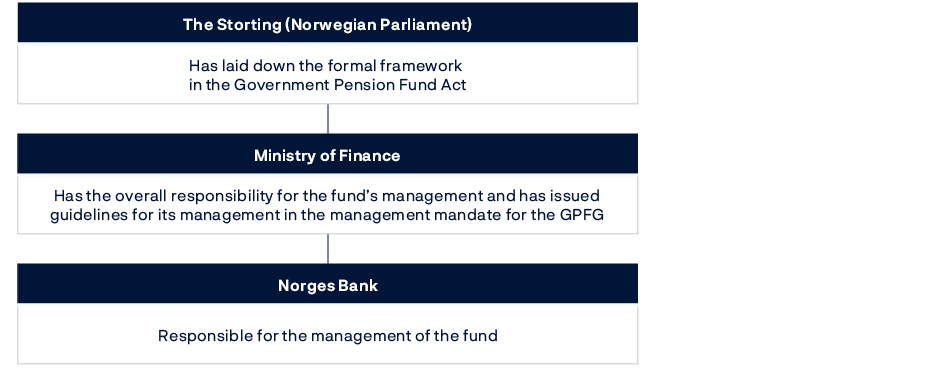
Norges Bank’s governance structure
The Executive Board of Norges Bank has delegated responsibility for the management of the GPFG to the Chief Executive Officer (CEO) of Norges Bank Investment Management.
The CEO of Norges Bank Investment Management is authorised through a job description and an investment mandate. The Executive Board has issued principles for, among other things, risk management, responsible investment and remuneration for employees in Norges Bank Investment Management. Internationally recognised standards are applied for valuation and performance measurement, as well as for the management, measurement and control of risk. Reporting to the Executive Board is carried out monthly, and more extensively on a quarterly basis. The Governor of Norges Bank and the Executive Board are notified immediately in the event of special events or significant matters.
Investment responsibilities within Norges Bank Investment Management are further delegated through investment mandates. Responsibility for processes and personnel is delegated through job descriptions, while process requirements are described in policies and guidelines. The composition of the leader group and the delegation of authority shall ensure segregation of duties between the investment areas, trading, operations, risk management and compliance and control.

The NBIM leader group investment committee complements the delegation of responsibility by advising on investment risk management and the portfolio’s investment universe.
Requirements for internal risk reporting are set by the CEO of Norges Bank Investment Management, through job descriptions within the risk area. Reporting to the CEO is done on a daily, weekly and monthly basis. The CEO shall be notified immediately of any special events or serious breaches of the investment mandate.
Framework for investment risk
The management mandate for the GPFG includes several limits and restrictions for the combined equity and bond asset class, as well as within the individual asset classes. Investments in unlisted real estate and unlisted renewable energy infrastructure are regulated by a separate management framework in the investment mandate. The framework underpins how a diversified exposure to unlisted real estate and unlisted infrastructure shall be established and managed.
Clear roles and responsibilities are a cornerstone of process design at Norges Bank Investment Management. Changes to investment mandates, the portfolio hierarchy and new counterparties are monitored and require approval from the Chief Risk Officer (CRO), or a person authorised by the CRO.
The Executive Board’s principles for risk management are further described in policies and guidelines. Responsibility for effective processes related to risk management is delegated to the CRO and the Chief Corporate Governance & Compliance Officer.
Risk management is defined as the management of market risk, credit risk, counterparty risk, operational risk and risk related to environmental, social and governance factors. The first three are defined as investment risk. The investment area in Norges Bank Investment Management is responsible for managing risk in the portfolio and in individual mandates, while the risk management areas independently measure, manage and report investment risk across the portfolio, at asset class level and other levels within the portfolio that reflect the investment process. Separate risk assessments are required in advance of investments in unlisted real estate and unlisted infrastructure.
Table 9.1 Investment risk
|
Type |
Market risk |
Credit risk |
Counterparty risk |
|---|---|---|---|
|
Definition |
Risk of loss or a change in the market value of the portfolio, or parts of the portfolio, due to changes in financial market variables, real estate and infrastructure values |
Risk of loss due to a bond issuer not meeting its payment obligations |
Risk of loss due to counterparty bankruptcy or other events leading to counterparties defaulting |
|
Main dimensions |
Measured both absolute and relative to the benchmark - Volatility and correlation risk - Systematic factor risk - Liquidity risk |
Measured at single issuer and portfolio levels - Probability of default - Loss given default - Correlation between instruments and issuers at portfolio level |
Measured risk exposure by type of position - Derivatives including FX contracts - Securities lending - Unsecured bank deposits - Repurchase and reverse repurchase agreements - Prime brokerage - Settlement risk towards counterparties and long-settlement transactions |
Investment risk - market risk
Norges Bank Investment Management defines market risk as the risk of loss or a change in the market value of the portfolio, or parts of the portfolio, due to changes in financial market variables, as well as real estate and infrastructure values. Market risk for the investment portfolio, both absolute and relative to the benchmark, is measured along the dimensions concentration risk, volatility and correlation risk, systematic factor risk and liquidity risk. For unlisted real estate, this involves measurement of the share of real estate under construction, vacancy, tenant concentration and geographical concentration. For unlisted infrastructure, this involves measurement of exposure towards different sectors, share of income from government subsidies, construction exposure and geographical concentration. Market risk is actively taken to generate investment returns in line with the objectives of the investment mandates.
Investment risk – credit risk
Norges Bank Investment Management defines credit risk as the risk of loss resulting from a bond issuer defaulting on their payment obligations. Credit risk is measured both in relation to individual issuers, where the probability of default and loss given default are taken into account, and at portfolio level, where the correlation of credit losses between instruments and issuers is taken into account. Credit risk is actively taken to generate investment returns in line with the objectives of the investment mandates.
Investment risk – counterparty risk
Norges Bank Investment Management defines counterparty risk as the risk of loss due to counterparty bankruptcy or other events leading to counterparties defaulting. Counterparties are necessary to ensure effective liquidity management and effective trading and management of market and credit risk. Counterparty risk also arises in connection with securities lending and the management of the equity and bond portfolios, as well as the real estate and infrastructure portfolios. Counterparty risk is controlled and limited to the greatest extent possible, given the investment strategy.
Risk management process
Norges Bank Investment Management employs several measurement methodologies, processes and systems to control investment risk. Robust and recognised risk management systems and processes are complemented by internally developed measurement methodologies and processes.
Market risk
Norges Bank Investment Management measures market risk both for the actual portfolio, and the relative market risk for holdings in the GPFG.
Continuous monitoring, measurement and assessment of market risk is carried out across multiple risk dimensions, using various methods and approaches. By combining different and complementary risk measures, greater insight is gained into the risk profile of the GPFG’s holdings.
Concentration risk
Concentration analysis complements statistical risk estimation by describing the concentration of a single exposure or a group of exposures. More concentrated portfolios tend to contribute to less diversification. Concentration is measured across different dimensions depending on the asset class, including country, currency, sector, issuer and company exposure.
The portfolio is invested across several asset classes, countries and currencies, as shown in table 9.2.
Table 9.2 Allocation by asset class, country and currency
|
Asset class |
Market value in percent by country and currency1 |
Market value by asset class in percent |
Market value by asset class in NOK million |
||||||
|---|---|---|---|---|---|---|---|---|---|
|
31.12.2025 |
31.12.2024 |
||||||||
|
Market |
31.12.2025 |
Market |
31.12.2024 |
31.12.2025 |
31.12.2024 |
||||
|
Equities |
Developed |
89.0 |
Developed |
89.2 |
|||||
|
US |
53.6 |
US |
54.7 |
||||||
|
Japan |
6.4 |
Japan |
6.6 |
||||||
|
UK |
4.8 |
UK |
5.2 |
||||||
|
Germany |
3.3 |
Switzerland |
3.2 |
||||||
|
Switzerland |
3.2 |
Germany |
3.2 |
||||||
|
Total other |
17.7 |
Total other |
16.3 |
||||||
|
Emerging |
11.0 |
Emerging |
10.8 |
||||||
|
China |
3.6 |
China |
3.3 |
||||||
|
Taiwan |
2.7 |
India |
2.5 |
||||||
|
India |
2.1 |
Taiwan |
2.5 |
||||||
|
South Africa |
0.6 |
Brazil |
0.4 |
||||||
|
Brazil |
0.4 |
South Africa |
0.4 |
||||||
|
Total other |
1.6 |
Total other |
1.7 |
||||||
|
Total equities |
71.28 |
71.44 |
15 173 080 |
14 112 924 |
|||||
|
Bonds |
Developed |
99.8 |
Developed |
100.0 |
|||||
|
US dollar |
53.8 |
US dollar |
54.4 |
||||||
|
Euro |
27.6 |
Euro |
27.4 |
||||||
|
Japanese yen |
5.4 |
Japanese yen |
5.9 |
||||||
|
British pound |
4.6 |
British pound |
4.6 |
||||||
|
Canadian dollar |
4.0 |
Canadian dollar |
3.8 |
||||||
|
Total other |
4.4 |
Total other |
4.0 |
||||||
|
Emerging2 |
0.2 |
Emerging2 |
0.0 |
||||||
|
Total bonds |
26.54 |
26.59 |
5 649 375 |
5 253 095 |
|||||
|
Unlisted real estate |
US |
43.6 |
US |
50.0 |
|||||
|
UK |
23.6 |
UK |
20.1 |
||||||
|
France |
17.4 |
France |
14.8 |
||||||
|
Germany |
5.2 |
Germany |
5.0 |
||||||
|
Switzerland |
3.0 |
Switzerland |
3.0 |
||||||
|
Total other |
7.2 |
Total other |
7.2 |
||||||
|
Total unlisted real estate |
1.75 |
1.84 |
372 377 |
363 583 |
|||||
|
Total unlisted infrastructure |
0.43 |
0.13 |
91 335 |
25 348 |
|||||
|
Market value investment portfolio3 |
21 286 167 |
19 754 950 |
|||||||
1 Market value in percentage by country and currency includes derivatives and cash. At year-end 2025, the difference between market value for the unlisted infrastructure asset class and balance sheet value is NOK 31 billion. This is cash allocated to the asset class that has not yet been distributed to the subsidiaries.
2 The share of individual emerging market currencies in the fixed income portfolio is insignificant.
3 Market value investment portfolio is exclusive of Management fee payable and Deferred tax.
At the end of 2025, the equity portfolio’s share of the fund was 71.3 percent, down from 71,4 percent at year-end 2024. The bond portfolio’s share of the fund was 26.5 percent, down from 26.6 percent at year-end 2024. Unlisted real estate amounted to 1.7 percent of the fund at year-end, compared to 1.8 percent at year-end 2024. Unlisted infrastructure amounted to 0.4 percent of the fund at year-end, an increase from 0.1 percent at year-end 2024.
For equity investments, concentration in the portfolio is further measured by sector. Table 9.3 shows the composition of the equity asset class by sector.
Table 9.3 Allocation of equity investments by sector1, percent
|
Sector |
31.12.2025 |
31.12.2024 |
|---|---|---|
|
Technology |
28.5 |
27.9 |
|
Financials |
16.9 |
15.9 |
|
Consumer discretionary |
13.2 |
14.8 |
|
Industrials |
12.7 |
13.1 |
|
Health care |
9.3 |
10.2 |
|
Real estate |
4.2 |
5.1 |
|
Consumer staples |
3.8 |
4.8 |
|
Basic materials |
3.4 |
3.2 |
|
Telecommunications |
2.9 |
3.0 |
|
Energy |
2.8 |
3.3 |
|
Utilities |
2.4 |
2.4 |
1 Does not sum up to 100 percent because cash and derivatives are not included.
The GPFG has substantial investments in government-issued bonds. Table 9.4 shows the largest holdings in bonds issued by governments. These include government bonds issued in local and foreign currency and inflation-linked bonds issued in local currency.
Table 9.4 Largest holdings within the segment government bonds
|
Amounts in NOK million |
Market value 31.12.2025 |
Amounts in NOK million |
Market value 31.12.2024 |
|
|---|---|---|---|---|
|
US |
2 010 684 |
US |
1 788 943 |
|
|
Japan |
267 116 |
Japan |
275 041 |
|
|
Germany |
249 680 |
Germany |
267 331 |
|
|
UK |
201 926 |
Singapore |
221 803 |
|
|
Canada |
95 902 |
UK |
174 860 |
|
|
Singapore |
95 491 |
Canada |
120 290 |
|
|
France |
94 301 |
France |
96 876 |
|
|
Netherlands |
84 137 |
Italy |
92 413 |
|
|
Italy |
82 936 |
Netherlands |
78 868 |
|
|
Spain |
64 632 |
Spain |
56 684 |
The portfolio is also invested in companies that issue both equities and bonds. Table 9.5 shows the portfolio’s largest holdings of non-government issuers, including both bond and equity holdings. Covered bonds issued by financial institutions and debt issued by other underlying companies are included in the bonds column.
Table 9.5 Largest holdings excluding sovereigns, both bonds and equities
|
Amounts in NOK million, 31.12.2025 |
Sector |
Equities |
Bonds |
Total |
|---|---|---|---|---|
|
NVIDIA Corp |
Technology |
573 855 |
2 725 |
576 580 |
|
Apple Inc |
Technology |
496 547 |
3 081 |
499 628 |
|
Microsoft Corp |
Technology |
458 595 |
661 |
459 256 |
|
Alphabet Inc |
Technology |
439 314 |
8 099 |
447 413 |
|
Amazon.com Inc |
Consumer discretionary |
307 904 |
5 844 |
313 748 |
|
Taiwan Semiconductor Manufacturing Co Ltd |
Technology |
228 828 |
- |
228 828 |
|
Broadcom Inc |
Technology |
215 637 |
4 308 |
219 945 |
|
Meta Platforms Inc |
Technology |
195 643 |
11 257 |
206 901 |
|
Tesla Inc |
Consumer discretionary |
161 449 |
- |
161 449 |
|
JPMorgan Chase & Co |
Financials |
113 138 |
22 882 |
136 020 |
|
Amounts in NOK million, 31.12.2024 |
Sector |
Equities |
Bonds |
Total |
|---|---|---|---|---|
|
Apple Inc |
Technology |
524 828 |
3 729 |
528 557 |
|
Microsoft Corp |
Technology |
496 984 |
1 152 |
498 136 |
|
NVIDIA Corp |
Technology |
488 070 |
3 949 |
492 019 |
|
Alphabet Inc |
Technology |
332 449 |
2 224 |
334 672 |
|
Amazon.com Inc |
Consumer discretionary |
306 414 |
6 372 |
312 786 |
|
Meta Platforms Inc |
Technology |
224 314 |
9 466 |
233 780 |
|
Broadcom Inc |
Technology |
189 808 |
3 768 |
193 575 |
|
Taiwan Semiconductor Manufacturing Co Ltd |
Technology |
174 541 |
- |
174 541 |
|
Tesla Inc |
Consumer discretionary |
161 402 |
- |
161 402 |
|
JPMorgan Chase & Co |
Financials |
92 806 |
32 365 |
125 172 |
Table 9.6 shows the composition of the unlisted real estate asset class by sector.
Table 9.6 Distribution of unlisted real estate investments by sector, percent
|
Sector |
31.12.2025 |
31.12.2024 |
|---|---|---|
|
Office |
47.5 |
48.0 |
|
Logistics |
35.0 |
37.0 |
|
Retail |
15.6 |
12.6 |
|
Other |
1.8 |
2.4 |
|
Total |
100.0 |
100.0 |
Volatility and correlation risk
Norges Bank Investment Management uses models to quantify the risk of fluctuations in value for all or parts of the portfolio. Volatility is a standard risk measure based on the statistical concept of standard deviation, which takes into account the correlation between different investments in the portfolio. Expected volatility is defined as one standard deviation. This risk measure provides an estimate of how much the current portfolio value can be expected to fluctuate during the course of a year, based on market conditions over the past three years. In two out of three years, the portfolio’s return is expected to fall within the negative and positive value of the metric. Expected volatility can be expressed in terms of the portfolio’s absolute or relative risk. Norges Bank Investment Management uses the same model for both portfolio risk and relative volatility.
All the fund’s investments are included in the calculation of expected relative volatility and are measured against the fund’s benchmark index consisting of global equity and bond indices.
Modelling unlisted investments is challenging due to limited or no historical prices. For investments in unlisted real estate, the exposure to a group of relevant risk factors is mapped in MSCI’s Barra Private Real Estate 2 (PRE2) model framework. These factors are determined by key attributes such as location and property type. The model uses time series of valuations and actual transactions as a starting point, but also incorporates listed real estate shares to establish representative, daily time series. For investments in unlisted infrastructure, the approach is based on a combination of time series available in the existing framework for listed markets. The exposure to generic listed risk factors is mapped for each project based on attributes such as the share of contractually agreed prices, project lifetime, project phase, sector, country, and counterparty quality.
MSCI’s risk model then uses these mapped factors for unlisted investments in the same way as standard equity and fixed-income risk factors, to calculate expected absolute and relative volatility, as well as expected shortfall for the fund’s investments.
Calculation of expected volatility
Expected volatility of the portfolio, and volatility relative to the benchmark index, is estimated using a parametric calculation method based on current investments. The model equally weights weekly return data over a sampling period of three years.
Tables 9.7 and 9.8 present risk both in terms of the portfolio’s absolute risk and relative risk.
Table 9.7 Portfolio risk, expected volatility, percent
|
Expected volatility, actual portfolio |
||||||||
|---|---|---|---|---|---|---|---|---|
|
31.12.2025 |
Min 2025 |
Max 2025 |
Average 2025 |
31.12.2024 |
Min 2024 |
Max 2024 |
Average 2024 |
|
|
Portfolio |
10.9 |
10.5 |
11.5 |
11.2 |
11.2 |
10.2 |
11.3 |
10.8 |
|
Equities |
13.2 |
12.7 |
13.9 |
13.5 |
13.9 |
12.4 |
14.0 |
13.1 |
|
Bonds |
10.1 |
10.1 |
11.2 |
10.5 |
10.7 |
10.7 |
11.1 |
10.9 |
|
Unlisted real estate |
13.7 |
13.6 |
14.1 |
13.9 |
13.8 |
12.7 |
13.9 |
13.1 |
|
Unlisted infrastructure |
11.3 |
9.8 |
25.7 |
13.0 |
23.9 |
23.9 |
54.0 |
39.6 |
Table 9.8 Relative risk measured against the fund's reference index, expected relative volatility, basis points
|
Expected relative volatility |
||||||||
|---|---|---|---|---|---|---|---|---|
|
31.12.2025 |
Min 2025 |
Max 2025 |
Average 2025 |
31.12.2024 |
Min 2024 |
Max 2024 |
Average 2024 |
|
|
Portfolio |
37 |
37 |
45 |
42 |
44 |
34 |
44 |
37 |
Risk measured as expected volatility indicates an expected annual value fluctuation in the fund of 10.9 percent, or approximately NOK 2 300 billion at the end of 2025, down from 11.2 percent at year-end 2024. Expected volatility for the equity portfolio was 13.2 percent at year-end, down from 13.9 percent at year-end 2024, while expected volatility for the fixed-income portfolio was 10.1 percent, compared to 10.7 percent at year-end 2024.
The management mandate stipulates that expected relative volatility for the fund shall not exceed 1.25 percentage points. The measurement of risk and monitoring of the limit is done based on the risk model described above. The fund’s expected relative volatility was 37 basis points at the end of 2025, down from 44 basis points at year-end 2024. The decrease in the fund’s expected relative volatility in 2025 is mainly due to decreased relative volatility from equity investments.
In addition to the aforementioned model, other risk models are used that take greater account of recent market dynamics and models that measure tail risk.
Expected shortfall is a tail risk measure that quantifies the expected loss of a portfolio in extreme market situations. The measure is calculated using historical simulations. The Executive Board has determined that the fund shall be managed so that the annual expected shortfall measured against the benchmark index does not exceed 3.75 percentage points. Expected shortfall is measured and monitored based on the risk model described above. At year-end, expected shortfall was 1.01 percentage points, compared to 1.18 percentage points at year-end 2024.
Calculation of expected shortfall
Expected shortfall for the portfolio, measured against its benchmark index, is estimated using historical simulations based on current investments. The model equally weights weekly returns over a sampling period from January 2007 to the end of the last accounting period, so that the measure can capture extreme market movements. Expected shortfall is calculated as the average of losses beyond the 97.5th percentile, i.e. the expected loss when the outcome belongs to the worst 2.5 percent of weekly returns.
Strengths and weaknesses
The strength of these types of risk model is that one can estimate the risk associated with a portfolio across different asset classes, markets, currencies, securities and derivatives, and express this risk as a single numerical value that takes into account the correlation between different asset classes, securities and risk factors, as well as capturing deviations from a normal distribution.
The model-based risk estimates are based on historical relationships in the markets and are expected to provide reliable forecasts in markets without significant changes in volatility and correlation. Estimates will be less reliable in periods marked by significant changes in volatility and correlation. Calculated volatility gives a point estimate of risk but provides little information on the overall risk profile and potential tail risk. Annualisation implies that volatility and the composition of the portfolio are assumed to be constant over time. To compensate for these shortcomings, complementary models and methods are employed, such as stress tests and analyses of concentration risk and realised returns.
Verification of models
Risk models used in estimating and controlling investment risk are continuously evaluated and verified for their ability to estimate risk. The special nature of the investment portfolio and the investment universe, as well as the GPFG’s long-term investment horizon, are taken into account when evaluating the models.
Credit risk
Credit risk is the risk of losses resulting from issuers of bonds defaulting on their payment obligations. Fixed-income instruments in the portfolio’s benchmark index are all rated investment grade by one of the major credit rating agencies. Investments in bonds are made based on internal assessments with regards to expected return and risk profile.
Table 9.9 Bond portfolio specified by external credit rating
|
Amounts in NOK million, 31.12.2025 |
AAA |
AA |
A |
BBB |
BB+ and lower |
Total |
|---|---|---|---|---|---|---|
|
Government bonds |
576 052 |
2 040 965 |
451 447 |
89 207 |
28 986 |
3 186 656 |
|
Government-related bonds |
246 443 |
194 223 |
46 408 |
22 117 |
3 900 |
513 092 |
|
Inflation-linked bonds |
63 886 |
224 239 |
27 216 |
26 483 |
738 |
342 561 |
|
Corporate bonds |
5 168 |
98 910 |
669 435 |
615 070 |
24 281 |
1 412 864 |
|
Securitised bonds |
302 672 |
24 826 |
2 763 |
- |
- |
330 261 |
|
Total bonds1 |
1 194 221 |
2 583 164 |
1 197 267 |
752 876 |
57 905 |
5 785 434 |
|
Amounts in NOK million, 31.12.2024 |
AAA |
AA |
A |
BBB |
BB+ and lower |
Total |
|---|---|---|---|---|---|---|
|
Government bonds |
729 896 |
1 925 725 |
345 833 |
128 129 |
35 051 |
3 164 634 |
|
Government-related bonds |
266 286 |
168 844 |
33 055 |
22 088 |
2 392 |
492 665 |
|
Inflation-linked bonds |
52 249 |
216 988 |
16 470 |
18 084 |
- |
303 792 |
|
Corporate bonds |
10 371 |
93 141 |
614 581 |
565 884 |
18 375 |
1 302 352 |
|
Securitised bonds |
270 150 |
32 744 |
2 102 |
- |
- |
304 996 |
|
Total bonds1 |
1 328 952 |
2 437 443 |
1 012 041 |
734 185 |
55 818 |
5 568 439 |
1 At year-end 2025, bonds received as collateral amounting to NOK 13.7 billion were sold. At year-end 2024, NOK 1.5 billion were sold. These bonds are presented in the balance sheet as a liability under Secured borrowing.
The market value of the bond portfolio increased to NOK 5 785 billion at year-end 2025, from NOK 5 568 billion at year-end 2024. The share of holdings in corporate bonds increased by 1.0 percentage point during the year, to 24.4 percent of the bond portfolio at year-end 2025. Government bonds, including inflation-linked bonds, constituted 61.0 percent of the bond portfolio at year-end, a reduction of 1.3 percentage points compared to year-end 2024.
The share of bonds with credit rating AAA was reduced by 3.3 percentage points during the year, to 20.6 percent at year-end 2025. The decrease was mainly due to a reduction in the holdings of Singapore government bonds in the period. The share of the bond portfolio with credit rating A increased by 2.5 percentage points during the year, mainly driven by a downgrade of French government bonds to A from AA. The share of the bond portfolio with credit rating BBB decreased by 0.2 percentage point compared to year-end 2024, to 13.0 percent at year-end 2025.
The share of bonds in the category BB+ and lower was 1.0 percent at year-end 2025, unchanged from year-end 2024. The largest holding of bonds in this category was government bonds issued by South Africa. Defaulted bonds had a market value of NOK 7.1 million at year-end 2025, compared to NOK 13.8 million at year-end 2024. Defaulted bonds are grouped under BB+ and lower.
Table 9.10 Bond portfolio by external credit rating and currency, percent
|
31.12.2025 |
AAA |
AA |
A |
BBB |
BB+ and lower |
Total |
|---|---|---|---|---|---|---|
|
US dollar |
0.6 |
36.5 |
7.4 |
7.0 |
0.3 |
51.7 |
|
Euro |
12.0 |
2.3 |
7.3 |
4.5 |
0.2 |
26.2 |
|
British pound |
0.1 |
3.6 |
0.5 |
0.6 |
- |
4.8 |
|
Japanese yen |
- |
- |
4.6 |
0.0 |
- |
4.7 |
|
Canadian dollar |
2.6 |
1.0 |
0.4 |
0.4 |
- |
4.3 |
|
Other currencies |
5.4 |
1.3 |
0.5 |
0.6 |
0.5 |
8.2 |
|
Total |
20.6 |
44.6 |
20.7 |
13.0 |
1.0 |
100.0 |
|
31.12.2024 |
AAA |
AA |
A |
BBB |
BB+ and lower |
Total |
|---|---|---|---|---|---|---|
|
US dollar |
0.9 |
34.0 |
7.6 |
6.8 |
0.2 |
49.4 |
|
Euro |
12.3 |
4.6 |
4.5 |
4.5 |
0.1 |
26.0 |
|
Japanese yen |
- |
- |
5.0 |
0.0 |
- |
5.0 |
|
Canadian dollar |
3.3 |
0.9 |
0.5 |
0.3 |
- |
5.0 |
|
British pound |
0.1 |
3.2 |
0.4 |
0.5 |
- |
4.4 |
|
Other currencies |
7.3 |
1.2 |
0.2 |
1.0 |
0.6 |
10.2 |
|
Total |
23.9 |
43.8 |
18.2 |
13.2 |
1.0 |
100.0 |
At year-end 2025, investments in purchased credit default swaps had a nominal value of NOK 209.3 billion, an increase from NOK 173.8 billion at year-end 2024. 15.0 percent of these were in the category where the underlying issuers have a low credit rating. See table 5.3 in note 5 Holdings of equities, bonds and financial derivatives for further information. When investing in purchased credit default swaps, the credit risk in the bond portfolio is reduced when the portfolio has investments in the same underlying bonds as the credit default swaps. At year-end 2025, credit risk exposure was reduced by NOK 100.6 billion as a result of purchased credit default swaps, compared to a reduction of NOK 79.5 billion at year-end 2024.
In addition to credit ratings from credit rating agencies, credit risk measurement is complemented by two credit risk models, one of which is based on credit ratings and the other on observable credit premiums. Both of these methods also take into account the correlation and expected value of bonds in a bankruptcy situation. The models also consider credit default swaps, which reduce or increase credit risk depending on whether credit risk is purchased or sold. The models are used for risk measurement and monitoring of credit risk in the fixed-income portfolio. The overall credit quality of the bond portfolio was virtually unchanged from year-end 2024 to year-end 2025.
Counterparty risk
Counterparties are necessary for trading in markets and for ensuring effective management of liquidity, market and credit risk. Counterparty risk exposure is related to trading in derivatives and foreign exchange contracts, securities lending, and repurchase and reverse repurchase agreements. Counterparty risk also arises in connection with unsecured bank deposits and the daily liquidity management of the fund, as well as purchases and sales of unlisted real estate and unlisted infrastructure. There is further exposure to counterparty risk related to counterparties in the international settlement and custody systems where transactions are settled. This can occur both in currency trading and in the purchase and sale of securities. Settlement risk and exposure from trades with a long settlement period are also defined as counterparty risk.
Multiple counterparties are used to reduce concentration and there are strict requirements for counterparty credit rating. Credit rating requirements are generally higher for counterparties to unsecured deposits in banks than where collateral is received. Changes in counterparty credit ratings are monitored continuously.
To reduce counterparty risk, netting agreements are used for trades in OTC derivatives, currency contracts, as well as repurchase and reverse repurchase agreements. Many derivatives are also cleared, such that counterparty risk is primarily towards the clearing house instead of banks. Further reduction of counterparty risk is ensured by requirements for collateral for counterparty net positions with a positive market value. For instruments where collateral is used, minimum requirements have been set relating to the credit quality, time to maturity and concentration of the collateral. Netting and collateral agreements are entered into for all approved counterparties for these types of trades.
Requirements are also set for how real estate and infrastructure transactions are conducted, to ensure acceptable counterparty risk. Counterparty risk that arises during the acquisition process is analysed in advance of the transaction and requires approval from the CRO. In 2025, 16 real estate transactions were analysed and approved by the CRO through this process, compared to 14 transactions in 2024. In 2025, 6 investments in unlisted infrastructure were analysed and approved by the CRO through this process, compared to 4 in 2024.
Counterparty risk is also limited by setting exposure limits for individual counterparties. In most instances, the exposure limit is determined by the counterparty’s credit rating, where counterparties with strong credit rating have a higher limit than counterparties with weaker credit rating. Exposure per counterparty is measured daily against established limits set by the Executive Board and the CEO of Norges Bank Investment Management.
The methods used to calculate counterparty risk are in accordance with internationally recognised standards. As a rule, the Basel regulations for banks are used for measuring counterparty risk, with some adjustments based on internal analyses. The risk model calculates the expected counterparty exposure in the event of a counterparty default. The Standardised Approach in the Basel regulations (SA-CCR) is used for derivatives and foreign exchange contracts. The Standardised Approach takes into account collateral received and netting arrangements when calculating counterparty risk.
For repurchase agreements, securities lending transactions executed through an external agent and securities posted as collateral in derivative trades, a method is used where a premium is added to the market value to reflect the position’s volatility. When determining counterparty risk exposure for these positions, an adjustment is also made for netting and actual collateral received and posted. There is also counterparty risk in connection with investment strategies for equities facilitated by prime brokers.
Exposure to counterparty risk is linked to counterparties in the settlement and custody systems, both for currency trades and for the purchase and sale of securities. Settlement risk is reduced using the currency settlement system CLS (Continuous Linked Settlement), or by trading directly with the settlement bank. For some currencies, Norges Bank is exposed to settlement risk when the sold currency is delivered to the counterparty before the receipt of currency is confirmed. This type of exposure is included on the line Settlement risk towards counterparties and long settlement transactions in table 9.11.
Total counterparty risk increased to NOK 310.3 billion at year-end 2025, from NOK 296.7 billion at year-end 2024. The largest increase in counterparty risk exposure came from securities lending, while there was a decrease in the counterparty risk exposure from derivatives including foreign exchange contracts. Derivatives including foreign exchange contracts accounted for 43.4 percent of the total counterparty risk at year end, and decreased by 17.3 billion compared to year-end 2024. The decrease is due to lower risk exposure from both foreign exchange contracts and derivatives throughout the year.
Counterparty risk exposure from the securities lending programme increased to NOK 120.8 billion at year-end 2025, from NOK 105.9 billion at year-end 2024. The increase was mainly due to higher equity lending in the programme at year-end 2025. Both equities and bonds are lent through the securities lending programme. Counterparty risk exposure from securities lending accounted for 38.9 percent of the fund’s total counterparty risk exposure at the end of 2025, compared to 35.7 percent at the end of 2024.
In table 9.11, exposure is broken down by type of activity/instrument associated with counterparty risk.
Table 9.11 Counterparty risk by type of position
|
Amounts in NOK million |
Risk exposure |
|
|---|---|---|
|
31.12.2025 |
31.12.2024 |
|
|
Derivatives including foreign exchange contracts |
134 734 |
152 047 |
|
Securities lending |
120 786 |
105 908 |
|
Unsecured bank deposits1 |
29 176 |
23 518 |
|
Repurchase and reverse repurchase agreements |
11 754 |
14 316 |
|
Prime brokerage |
6 409 |
554 |
|
Settlement risk towards counterparties and long-settlement transactions |
7 443 |
344 |
|
Total |
310 301 |
296 687 |
1 Includes bank deposits in non-consolidated subsidiaries.
Norges Bank’s counterparties have a credit rating from independent credit rating agencies or a documented internal credit rating. Credit ratings for counterparties are monitored and complemented by alternative credit risk indicators.
Table 9.12 shows approved counterparties classified according to credit rating category. The table also includes brokers used when purchasing and selling securities.
Table 9.12 Counterparties by credit rating1
|
Norges Bank's counterparties (excluding brokers) |
Brokers |
|||
|---|---|---|---|---|
|
31.12.2025 |
31.12.2024 |
31.12.2025 |
31.12.2024 |
|
|
AAA |
3 |
3 |
1 |
1 |
|
AA |
45 |
43 |
45 |
45 |
|
A |
71 |
64 |
91 |
88 |
|
BBB |
10 |
9 |
36 |
34 |
|
BB |
2 |
2 |
28 |
25 |
|
B |
- |
- |
4 |
5 |
|
Total |
131 |
121 |
205 |
198 |
1 The table shows the number of legal entities. The same legal entity can be included as both broker and counterparty.
The total number of counterparties and brokers increased slightly during the year. There were 131 counterparties at year-end 2025, compared to 121 at year-end 2024. The number of brokers increased to 205 at year-end 2025, from 198 at year-end 2024. The overall credit quality of brokers and counterparties remained unchanged from year-end 2024.
Leverage
Leverage may be used to ensure efficient management of investments within the equity and bond portfolios, but not with the aim of increasing the economic exposure to risky assets. The use of leverage is regulated both in the management mandate and in the investment mandate. Leverage is the difference between total net exposure and market value of the portfolio. Net exposure is determined by including securities at market value, cash at nominal value and positions in derivatives by converting them to the underlying exposure. When the exposure is greater than market value, the portfolio is leveraged.
The GPFG’s leverage was 0.1 percent for the aggregated equity and bond portfolio at the end of 2025, compared to 1.2 percent at the end of 2024. For investments in unlisted real estate, requirements are set in the investment mandate, limiting the maximum leverage of the portfolio to 25 percent. The unlisted real estate investments had a debt ratio of 9.3 percent at the end of 2025, compared to 8.0 percent at the end of 2024. For investments in unlisted infrastructure, the maximum leverage of the portfolio is limited to 60 percent. At year-end 2025, the investments in unlisted infrastructure had a debt ratio of 12.9 percent, compared to 29.4 percent at year end 2024.
Sale of securities Norges Bank does not own
Sale of securities not owned by Norges Bank (short sales) can only be carried out if there are established borrowing agreements to cover a negative position. Such transactions amounted to NOK 48.7 billion at year-end 2025.
GPFG Note 10 Tax
Accounting policy
Investment income and gains of the GPFG are exempt from income tax in Norway, but may be subject to taxes in foreign jurisdictions.
Tax expense in the income statement represents income taxes that are not reimbursed through local tax laws or treaties, and consists of taxes on dividends, interest income and capital gains related to the GPFG’s investments in equities and bonds, tax on fee income from secured lending and taxes in consolidated subsidiaries. The majority of these taxes are collected at source.
Withholding taxes, net of deductions for refundable amounts, are recognised at the same time as the related dividend or interest income. See the accounting policy in note 4 Income/expense from equities, bonds and financial derivatives.
Other income tax, which is not collected at source, is recognised in the income statement in the same period as the related income or gain and presented in the balance sheet as a liability within Other liabilities, until it has been settled. Deferred tax in the balance sheet mainly consists of capital gains tax. Capital gains tax is recognised as a liability based on the expected future payment when the GPFG is in a gain position in the applicable market. No deferred tax asset is presented in the balance sheet when the GPFG is in a loss position, since the recognition criteria are not considered to be met.
Tax incurred in subsidiaries presented in the balance sheet lines Unlisted real estate and Unlisted infrastructure is recognised in the income statement as Income/expense from unlisted real estate and Income/expense from unlisted infrastructure, respectively. Only the tax expense in consolidated subsidiaries is included in the income statement line Tax expense. This is specified in table 10.1 in the line Other.
All uncertain tax positions, such as disputed withholding tax refunds, are assessed each reporting period. The best estimate of the probable reimbursement or payment is recognised in the balance sheet.
Table 10.1 shows tax expense by type of investment and type of tax.
Table 10.1 Specification tax expense
|
Amounts in NOK million, 2025 |
Gross income before taxes |
Income tax on dividends, interest and fees |
Capital gains tax |
Other |
Tax expense |
Net income after taxes |
|---|---|---|---|---|---|---|
|
Income/expense from: |
||||||
|
Equities |
2 115 405 |
-8 846 |
-2 070 |
- |
-10 916 |
2 104 489 |
|
Bonds |
243 405 |
-5 |
-39 |
- |
-44 |
243 361 |
|
Secured lending |
20 801 |
-187 |
- |
- |
-187 |
20 614 |
|
Other |
- |
- |
- |
-10 |
-10 |
- |
|
Tax expense1 |
-9 038 |
-2 109 |
-10 |
-11 157 |
1 The rules on global minimum taxation (Pillar 2) have no economic impact for the GPFG, and the tax expense for the period included no Pillar 2 income taxes.
|
Amounts in NOK million, 2024 |
Gross income before taxes |
Income tax on dividends, interest and fees |
Capital gains tax |
Other |
Tax expense |
Net income after taxes |
|---|---|---|---|---|---|---|
|
Income/expense from: |
||||||
|
Equities |
2 454 653 |
-8 522 |
-8 393 |
- |
-16 915 |
2 437 738 |
|
Bonds |
70 889 |
-36 |
-4 |
- |
-40 |
70 849 |
|
Secured lending |
21 622 |
-246 |
- |
- |
-246 |
21 376 |
|
Other |
- |
- |
- |
-10 |
-10 |
- |
|
Tax expense1 |
-8 804 |
-8 397 |
-10 |
-17 211 |
1 The rules on global minimum taxation (Pillar 2) have no economic impact for the GPFG, and the tax expense for the period included no Pillar 2 income taxes.
Table 10.2 shows receivables and liabilities recognised in the balance sheet related to tax.
Table 10.2 Specification balance sheet items related to tax
|
Amounts in NOK million |
31.12.2025 |
31.12.2024 |
|---|---|---|
|
Withholding tax receivable |
11 594 |
17 938 |
|
Tax payable1 |
30 |
40 |
|
Deferred tax |
10 744 |
13 170 |
1 Included in the balance sheet line Other liabilities.
Table 10.3 specifies the line Net payment of taxes in the statement of cash flows.
Table 10.3 Specification net payment of taxes
|
Amounts in NOK million |
2025 |
2024 |
|---|---|---|
|
Receipt of refunded withholding tax |
14 512 |
8 494 |
|
Payment of taxes |
-20 086 |
-29 204 |
|
Net payment of taxes |
-5 574 |
-20 710 |
GPFG Note 11 Foreign exchange gains and losses
In accordance with the management mandate, the fund is not invested in securities issued by Norwegian companies, securities denominated in Norwegian kroner nor real estate or infrastructure located in Norway. The fund’s returns are measured primarily in the fund’s currency basket, which is a weighted combination of the currencies in the fund’s benchmark index for equities and bonds. The fund’s market value in Norwegian kroner is impacted by changes in exchange rates, but this has no bearing on the fund’s international purchasing power.
Accounting judgement
The GPFG’s functional currency is the Norwegian krone. Owner’s equity, in the form of the GPFG krone account, is denominated in Norwegian kroner and returns on the investment portfolio are reported both internally and to the owner in Norwegian kroner. The percentage return is measured both in Norwegian kroner and in the currency basket defined in the management mandate. Furthermore, there is no single investment currency that stands out as dominant within the investment management.
Accounting policy
Foreign currency transactions are recognised in the financial statements using the exchange rate prevailing on the transaction date. Assets and liabilities in foreign currencies are translated into Norwegian kroner using the exchange rate at the balance sheet date. The foreign exchange element linked to realised and unrealised gains and losses on assets and liabilities is disaggregated in the income statement and presented on a separate line, Foreign exchange gain/loss. This presentation is considered to provide the best informational value, based on the objective of the investment strategy of the GPFG which is to maximise the international purchasing power of the fund.
Accounting policy
Gains and losses on financial instruments are due to changes in the price of the instrument (security element) and changes in foreign exchange rates (foreign exchange element). These are presented separately in the income statement. The method used to allocate the total gain/loss in Norwegian kroner to a security element and a foreign exchange element is described below.
Foreign exchange element
Unrealised gain/loss due to changes in foreign exchange rates is calculated based on the cost of the holding in foreign currency and the change in the exchange rate from the time of purchase until the balance sheet date. If the holding has been purchased in a prior period, previously recognised gain/loss is deducted to arrive at the gain/loss in the current period. Upon realisation, the exchange rate on the date of sale is used when calculating the realised gain/loss.
Security element
Unrealised gain/loss due to changes in the security price is calculated based on the change in the security price from the purchase date to the balance sheet date, and the exchange rate at the balance sheet date. If the holding has been purchased in a prior period, previously recognised gain/loss is deducted to arrive at the gain/loss in the current period. Upon realisation, the selling price is used when calculating the realised gain/loss.
The change in the fund’s market value due to changes in foreign exchange rates is presented in table 11.1.
Table 11.1 Specification foreign exchange gain/loss
|
Amounts in NOK million |
2025 |
2024 |
|---|---|---|
|
Foreign exchange gain/loss - USD/NOK |
-883 982 |
758 950 |
|
Foreign exchange gain/loss - EUR/NOK |
21 126 |
119 705 |
|
Foreign exchange gain/loss - GBP/NOK |
-40 526 |
81 057 |
|
Foreign exchange gain/loss - JPY/NOK |
-103 818 |
3 936 |
|
Foreign exchange gain/loss - CHF/NOK |
6 027 |
13 967 |
|
Foreign exchange gain/loss - other |
-154 124 |
94 593 |
|
Foreign exchange gain/loss |
-1 155 299 |
1 072 207 |
Table 11.2 gives an overview of the distribution of the market value of the investment portfolio for the main currencies the GPFG is exposed to. This supplements the overview of the allocation by asset class, country and currency shown in table 9.2 in note 9 Investment risk.
Table 11.2 Specification of the investment portfolio by currency
|
Amounts in NOK million |
31.12.2025 |
31.12.2024 |
|---|---|---|
|
US dollar |
11 059 763 |
10 632 003 |
|
Euro |
3 589 013 |
3 168 468 |
|
British pound |
1 343 999 |
1 212 905 |
|
Japanese yen |
1 139 206 |
1 098 646 |
|
Swiss franc |
723 685 |
637 326 |
|
Other currencies |
3 430 501 |
3 005 601 |
|
Market value investment portfolio |
21 286 167 |
19 754 950 |
Table 11.3 gives an overview of exchange rates at the balance sheet date for the main currencies the GPFG is exposed to.
Table 11.3 Exchange rates
|
31.12.2025 |
31.12.2024 |
Percent change |
|
|---|---|---|---|
|
US dollar |
10.09 |
11.36 |
-11 |
|
Euro |
11.85 |
11.76 |
1 |
|
British pound |
13.57 |
14.22 |
-5 |
|
Japanese yen |
0.06 |
0.07 |
-11 |
|
Swiss franc |
12.73 |
12.53 |
2 |
GPFG Note 12 Management costs
Accounting policy
Management fee is recognised in the GPFG’s income statement as an expense when incurred.
Performance-based fees to external managers are based on achieved excess returns relative to the applicable benchmark index over time. The provision for performance-based fees is based on the best estimate of the incurred fee to be paid. The effect of changes in estimates is recognised in profit or loss in the current period.
Management costs comprise all costs relating to the management of the fund. These are mainly incurred in Norges Bank, but management costs are also incurred in subsidiaries of Norges Bank that are exclusively established as part of the management of the GPFG’s investments in unlisted real estate and unlisted renewable energy infrastructure.
Management costs in Norges Bank
The Ministry of Finance reimburses Norges Bank for costs incurred in connection with the management of the GPFG, in the form of a management fee. The management fee is equivalent to the actual costs incurred by Norges Bank, including performance-based fees to external managers, and is expensed in the income statement line Management fee. Costs included in the management fee are specified in table 12.1.
Table 12.1 Management fee
|
Amounts in NOK million |
2025 |
2024 |
||
|---|---|---|---|---|
|
Basis points |
Basis points |
|||
|
Salary, social security and other personnel-related costs1 |
2 476 |
2 218 |
||
|
Custody costs |
447 |
483 |
||
|
IT services, systems, data and information |
858 |
815 |
||
|
Research, consulting and legal fees |
287 |
255 |
||
|
Other costs |
274 |
282 |
||
|
Allocated costs Norges Bank |
257 |
241 |
||
|
Base fees to external managers |
1 756 |
1 554 |
||
|
Management fee excluding performance-based fees |
6 355 |
3.2 |
5 848 |
3.3 |
|
Performance-based fees to external managers |
1 182 |
1 543 |
||
|
Management fee |
7 537 |
3.8 |
7 390 |
4.1 |
1 Costs increased by NOK 235 million in 2025 due to an accounting transition effect related to a change in practice for payment of performance-based pay, which affects the timing of expense recognition.
Management costs in subsidiaries
Management costs incurred in wholly owned subsidiaries consist of costs related to the management of the investments in unlisted real estate and unlisted renewable energy infrastructure. These costs are expensed directly in the portfolio result and are not part of the management fee.
Management costs incurred in non-consolidated subsidiaries are presented in the income statement lines Income/expense from unlisted real estate and Income/expense from unlisted infrastructure. Management costs incurred in consolidated subsidiaries are presented in the income statement line Other income/expense. These costs are specified in table 12.2.
Table 12.2 Management costs subsidiaries
|
Amounts in NOK million |
2025 |
2024 |
||
|---|---|---|---|---|
|
Basis points |
Basis points |
|||
|
Salary, social security and other personnel-related costs |
48 |
35 |
||
|
IT services, systems, data and information |
7 |
6 |
||
|
Research, consulting and legal fees |
90 |
59 |
||
|
Other costs |
99 |
49 |
||
|
Total management costs, subsidiaries1 |
244 |
0.1 |
149 |
0.1 |
|
Of which management costs non-consolidated subsidiaries |
157 |
88 |
||
|
Of which management costs consolidated subsidiaries |
87 |
61 |
||
1 Costs in 2025 consisted of NOK 203 million related to investments in unlisted real estate and NOK 41 million related to investments in unlisted infrastructure. In 2024, NOK 137 million was related to investments in unlisted real estate and NOK 12 million was related to investments in unlisted infrastructure.
Upper limit for reimbursement of management costs
Every year the Ministry of Finance establishes an upper limit for the reimbursement of management costs. Norges Bank is only reimbursed for costs incurred within this limit. Norges Bank is also reimbursed for performance-based fees to external managers. These fees are not measured against the upper limit.
For 2025, total management costs incurred in Norges Bank and its subsidiaries, excluding performance-based fees to external managers, were limited to NOK 8 100 million. In 2024, the limit was NOK 7 100 million.
Total management costs measured against the upper limit amounted to NOK 6 600 million in 2025. This consisted of management costs in Norges Bank, excluding performance-based fees to external managers, of NOK 6 355 million and management costs in subsidiaries of NOK 244 million. Total management costs including performance-based fees to external managers amounted to NOK 7 781 million in 2025.
Costs measured as a share of assets under management
Costs are also measured in basis points, as a share of average assets under management. Average assets under management are calculated based on the market value of the portfolio in Norwegian kroner at the start of each month in the calendar year.
In 2025, management costs incurred in Norges Bank and its subsidiaries, excluding performance-based fees to external managers, corresponded to 3.3 basis points of assets under management. Management costs including performance-based fees to external managers corresponded to 3.9 basis points of assets under management.
Other operating costs in subsidiaries
In addition to the management costs presented in table 12.2, other operating costs are also incurred in subsidiaries related to the ongoing maintenance, operation and development of the investments. These are not costs related to investing in real estate or renewable energy infrastructure but are costs for operating the underlying investments once they are acquired. Therefore, they are not defined as management costs. Other operating costs are expensed directly in the portfolio result and are not part of the management fee. They are also not included in the costs measured against the upper limit.
Other operating costs incurred in non-consolidated subsidiaries are presented in the income statement lines Income/expense from unlisted real estate and Income/expense from unlisted infrastructure. For further information, see table 6.4 in note 6 Unlisted real estate and table 7.4 in note 7 Unlisted renewable energy infrastructure. Other operating costs incurred in consolidated subsidiaries are presented in the income statement line Other income/expense.
GPFG Note 13 Secured lending and borrowing
Secured lending and borrowing consists of collateralised (secured) transactions, where the GPFG posts or receives securities or cash to or from a counterparty, with collateral in the form of other securities or cash. These transactions take place under various agreements such as securities lending agreements, repurchase and reverse repurchase agreements and equity swaps in combination with purchases or sales of equities.
The objective of secured lending and borrowing is primarily to provide an incremental return on the GPFG’s holdings of securities and cash. These transactions are also used in connection with liquidity management.
Principles for presentation
Income and expense from secured lending and borrowing
Income and expense mainly consist of interest and net fees. These are recognised on a straight-line basis over the term of the agreement and are presented in the income statement as Income/expense from secured lending and Income/expense from secured borrowing.
Table 13.1 Income/expense from secured lending and borrowing
|
Amounts in NOK million |
2025 |
2024 |
|---|---|---|
|
Income/expense from secured lending |
20 801 |
21 622 |
|
Income/expense from secured borrowing |
-22 889 |
-24 810 |
|
Net income/expense from secured lending and borrowing |
-2 088 |
-3 188 |
Accounting policy
Transferred financial assets
Securities transferred to counterparties are not derecognised when the agreement is entered into, as the derecognition criteria are not met. Since the counterparty has the right to sell or pledge the security, the security is considered to be transferred. Transferred securities are presented separately in the balance sheet lines Equities lent and Bonds lent. During the lending period, the underlying securities are accounted for in accordance with accounting policies for the relevant securities.
When an equity is sold in combination with the purchase of an equivalent equity swap, the sold equity is presented in the balance sheet as Equities lent, since the GPFG’s exposure to the equity is virtually unchanged. The equity swap (derivative) is not recognised in the balance sheet, since this would lead to recognition of the same rights twice. When an equity is purchased in combination with the sale of an equivalent equity swap, the GPFG has virtually no exposure to the equity or the derivative and neither the equity nor the derivative are recognised in the balance sheet.
Secured lending
Cash collateral posted to counterparties is derecognised, and a corresponding receivable reflecting the cash amount that will be returned is recognised as a financial asset, Secured lending. This receivable is measured at fair value.
Secured borrowing
Cash collateral received from counterparties is recognised as Deposits in banks. A corresponding financial liability is recognised under Secured borrowing, representing the obligation to return the cash collateral. This liability is measured at fair value.
Securities transferred from counterparties and subsequently sold in the market (short positions), give rise to a financial liability representing the obligation to return equivalent securities at the end of the borrowing period. This liability is recognised under Secured borrowing and measured at fair value.
Collateral received in the form of securities
Collateral received in the form of securities, where the GPFG has the right to sell or pledge the security is not recognised in the balance sheet.
Table 13.2 shows the amount presented as Secured lending, and the associated collateral received in the form of securities.
Table 13.2 Secured lending
|
Amounts in NOK million |
31.12.2025 |
31.12.2024 |
|---|---|---|
|
Secured lending |
1 374 213 |
1 020 455 |
|
Total secured lending |
1 374 213 |
1 020 455 |
|
Associated collateral in the form of securities (off balance sheet) |
||
|
Equities received as collateral |
949 641 |
690 154 |
|
Bonds received as collateral1 |
445 178 |
336 265 |
|
Total collateral received in the form of securities related to secured lending |
1 394 820 |
1 026 419 |
1 At year-end 2025, bonds received as collateral amounting to NOK 13.7 billion were sold (2024: NOK 1.5 billion)
Table 13.3 shows transferred securities with the associated liability presented as Secured borrowing, and collateral received in the form of securities or guarantees.
Table 13.3 Transferred financial assets and secured borrowing
|
Amounts in NOK million |
31.12.2025 |
31.12.2024 |
|---|---|---|
|
Transferred financial assets |
||
|
Equities lent |
1 011 469 |
862 197 |
|
Bonds lent |
811 514 |
1 088 846 |
|
Total transferred financial assets |
1 822 984 |
1 951 043 |
|
Secured borrowing |
||
|
Cash received as collateral for transferred financial assets |
1 321 603 |
1 316 345 |
|
Securities sold short |
48 725 |
3 547 |
|
Total secured borrowing |
1 370 328 |
1 319 892 |
|
Collateral in the form of securities or guarantees (off balance sheet) |
||
|
Equities received as collateral |
286 391 |
320 398 |
|
Bonds received as collateral |
232 231 |
361 132 |
|
Guarantees |
2 969 |
5 406 |
|
Total collateral received in the form of securities or guarantees related to transferred financial assets |
521 591 |
686 936 |
GPFG Note 14 Collateral and offsetting
Accounting policy
Cash collateral derivative transactions
Cash collateral posted in connection with derivative transactions is derecognised and a corresponding receivable, reflecting the cash amount that will be returned, is recognised in the balance sheet as Cash collateral posted. Cash collateral received in connection with derivative transactions is recognised in the balance sheet as Deposits in banks with a corresponding liability, Cash collateral received. Both Cash collateral posted and Cash collateral received are measured at fair value.
Offsetting
Financial assets and liabilities are offset and presented net in the balance sheet when there is a legal right to offset and the intention is to settle net or realise the asset and settle the liability simultaneously.
Collateral
For various counterparties and transaction types, cash collateral is both posted to and received from the same counterparty. Therefore, received cash collateral can be netted against posted cash collateral and vice-versa as shown in table 14.1. The balance sheet lines Cash collateral posted and Cash collateral received are related exclusively to derivative transactions. Collateral in the form of cash or securities is also posted and received in connection with secured lending and borrowing transactions. See note 13 Secured lending and borrowing for further information.
Offsetting
Table 14.1 shows an overview of financial assets and liabilities, the effect of legally enforceable netting agreements and related collateral to reduce counterparty risk. The column Assets/Liabilities in the balance sheet subject to netting shows the carrying amounts for financial assets and liabilities that are subject to legally enforceable netting agreements. These amounts are adjusted for the effect of potential netting of recognised financial assets and liabilities, as well as collateral posted or received, against the same counterparty. This results in a net exposure, which is shown in the column Assets/Liabilities after netting and collateral.
Some netting agreements could potentially not be legally enforceable. Transactions under the relevant contracts are shown in the column Assets/Liabilities not subject to enforceable netting agreements.
In the event of counterparty default, a collective settlement between Norges Bank and the bankruptcy estate could be agreed for certain groups of instruments, irrespective of whether the instruments belong to the GPFG or Norges Bank’s foreign exchange reserves. Such a settlement will be allocated proportionately between these portfolios and is not adjusted for in the table.
Table 14.1 Assets and liabilities subject to netting agreements
|
Amounts in NOK million, 31.12.2025 |
Amounts subject to enforceable master netting agreements |
||||||||
|---|---|---|---|---|---|---|---|---|---|
|
Description |
Gross financial assets recognised in the balance sheet |
Gross financial liabilities offset in the balance sheet |
Net financial assets in the balance sheet |
Assets not subject to enforceable netting agreements1 |
Assets in the balance sheet subject to netting |
Financial liabilities related to same counterparty |
Cash collateral received (recognised as liability) |
Security collateral received (not recognised) |
Assets after netting and collateral |
|
Assets |
|||||||||
|
Secured lending |
1 374 213 |
- |
1 374 213 |
931 363 |
442 850 |
- |
115 993 |
326 092 |
765 |
|
Cash collateral posted |
20 426 |
- |
20 426 |
- |
20 426 |
10 849 |
8 527 |
- |
1 051 |
|
Financial derivatives |
28 394 |
797 |
27 597 |
277 |
27 320 |
21 497 |
5 689 |
- |
134 |
|
Total |
1 423 033 |
797 |
1 422 236 |
931 640 |
490 596 |
32 346 |
130 209 |
326 092 |
1 950 |
|
Amounts in NOK million, 31.12.2025 |
Amounts subject to enforceable master netting agreements |
||||||||
|---|---|---|---|---|---|---|---|---|---|
|
Description |
Gross financial liabilities recognised in the balance sheet |
Gross financial assets offset in the balance sheet |
Net financial liabilities in the balance sheet |
Liabilities not subject to enforceable netting agreements2 |
Liabilities in the balance sheet subject to netting |
Financial assets related to same counterparty |
Cash collateral posted (recognised as asset) |
Security collateral posted (not derecognised) |
Liabilities after netting and collateral |
|
Liabilities |
|||||||||
|
Secured borrowing |
1 370 328 |
- |
1 370 328 |
241 329 |
1 128 999 |
- |
116 124 |
998 681 |
14 194 |
|
Cash collateral received |
129 608 |
- |
129 608 |
117 873 |
11 735 |
11 606 |
- |
- |
129 |
|
Financial derivatives |
27 280 |
797 |
26 483 |
48 |
26 435 |
21 497 |
4 759 |
- |
179 |
|
Total |
1 527 216 |
797 |
1 526 419 |
359 250 |
1 167 169 |
33 103 |
120 883 |
998 681 |
14 502 |
|
Amounts in NOK million, 31.12.2024 |
Amounts subject to enforceable master netting agreements |
||||||||
|---|---|---|---|---|---|---|---|---|---|
|
Description |
Gross financial assets recognised in the balance sheet |
Gross financial liabilities offset in the balance sheet |
Net financial assets in the balance sheet |
Assets not subject to enforceable netting agreements1 |
Assets in the balance sheet subject to netting |
Financial liabilities related to same counterparty |
Cash collateral received (recognised as liability) |
Security collateral received (not recognised) |
Assets after netting and collateral |
|
Assets |
|||||||||
|
Secured lending |
1 020 455 |
- |
1 020 455 |
726 830 |
293 624 |
- |
117 987 |
175 637 |
- |
|
Cash collateral posted |
11 340 |
- |
11 340 |
526 |
10 814 |
8 819 |
1 939 |
- |
57 |
|
Financial derivatives |
37 245 |
4 342 |
32 904 |
76 |
32 827 |
25 630 |
5 911 |
- |
1 286 |
|
Total |
1 069 040 |
4 342 |
1 064 699 |
727 432 |
337 265 |
34 449 |
125 837 |
175 637 |
1 343 |
|
Amounts in NOK million, 31.12.2024 |
Amounts subject to enforceable master netting agreements |
||||||||
|---|---|---|---|---|---|---|---|---|---|
|
Description |
Gross financial liabilities recognised in the balance sheet |
Gross financial assets offset in the balance sheet |
Net financial liabilities in the balance sheet |
Liabilities not subject to enforceable netting agreements2 |
Liabilities in the balance sheet subject to netting |
Financial assets related to same counterparty |
Cash collateral posted (recognised as asset) |
Security collateral posted (not derecognised) |
Liabilities after netting and collateral |
|
Liabilities |
|||||||||
|
Secured borrowing |
1 319 892 |
- |
1 319 892 |
356 652 |
963 240 |
- |
119 909 |
830 109 |
13 222 |
|
Cash collateral received |
103 193 |
- |
103 193 |
94 213 |
8 980 |
8 980 |
- |
- |
- |
|
Financial derivatives |
35 571 |
4 342 |
31 229 |
20 |
31 209 |
25 630 |
5 554 |
- |
25 |
|
Total |
1 458 656 |
4 342 |
1 454 314 |
450 885 |
1 003 429 |
34 610 |
125 463 |
830 109 |
13 247 |
1 Secured lending includes amounts related to shares purchased in combination with equity swaps. In 2025, this amounted to NOK 873 billion (NOK 671 billion in 2024). Se note 13 Secured lending and borrowing for further information.
2 Secured borrowing includes amounts related to shares sold in combination with equity swaps. In 2025, this amounted to NOK 179 billion (NOK 194 billion in 2024). Se note 13 Secured lending and borrowing for further information.
GPFG Note 15 Related parties
Accounting policy
Norges Bank is owned by the Norwegian government and is, in accordance with IAS 24 Related party disclosures, exempt from the disclosure requirements regarding transactions and outstanding balances, including commitments, with the Norwegian government as a related party. This includes transactions with other entities that are related parties because the Norwegian government has control of, joint control of, or significant influence over both Norges Bank and the other entities.
Norges Bank, including the GPFG, is a separate legal entity that is wholly state-owned through the Ministry of Finance. See note 1 General information for information regarding the relationship between the Ministry of Finance, Norges Bank and the GPFG. All transactions are conducted at market terms.
Transactions with the government
In accordance with the management mandate for the GPFG, monthly transfers are made to and from the krone account. See further information regarding the inflow/withdrawal for the period in the Statement of changes in owner’s capital.
Transactions with Norges Bank
Norges Bank bears no financial risk related to the management of the GPFG.
Inflows to or withdrawals from the Ministry of Finance's krone account
Inflows to or withdrawals from the krone account are made through monthly transfers between the GPFG and Norges Bank. Five percent of the transferred amount is withheld until the following month, to adjust the transferred amount in transaction currency to the Ministry of Finance’s instructed amount stated in Norwegian kroner. Unsettled transfer constitutes an outstanding balance between the GPFG and Norges Bank and is presented in the balance sheet line Other assets or Other liabilities. At the end of 2025, NOK 303 million was presented in Other assets related to unsettled inflow. At the end of 2024, there was no unsettled inflow between the GPFG and Norges Bank.
Management fee
The Ministry of Finance reimburses Norges Bank for costs incurred in connection with the management of the GPFG in the form of a management fee. See note 12 Management costs for further information. In 2025, NOK 190 million was deducted from the krone account to pay accrued management fee, while NOK 7 032 million was deducted in 2024. The timing of the deduction of management fee was changed with effect from 2025 and the management fee for 2025 will be settled in 2026. Management fee payable was NOK 7 537 million at the end of 2025, compared to management fee payable of NOK 190 million at the end of 2024.
Transactions between the GPFG and Norges Bank’s foreign exchange reserves
Internal trades in the form of money market lending or borrowing between the GPFG and Norges Bank’s foreign exchange reserves are presented as a net balance between the two portfolios in the balance sheet lines Other assets and Other liabilities. At the end of 2025, the net balance between the portfolios represented a receivable for the GPFG of NOK 299 million, compared to a receivable of NOK 301 million at the end of 2024. Related income and expense items are presented net in the income statement as Interest income/expense.
Transactions with subsidiaries
Subsidiaries of Norges Bank are established as part of the management of the GPFG’s investments in unlisted real estate and unlisted renewable energy infrastructure. For an overview of the companies that own and manage the investments, as well as consolidated subsidiaries, see note 16 Interests in other entities. For further information regarding transactions with subsidiaries, see note 6 Unlisted real estate and note 7 Unlisted renewable energy infrastructure.
GPFG Note 16 Interests in other entities
Investments in unlisted real estate and unlisted renewable energy infrastructure are made through subsidiaries of Norges Bank, exclusively established as part of the management of the GPFG. All subsidiaries are 100 percent owned. These subsidiaries invest, through holding companies, in entities that invest in properties and renewable energy infrastructure. These entities may be subsidiaries or jointly controlled entities.
The overall objective of the ownership structures used for investments in unlisted real estate and unlisted infrastructure is to safeguard the financial wealth under management and to ensure the highest possible net return after costs, in accordance with the management mandate. Key criteria when deciding the ownership structure are legal protection, governance and operational efficiency. Taxes may represent a significant cost for the unlisted investments. Expected tax expense for the fund is therefore one of the factors considered when determining the ownership structure.
Table 16.1 shows the companies that own and manage the properties and infrastructure assets, as well as consolidated subsidiaries. The ownership or voting interest in the table represents the share at year end.
Table 16.1 Real estate and infrastructure companies
|
Company |
Area |
Business address |
Property address1 |
Ownership share and voting right in percent 31.12.2025 |
Effective ownership share of underlying properties in percent 31.12.2025 |
Recognised from |
|---|---|---|---|---|---|---|
|
Non-consolidated companies |
||||||
|
United Kingdom |
||||||
|
NBIM George Partners LP2 |
Unlisted real estate |
London |
London |
100.00 |
25.00 |
2011 |
|
MSC Property Intermediate Holdings Limited |
Unlisted real estate |
London |
Sheffield |
100.00 |
100.00 |
2012 |
|
NBIM Edward Partners LP |
Unlisted real estate |
London |
London |
100.00 |
100.00 |
2014 |
|
NBIM Caroline Partners LP |
Unlisted real estate |
London |
London |
100.00 |
100.00 |
2015 |
|
NBIM Henry Partners LP |
Unlisted real estate |
London |
London |
100.00 |
100.00 |
2016 |
|
NBIM Elizabeth Partners LP |
Unlisted real estate |
London |
London |
100.00 |
100.00 |
2016 |
|
NBIM Eleanor Partners LP |
Unlisted real estate |
London |
London |
100.00 |
100.00 |
2018 |
|
WOSC Partners LP |
Unlisted real estate |
London |
London |
75.00 |
75.00 |
2019 |
|
PELP UK Limited |
Unlisted real estate |
Solihull |
Multiple British cities |
50.00 |
50.00 |
2022 |
|
Longfellow Strategic Value UK I LP |
Unlisted real estate |
Bristol |
Cambridge |
47.50 |
47.50 |
2022 |
|
Firebolt RB Holdings Limited |
Unlisted infrastructure |
Swanley |
Race Bank |
75.00 |
37.50 |
2024 |
|
The Pollen Estate LP |
Unlisted real estate |
London |
London |
72.27 |
72.27 |
2025 |
|
Covent Garden Real Estate Holdings Ltd |
Unlisted real estate |
London |
London |
25.00 |
25.00 |
2025 |
|
Mayfair Estate London LP |
Unlisted real estate |
London |
London |
24.99 |
24.99 |
2025 |
|
NBIM Jane Limited |
Unlisted real estate |
London |
London |
100.00 |
100.00 |
2025 |
|
Luxembourg |
||||||
|
NBIM S.à r.l. |
Unlisted real estate |
Luxembourg |
N/A |
100.00 |
N/A |
2011 |
|
Copenhagen Infrastructure V |
Unlisted infrastructure, fund |
Luxembourg |
Multiple locations in OECD countries |
9.00 |
N/A |
2024 |
|
France |
||||||
|
NBIM Louis SAS |
Unlisted real estate |
Paris |
Paris |
100.00 |
50.00 |
2011 |
|
SCI 16 Matignon |
Unlisted real estate |
Paris |
Paris |
50.00 |
50.00 |
2011 |
|
Champs Elysées Rond-Point SCI |
Unlisted real estate |
Paris |
Paris |
50.00 |
50.00 |
2011 |
|
SCI PB 12 |
Unlisted real estate |
Paris |
Paris |
50.00 |
50.00 |
2011 |
|
SCI Malesherbes |
Unlisted real estate |
Paris |
Paris |
50.00 |
50.00 |
2012 |
|
SCI 15 Scribe |
Unlisted real estate |
Paris |
Paris |
50.00 |
50.00 |
2012 |
|
SAS 100 CE |
Unlisted real estate |
Paris |
Paris |
50.00 |
50.00 |
2012 |
|
SCI Daumesnil |
Unlisted real estate |
Paris |
Paris |
50.00 |
50.00 |
2012 |
|
SCI 9 Messine |
Unlisted real estate |
Paris |
Paris |
50.00 |
50.00 |
2012 |
|
SCI Pasquier |
Unlisted real estate |
Paris |
Paris |
50.00 |
50.00 |
2013 |
|
NBIM Marcel SCI |
Unlisted real estate |
Paris |
Paris |
100.00 |
100.00 |
2014 |
|
NBIM Victor SCI |
Unlisted real estate |
Paris |
Paris |
100.00 |
100.00 |
2016 |
|
NBIM Eugene SCI |
Unlisted real estate |
Paris |
Paris |
100.00 |
100.00 |
2017 |
|
NBIM Beatrice SCI |
Unlisted real estate |
Paris |
Paris |
100.00 |
100.00 |
2018 |
|
NBIM Jeanne SCI |
Unlisted real estate |
Paris |
Paris |
100.00 |
100.00 |
2019 |
|
Rodolphe Paris 1 SCI |
Unlisted real estate |
Paris |
Paris |
65.00 |
65.00 |
2022 |
|
Rodolphe 2 Paris 1 SCI |
Unlisted real estate |
Paris |
Paris |
65.00 |
65.00 |
2024 |
|
Trinity Defense SCI |
Unlisted real estate |
Paris |
Paris |
80.00 |
80.00 |
2025 |
|
AXA Lifestyle Housing SAS |
Unlisted real estate |
Paris |
Paris |
40.00 |
38.56 |
2025 |
|
Germany |
||||||
|
NKE Neues Kranzler Eck Berlin Immobilien GmbH & Co. KG |
Unlisted real estate |
Frankfurt |
Berlin |
50.00 |
50.00 |
2012 |
|
NBIM Helmut 2 GmbH & Co KG |
Unlisted real estate |
Berlin |
Berlin |
100.00 |
100.00 |
2020 |
|
Sochribel GmbH |
Unlisted real estate |
Berlin |
Berlin |
50.00 |
50.00 |
2022 |
|
Rodolphe Berlin 1 GmbH |
Unlisted real estate |
Berlin |
Berlin |
65.00 |
65.00 |
2023 |
|
He Dreith Investor GmbH |
Unlisted infrastructure |
Karlsruhe |
He Dreiht |
33.33 |
16.63 |
2023 |
|
Nordseecluster A GmbH |
Unlisted infrastructure |
Hamburg |
Nordseecluster A |
49.00 |
49.00 |
2025 |
|
Nordseecluster B GmbH |
Unlisted infrastructure |
Hamburg |
Nordseecluster B |
49.00 |
49.00 |
2025 |
|
Switzerland |
||||||
|
NBIM Antoine CHF S.à r.l. |
Unlisted real estate |
Luxembourg |
Zürich |
100.00 |
100.00 |
2012 |
|
Europe |
||||||
|
Prologis European Logistics Partners S.à r.l. |
Unlisted real estate |
Luxembourg |
Multiple European cities |
50.00 |
50.00 |
2013 |
|
United States |
||||||
|
T-C 1101 Pennsylvania Avenue Venture LLC |
Unlisted real estate |
Wilmington, DE |
Washington |
100.00 |
100.00 |
2013 |
|
T-C Franklin Square Venture LLC |
Unlisted real estate |
Wilmington, DE |
Washington |
100.00 |
100.00 |
2013 |
|
T-C 33 Arch Street Venture LLC |
Unlisted real estate |
Wilmington, DE |
Boston |
100.00 |
100.00 |
2013 |
|
No. 1 Times Square Development LLC |
Unlisted real estate |
Wilmington, DE |
New York |
45.00 |
45.00 |
2013 |
|
OFC Boston LLC |
Unlisted real estate |
Wilmington, DE |
Boston |
47.50 |
47.50 |
2013 |
|
425 MKT LLC |
Unlisted real estate |
Wilmington, DE |
San Francisco |
47.50 |
47.50 |
2013 |
|
555 12th LLC |
Unlisted real estate |
Wilmington, DE |
Washington |
47.50 |
47.50 |
2013 |
|
Prologis U.S. Logistics Venture LLC |
Unlisted real estate |
Wilmington, DE |
Multiple American cities |
46.30 |
44.96 |
2014 |
|
OBS Boston LLC |
Unlisted real estate |
Wilmington, DE |
Boston |
47.50 |
47.50 |
2014 |
|
100 Federal JV LLC |
Unlisted real estate |
Wilmington, DE |
Boston |
45.00 |
45.00 |
2014 |
|
Atlantic Wharf JV LLC |
Unlisted real estate |
Wilmington, DE |
Boston |
45.00 |
45.00 |
2014 |
|
BP/CG Center MM LLC |
Unlisted real estate |
Wilmington, DE |
New York |
45.00 |
45.00 |
2014 |
|
T-C 2 Herald Square Venture LLC |
Unlisted real estate |
Wilmington, DE |
New York |
49.90 |
49.90 |
2014 |
|
T-C 800 17th Street NW Venture LP |
Unlisted real estate |
Wilmington, DE |
Washington |
100.00 |
100.00 |
2014 |
|
T-C Foundry Sq II Venture LLC |
Unlisted real estate |
Wilmington, DE |
San Francisco |
100.00 |
100.00 |
2014 |
|
T-C Hall of States Venture LLC |
Unlisted real estate |
Wilmington, DE |
Washington |
49.90 |
49.90 |
2014 |
|
SJP TS JV LLC |
Unlisted real estate |
Wilmington, DE |
New York |
45.00 |
45.00 |
2015 |
|
T-C Republic Square Venture LLC |
Unlisted real estate |
Wilmington, DE |
Washington |
100.00 |
100.00 |
2015 |
|
T-C 888 Brannan Venture LLC |
Unlisted real estate |
Wilmington, DE |
San Francisco |
100.00 |
100.00 |
2015 |
|
Hudson Square Properties LLC |
Unlisted real estate |
Wilmington, DE |
New York |
48.00 |
48.00 |
2015 |
|
ConSquare LLC |
Unlisted real estate |
Wilmington, DE |
Washington |
47.50 |
47.50 |
2016 |
|
100 First Street Member LLC |
Unlisted real estate |
Wilmington, DE |
San Francisco |
44.00 |
44.00 |
2016 |
|
303 Second Street Member LLC |
Unlisted real estate |
Wilmington, DE |
San Francisco |
44.00 |
44.00 |
2016 |
|
900 16th Street Economic Joint Venture (DE) LP |
Unlisted real estate |
Wilmington, DE |
Washington |
49.00 |
49.00 |
2017 |
|
1101 NYA Economic Joint Venture (DE) LP |
Unlisted real estate |
Wilmington, DE |
Washington |
49.00 |
49.00 |
2017 |
|
375 HSP LLC |
Unlisted real estate |
Wilmington, DE |
New York |
48.00 |
48.00 |
2017 |
|
T-C 501 Boylston Venture LP |
Unlisted real estate |
Wilmington, DE |
Boston |
100.00 |
100.00 |
2018 |
|
SVF Seaport JV LLC |
Unlisted real estate |
Wilmington, DE |
Boston |
45.00 |
45.00 |
2018 |
|
OMD Venture LLC |
Unlisted real estate |
Wilmington, DE |
Boston |
47.50 |
47.50 |
2021 |
|
ARE-MA Region No. 102 JV LLC |
Unlisted real estate |
Wilmington, DE |
Boston |
41.00 |
41.00 |
2021 |
|
300 Binney JV LLC |
Unlisted real estate |
Wilmington, DE |
Boston |
45.00 |
45.00 |
2023 |
|
290 Binney JV LLC |
Unlisted real estate |
Wilmington, DE |
Boston |
45.00 |
45.00 |
2024 |
|
Sand Hill Commons Holdings LLC |
Unlisted real estate |
Wilmington, DE |
San Francisco |
97.74 |
97.74 |
2024 |
|
Goodman North American Partnership LP |
Unlisted real estate |
Wilmington, DE |
Multiple American cities |
45.00 |
45.00 |
2025 |
|
Blackstone Americas Logistics L.P. |
Unlisted real estate, fund |
Wilmington, DE |
Multiple American and Canadian cities |
49.89 |
N/A |
2025 |
|
Brookfield Global Transition Fund II |
Unlisted infrastructure, fund |
Wilmington, DE |
Multiple locations in OECD countries |
8.36 |
N/A |
2025 |
|
1177 JV L.P. |
Unlisted real estate |
Wilmington, DE |
New York |
95.00 |
95.00 |
2025 |
|
Japan |
||||||
|
TMK Tokyo TN1 |
Unlisted real estate |
Tokyo |
Tokyo |
70.00 |
70.00 |
2017 |
|
Tokyo MN1 TMK |
Unlisted real estate |
Tokyo |
Tokyo |
100.00 |
39.90 |
2020 |
|
Netherlands |
||||||
|
Borssele Wind Farm C.V. |
Unlisted infrastructure |
Haag |
Borssele 1&2 |
50.00 |
50.00 |
2021 |
|
Spain |
||||||
|
Energías Renovables Romeo, S.L |
Unlisted infrastructure |
Madrid |
Multiple locations |
49.00 |
49.00 |
2023 |
|
Denmark |
||||||
|
Thor Wind JV K/S |
Unlisted infrastructure |
Copenhagen |
Thor |
49.00 |
49.00 |
2025 |
|
Consolidated subsidiaries |
||||||
|
Japan |
||||||
|
NBRE Management Japan Advisors K.K. |
Unlisted real estate |
Tokyo |
N/A |
100.00 |
N/A |
2015 |
|
United Kingdom |
||||||
|
NBRE Management Europe Limited |
Unlisted real estate |
London |
N/A |
100.00 |
N/A |
2016 |
1 For investments in unlisted real estate, the property address is shown. For investments in unlisted infrastructure, the project name is shown.
2 One property in this company, 20 Air Street, has an ownership share of 50 percent.
Activity in the consolidated subsidiaries consists of providing investment-related services to the GPFG. This activity is presented in the income statement line Other costs and included in the balance sheet lines Other assets and Other liabilities.
In addition to the companies shown in table 16.1, Norges Bank has wholly-owned holding companies established in connection with investments in unlisted real estate and unlisted renewable energy infrastructure. These holding companies do not engage in any operations and do not own any properties or infrastructure assets directly. The holding companies have their business address either in the same country as the investments, in connection with NBIM S.à r.l. in Luxembourg, or in Norway for the holding companies established for investments in Japan, continental Europe and fund investments.
GPFG Note 17 Other assets and other liabilities
Table 17.1 Other assets
|
Amounts in NOK million |
31.12.2025 |
31.12.2024 |
|---|---|---|
|
Net balance Norges Bank's foreign exchange reserves1 |
299 |
301 |
|
Unsettled inflow krone account1 |
303 |
- |
|
Accrued income from secured lending |
1 315 |
1 289 |
|
Other |
247 |
100 |
|
Other assets |
2 165 |
1 690 |
1 See note 15 Related parties for further information.
Table 17.2 Other liabilities
|
Amounts in NOK million |
31.12.2025 |
31.12.2024 |
|---|---|---|
|
Tax payable |
30 |
40 |
|
Other |
164 |
107 |
|
Other liabilities |
194 |
147 |
Reports, resolution and statement
Independent auditor's report
To the Supervisory Council of Norges Bank
Opinion
We have audited the financial statements of Norges Bank, which comprise the balance sheet as at
31 December 2025, the income statement, statement of changes in equity and statement of cash flows for the year then ended, and notes to the financial statements, including material accounting policy information.
In our opinion
- the financial statements comply with applicable statutory requirements, and
- the financial statements give a true and fair view of the financial position of Norges Bank as at 31 December 2025 and its financial performance and cash flows for the year then ended in accordance with the Regulation concerning annual financial reporting for Norges Bank. The Regulation requires the financial statements for Norges Bank to be prepared in accordance with IFRS Accounting Standards as adopted by the EU, with certain specific presentation requirements for the investment portfolio of the Government Pension Fund Global, including subsidiaries being part of the investment portfolio.
Basis for opinion
We conducted our audit in accordance with International Standards on Auditing (ISAs). Our responsibilities under those standards are further described in the Auditor’s responsibilities for the audit of the financial statements section of our report. We are independent of Norges Bank in accordance with the requirements of the relevant laws and regulations in Norway and the International Ethics Standards Board for Accountants’ International Code of Ethics for Professional Accountants (including International Independence Standards) (the IESBA Code), and we have fulfilled our other ethical responsibilities in accordance with these requirements. We believe that the audit evidence we have obtained is sufficient and appropriate to provide a basis for our opinion.
Key audit matters
Key audit matters are those matters that, in our professional judgment, were of most significance in our audit of the financial statements for 2025. These matters were addressed in the context of our audit of the financial statements as a whole, and in forming our opinion thereon, and we do not provide a separate opinion on these matters.
Valuation of investments
Basis for the key audit matter
Listed investments measured at fair value in the equity and fixed income portfolios in the foreign exchange reserves in Norges Bank Central Banking and the investment portfolio of the Government Pension Fund Global (hereinafter “the GPFG”) are valued at market price if the investment is traded in what is considered to be an active market. These investments are classified as level 1 assets in the valuation hierarchy. Listed investments valued using models that use directly or indirectly observable market data are classified as level 2 assets. Investments classified in level 1 and 2 of the valuation hierarchy as of 31.12 amounts to NOK 748 773 million and NOK 20 851 581 million for the foreign exchange reserves and the GPFG, respectively.
Investments valued based on models which mainly use inputs that are not observable in the market place, are classified as level 3 assets in the valuation hierarchy. These valuations are to a larger extent influenced by judgmental assessments and therefore have a higher inherent risk of misstatement. As of 31.12, these assets in the GPFG amount to NOK 434 584 million.
Investments measured at fair value in the foreign exchange reserves and the GPFG constitute the most material share of assets as at 31.12. The material amount, the measurement at fair value with occasional use of judgments and the classification to levels 1, 2 or 3 respectively in the fair value hierarchy, and the fact that the GPFG's return on investment measurement follows from these valuations, we have considered these investments to be a key audit matter. The foreign exchange reserves measured at fair value are disclosed in note 6. The investments in the GPFG are disclosed in Note 20, "GPFG Note 3" and "GPFG Note 8".
Our audit response
For both listed and unlisted investments, we assessed the design and tested the operating effectiveness of internal controls over valuation processes, including controls over management's determination and approval of the methodology and assumptions used for valuation. For listed investments, we furthermore compared the recognized value at the balance sheet date, against the external market price.
Our audit procedures for unlisted level 3 investments also comprised management's use of external experts and valuations, including the experts’ expertise and objectivity. We have used EY's internal valuation specialists to review assumptions and calculations of valuation reports on a sample basis.
We have furthermore evaluated the design and tested the operating effectiveness of internal controls over the classification in the fair value hierarchy. For a sample of investments, we have tested the detailed classification in levels 1, 2 and 3 in the fair value hierarchy.
IT systems that support financial reporting
Basis for the key audit matter
Norges Bank has a highly automated IT environment and is dependent on IT processes for reporting financial information. To ensure complete and accurate processing and reporting of financial information, it is important that controls over access management and system changes are designed and operate effectively. Key IT processes are also dependent on a well-functioning control environment at external service providers. IT systems that support financial reporting are considered to be a key audit matter as the IT environment is important to ensure accuracy, completeness and reliable financial reporting.
Our audit response
We obtained an understanding of Norges Bank's IT systems, IT environment and controls of importance to the financial reporting. We tested IT general controls over access management, system changes and IT operations. Further, we tested automated controls in the IT environment supporting financial reporting.
For relevant IT systems managed by external service providers, we evaluated third-party systems and organizations controls reports (ISAE 3402 reports) for the service provider's control environment. We further assessed the design and tested the operating effectiveness of Norges Bank's own controls relating to outsourced services. We have used our own IT specialists in our work to understand the organization's IT environment as well as in assessing the design of control activities and conducting the testing of the operating effectiveness of controls.
Other information
Other information consists of the information included in the annual report other than the financial statements and our auditor’s report thereon. The Executive Board and the Governor (management) are responsible for the other information. Our opinion on the financial statements does not cover the other information, and we do not express any form of assurance conclusion thereon.
In connection with our audit of the financial statements, our responsibility is to read the other information, and, in doing so, consider whether the board of directors’ report and the statement on corporate social responsibility contain the information required by applicable legal requirements and whether the other information is materially inconsistent with the financial statements or our knowledge obtained in the audit, or otherwise appears to be materially misstated. If, based on the work we have performed, we conclude that the other information is materially inconsistent with the financial statements, there is a material misstatement in this other information or that the information required by applicable legal requirements is not included in the board of directors’ report or the statement on corporate social responsibility, we are required to report that fact.
We have nothing to report in this regard, and in our opinion, the board of directors’ report and the statement on corporate social responsibility are consistent with the financial statements and contain the information required by applicable legal requirements.
Responsibilities of management for the financial statements
Management is responsible for the preparation of the financial statements that give a true and fair view in accordance with the Regulation concerning annual financial reporting for Norges Bank. The regulation requires the financial statements for Norges Bank to be prepared in accordance with IFRS Accounting Standards as adopted by the EU, with certain specific presentation requirements for the investment portfolio of the Government Pension Fund Global, including subsidiaries being part of the investment portfolio. Management is also responsible for such internal control as it determines necessary to enable the preparation of financial statements that are free from material misstatement, whether due to fraud or error.
In preparing the financial statements, management is responsible for assessing Norges Bank’s ability to continue as a going concern, disclosing, as applicable, matters related to going concern and using the going concern basis of accounting unless management either intends to liquidate the Company or to cease operations, or has no realistic alternative but to do so.
Auditor’s responsibilities for the audit of the financial statements
Our objectives are to obtain reasonable assurance about whether the financial statements as a whole are free from material misstatement, whether due to fraud or error, and to issue an auditor’s report that includes our opinion. Reasonable assurance is a high level of assurance, but is not a guarantee that an audit conducted in accordance with ISAs will always detect a material misstatement when it exists.
Misstatements can arise from fraud or error and are considered material if, individually or in the aggregate, they could reasonably be expected to influence the economic decisions of users taken on the basis of these financial statements.
As part of an audit in accordance with ISAs, we exercise professional judgment and maintain professional scepticism throughout the audit. We also:
- Identify and assess the risks of material misstatement of the financial statements, whether due to fraud or error, design and perform audit procedures responsive to those risks, and obtain audit evidence that is sufficient and appropriate to provide a basis for our opinion. The risk of not detecting a material misstatement resulting from fraud is higher than for one resulting from error, as fraud may involve collusion, forgery, intentional omissions, misrepresentations, or the override of internal control.
- Obtain an understanding of internal control relevant to the audit in order to design audit procedures that are appropriate in the circumstances, but not for the purpose of expressing an opinion on the effectiveness of Norges Bank’s internal control.
- Evaluate the appropriateness of accounting policies used and the reasonableness of accounting estimates and related disclosures made by management.
- Conclude on the appropriateness of management’s use of the going concern basis of accounting and, based on the audit evidence obtained, whether a material uncertainty exists related to events or conditions that may cast significant doubt on Norges Bank’s ability to continue as a going concern. If we conclude that a material uncertainty exists, we are required to draw attention in our auditor’s report to the related disclosures in the financial statements or, if such disclosures are inadequate, to modify our opinion. Our conclusions are based on the audit evidence obtained up to the date of our auditor’s report. However, future events or conditions may cause Norges Bank to cease to continue as a going concern.
- Evaluate the overall presentation, structure and content of the financial statements, including the disclosures, and whether the financial statements represent the underlying transactions and events in a manner that achieves fair presentation.
We communicate with the Executive board regarding, among other matters, the planned scope and timing of the audit and significant audit findings, including any significant deficiencies in internal control that we identify during our audit.
From the matters communicated with the Executive board, we determine those matters that were of most significance in the audit of the financial statements of the current period and are therefore the key audit matters. We describe these matters in our auditor’s report unless law or regulation precludes public disclosure about the matter or when, in extremely rare circumstances, we determine that a matter should not be communicated in our report because the adverse consequences of doing so would reasonably be expected to outweigh the public interest benefits of such communication.
Oslo, 5 February 2026
ERNST & YOUNG AS
Kjetil Rimstad
State Authorised Public Accountant (Norway)
(This translation from Norwegian has been prepared for information purposes only)
Independent accountant’s assurance report
To the Supervisory Council in Norges Bank
Scope
We have been engaged by Norges Bank to perform a limited assurance engagement, as defined by International Standards on Assurance Engagements, here after referred to as the engagement, to report on Norges Bank sustainability reporting as defined and presented in Norges Bank chapter “Limited assurance of sustainability indicators” in Norges Banks Annual report (the “Subject Matter”) as for the year ended 31 December 2025.
Other than as described in the preceding paragraph, which sets out the scope of our engagement, we did not perform assurance procedures on the remaining information included in the Annual report, and accordingly, we do not express a conclusion on this information.
Criteria applied by Norges Bank
In preparing the Subject Matter, Norges Bank applied the relevant criteria from the Global Reporting Initiative (GRI) sustainability reporting standards as well as its own defined published criteria (the “Criteria”). The Criteria can be accessed at globalreporting.org and are available to the public. Such Criteria were specifically designed for companies and other organizations that want to report their sustainability impacts in a consistent and credible way. As a result, the Subject Matter information may not be suitable for another purpose.
Norges Bank’s responsibilities
The management is responsible for selecting the Criteria, and for presenting the Subject Matter in accordance with that Criteria, in all material respects. This responsibility includes establishing and maintaining internal controls, maintaining adequate records and making estimates that are relevant to the preparation of the Subject Matter, such that it is free from material misstatement, whether due to fraud or error.
EY’s responsibilities
Our responsibility is to express a conclusion on the presentation of the Subject Matter based on the evidence we have obtained.
We conducted our engagement in accordance with the International Standard for Assurance Engagements Other Than Audits or Reviews of Historical Financial Information (‘ISAE 3000’). This standard requires that we plan and perform our engagement to obtain limited assurance about whether, in all material respects, the Subject Matter is presented in accordance with the Criteria, and to issue a report. The nature, timing, and extent of the procedures selected depend on our judgment, including an assessment of the risk of material misstatement, whether due to fraud or error.
We believe that the evidence obtained is sufficient and appropriate to provide a basis for our limited assurance conclusion.
Our Independence and Quality Control
We are independent of the Company and the Group in accordance with the requirements of the relevant laws and regulations in Norway and the International Ethics Standards Board for Accountants’ International Code of Ethics for Professional Accountants (including International Independence Standards) (IESBA Code), and we have fulfilled our other ethical responsibilities in accordance with these requirements.
EY also applies International Standard on Quality Management 1, Quality Management for Firms that Perform Audits or Reviews of Financial Statements, or Other Assurance or Related Services engagements, which requires that we design, implement and operate a system of quality management including policies or procedures regarding compliance with ethical requirements, professional standards and applicable legal and regulatory requirements.
Description of procedures performed
Procedures performed in a limited assurance engagement vary in nature and timing from, and are less in extent than for, a reasonable assurance engagement. Consequently, the level of assurance obtained in a limited assurance engagement is substantially lower than the assurance that would have been obtained if a reasonable assurance engagement had been performed. Our procedures were designed to obtain a limited level of assurance on which to base our conclusion and do not provide all the evidence that would be required to provide a reasonable level of assurance.
Although we considered the effectiveness of management’s internal controls when determining the nature and extent of our procedures, our assurance engagement was not designed to provide assurance on internal controls. Our procedures did not include testing controls or performing procedures relating to checking aggregation or calculation of data within IT systems.
A limited assurance engagement consists of making enquiries, primarily of persons responsible for preparing the Subject Matter and related information and applying analytical and other appropriate procedures.
Our procedures included:
- Interviews with key personnel to understand the business and the reporting process
- Interviews with key personnel to understand the process for collecting, collating and reporting the Subject Matter during the reporting period
- Test on a sample basis the calculation Criteria against the methodologies outlined in the Criteria
- Analytical review procedures of the data and inquiries with management in event of potential material deviations
- Comparison, on a sample basis, of data with the underlying source information
- Comparison of the presentation of the Subject Matter with the presentation requirements outlined in the Criteria.
We believe that our procedures provide us with an adequate basis for our conclusion. We also performed such other procedures as we considered necessary in the circumstances.
Conclusion
Based on our procedures and the evidence obtained, we are not aware of any material modifications that should be made to the Subject Matter as for the year then ended 31. December 2025 in order for it to be in accordance with the Criteria.
Oslo, 5 February 2026
ERNST & YOUNG AS
This translation from Norwegian has been made for information purposes only
Kjetil Rimstad
State Authorised Public Accountant
Resolution of the Supervisory Council on the financial statements for 2025
Norges Bank’s Supervisory Council adopted the following decision, at its meeting 26 February 2026:
- The Supervisory Council takes note of the Annual Report of the Executive Board for 2025.
- The Supervisory Council takes note of the auditor’s report for Norges Bank and independent accountant’s assurance report.
- The Supervisory Council approves Norges Bank’s financial statements for 2025.
- In accordance with the guidelines, the total comprehensive income of NOK -26.2 billion will be covered by a transfer from the Adjustment Fund of NOK 26.2 billion. From the Transfer Fund, one-third, or NOK 20.1 billion, will be transferred to the Treasury.
The Supervisory Council’s statements on the minutes of the meeting of the Executive Board and its supervision of the Bank
Under the Norges Bank Act, the Supervisory Council submits a separate report to the Storting concerning its supervision of the Bank. The report for 2025 will be adopted by the Supervisory Council on 19 March 2026 and published upon submission to the Storting.